The Undertones live in 1979 & 1980
 I first saw the Undertones at a gig in Middlesbrough Rock Garden on 4th March 1979. The place was completely jam packed and the band were simply incredible. There was a garage pop sensibility about this band, with Feargal’s wonderful warbling vocals, great tunes with instantly catchy hooks, cutting buzz guitar, and honest quirky songs about teenage angst and day to day life. The Undertones were a flash of welcome relief from the heavier political sentiments of many of the punk acts of the time. Their performances were pure raw energy, and they looked like (and were) young guys who had just stepped out of their front room rehearsals. The Rock Garden gig came soon after the release of the momentous “Teenage Kicks” single and before the release of their equally important first album. The original line-up of the band was Feargal Sharkey (vocals), John O’Neill (rhythm guitar), Damian O’Neill (lead guitar), Michael Bradley (bass) and Billy Doherty (drums).
 A few months later and the Undertones had been in the UK Top 20 with “Jimmy Jimmy” and were headlining theatres and civic halls up and down the country. I saw them at Newcastle City Hall on 8th October with support from Tenpole Tudor (“Swords of 1,000 Men”).
They were back in the charts in 1980 with “My Perfect Cousin” and the wonderful “Wednesday Week” which was my favourite song of theirs. The Undertones returned to Newcastle City Hall on 8th June 1980 for another glorious performance. Support this time came from the Moondogs, who were a fellow Northern Irish band.
Posts Tagged ‘concerts’
16 Dec
The Undertones live in 1979 & 1980
15 Dec
UB40 live 1980 to 1982
UB40 live 1980 to 1982
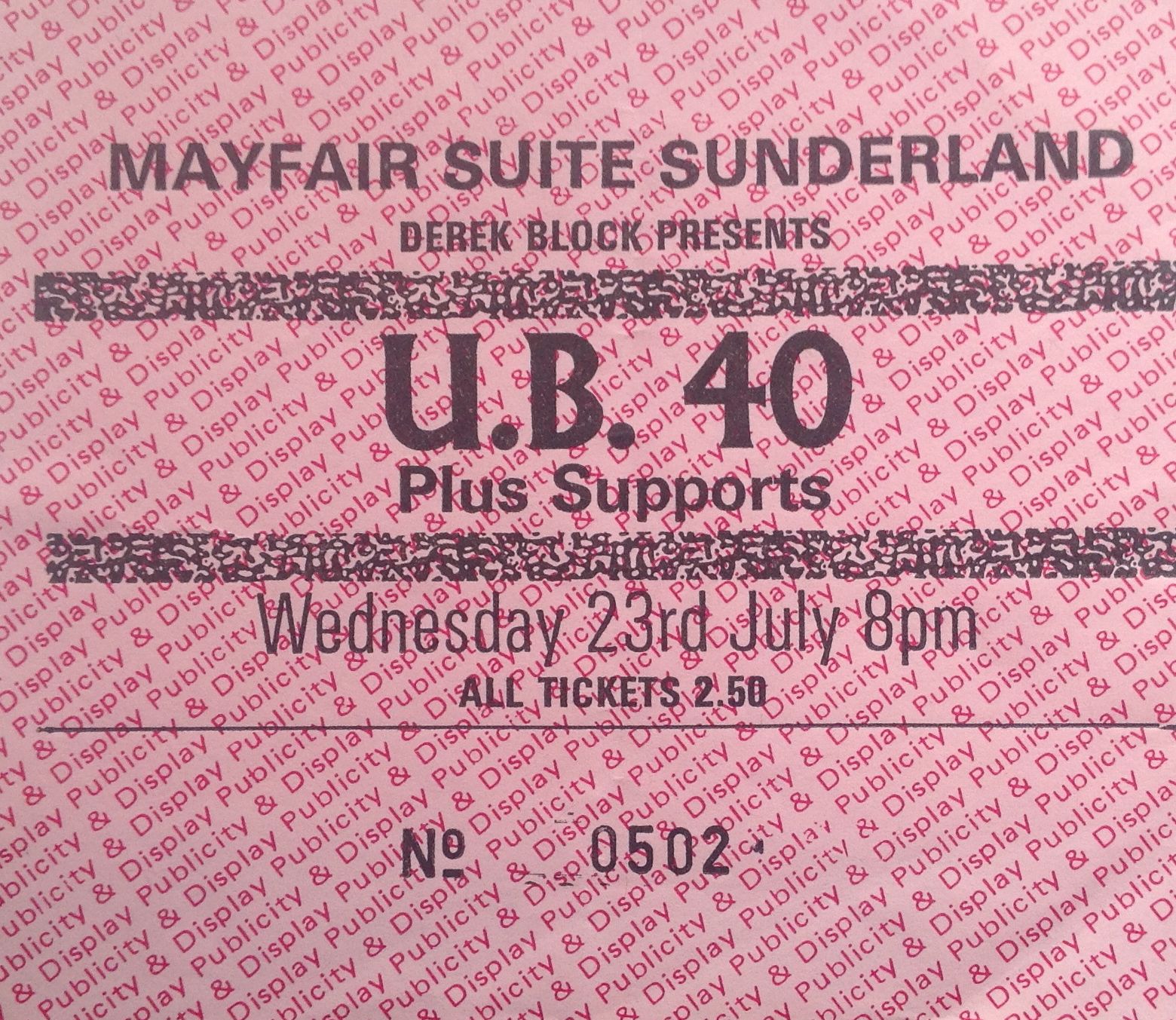 UB40 emerged out of the renewed interest in reggae during the punk and new wave movement of the late 70s and early 80s. UB40 were formed by Robin Campbell, his younger brother Ali, Earl Falconer, Brian Travers, James Brown, and Norman Hassan, who were all friends in Birmingham. They recruited Michael Virtue and Astro and aligned themselves to left-wing political ideals, naming themselves after an unemployment benefit form. I first saw them live during the summer of 1980 around the time of their debut single “King / Food For Thought” which reached the UK Top 5. I saw UB40 twice in the same week at Sunderland Mayfair on 23rd July 1980, and then supporting the Police at Milton Keynes Bowl on 26th July 1980.
UB40’s music was very different to anything else at the time. Political lyrics, sung over reggae rhythms with some lengthy instrumental passages, with horn solos and some rap and scat singing. Visually they were also very different, with so many musicians on stage. I remember going to the Sunderland gig having only heard “Food for Thought” and being pleasantly surprised by their performance.
 UB40’s first album “Signing Off” was released in September 1980. The album cover shows a yellow British UB40 unemployment benefit card from which the band took their name, stamped with the words SIGNING OFF, signally that the band were leaving the world of unemployment and had arrived on the music scene. “Signing Off” went to No. 2 in the UK and stayed on the album chart for 72 weeks. I saw UB40 twice more, at Newcastle City Hall on 9th June 1981 & 19th January 1982. Both of these were great, fun gigs.
UB40 setlist from 1980: Tyler; My Way of Thinking; Burden of Shame; Strange Fruit; Adella; One In Ten; I Think It’s Going to Rain Today; Summertime; King; 25%.
Encore: Food For Thought; Little by Little
“Ivory Madonna dying in the dust, Waiting for the manna coming from the west.
Barren is her bosom, empty as her eyes, Death a certain harvest scattered from the skies.” (Food for Thought, UB40, 1980)
14 Dec
Uriah Heep Carlisle Sands Centre 30th October 2004
Uriah Heep Carlisle Sands Centre 30th October 2004
 Support from Doogie White’s White Noise
Thanks for sticking with my during my week of ramblings on Uriah Heep. This will be my last post on that mighty, great band (at least until I see them again).
It was 2004 and I was suffering Heep withdrawal. I had foolishly lost touch with the band and it had been 19 years since I last saw them perform at a gig at Newcastle Mayfair. I read that they were touring the UK, and saw the nearest concert to me was at Carlisle Sands Centre, so I decided to go along. Carlisle is a 60 or so mile drive, and the Sands Centre is a leisure centre cum concert venue just outside the city centre. I arrived in time to catch support act Doogie White and White Noise. The ticket lists Manfred Mann’s Eartband as support, but this wasn’t the case. Doogie White was the singer in a later line-up of Blackmore’s Rainbow, and his set contained quite a few Rainbow favourites.
The 2004 line-up of Uriah Heep was Mick Box (guitar), Lee Kerslake (drums), Trevor Bolder (bass), Phil Lanzon (keyboards) and Bernie Shaw (vocals). Shaw and Lanzon both joined the band in 1986, and Shaw is now their longest serving vocalist. It was really great to see Uriah Heep again. I wasn’t sure how many old songs they would play, and whether I would know many, but I need not have worried. They started with Easy Livin’, and also played Stealin’, Gypsy, The Wizard and July Morning. The encores were Bird of Prey and Lady in Black. Shaw is an excellent front man with a great voice, and does justice to those classic Heep songs. It all came back to me, and I was once again a big fan. I’ve seen Uriah Heep on four further occasions since then, in Stockton, Workington, Newcastle and Holmfirth, and have already blogged about those shows. During that period Trevor Bolder has sadly passed away, and Lee Kerslake has retired from the band. Mick Box continues to lead the band. Long may they continue to rock.
Setlist: Easy Livin’; Shadows of Grief; Pilgrim; The Other Side of Midnight; Stealin’; Wise Man; The Wizard; Devil’s Daughter; Sunrise; Gypsy; July Morning; Look at Yourself
Encore: Bird of Prey; Lady in Black
12 Dec
Uriah Heep Newcastle Mayfair 1982 & 1985
Uriah Heep Newcastle Mayfair 1982 & 1985
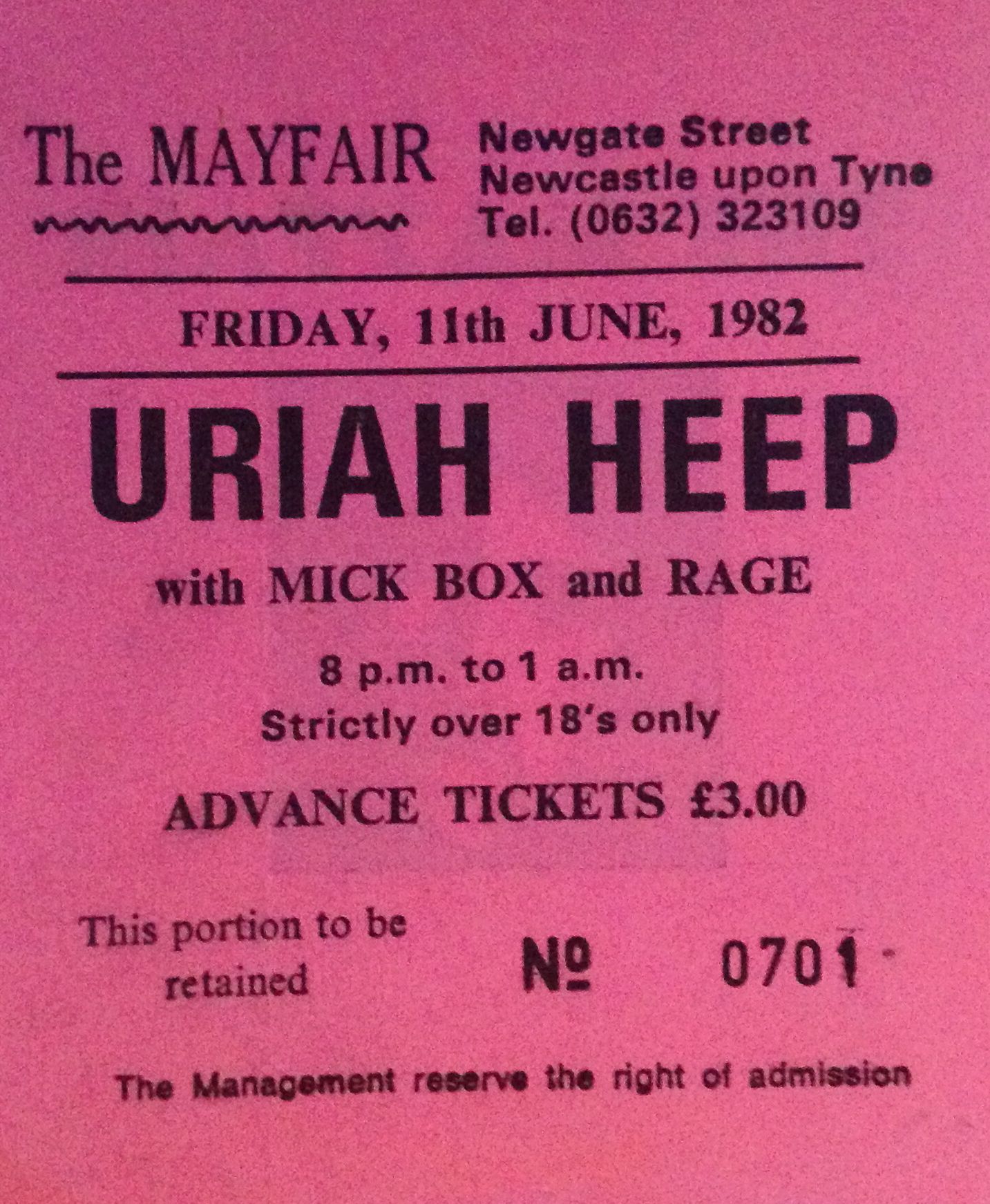 So….the mighty Uriah Heep were reduced to one member, guitar wizard extraordinaire Mick Box, who “locked myself in my flat for two days and drank myself senseless in complete self-pity.” Like any true wizard Box was not to be defeated and he soon began to forge a mystic plan for the future of Heep. He contacted his old mate and former Heepster drummer Lee Kerslake who was now with Ozzy Osbourne in Blizzard of Oz. Kerslake rejoined Uriah Heep,bringing bass player Bob Daisley with him. They were joined by ex Heavy Metal Kids keyboard player John Sinclair and vocalist Peter Goalby from Trapeze. The new Heep line-up shared the song writing duties and produced the 1982 album “Abominog” which was well received by fans and critics. Uriah Heep were well and truly back and went out on tour. Their success was, in part, helped by a resurgence in interest in heavy rock, as result of the emergence of the NWOBHM (New Wave Of British Heavy Metal). Their sound was moving more in a hard rock / heavy metal direction and away from the swirling operatic progisms of “Demons and Wizards”. I first saw the new line-up at Newcastle Mayfair in June 1982. Note how the ticket declares the concert as bing by “Uriah Heep with Mick Box”, so that punters knew what to expect. Support came from NWOBHM band Rage. I went along not sure what to expect from Uriah Heep, and half prepared to be disappointed, but I was seriously impressed by the new line-up. All credit to Mick Box, who could have given up at that point, but rebuilt the band which he continues to lead to this day.
 I saw Uriah Heep again a couple of months later in August 1982 when they appeared low down the bill at Donington Monsters of Rock festival. The line-up was, in order of appearance, Anvil, Uriah Heep, Hawkind, Saxon, Gillan and Status Quo.
My next Heep experience was when they returned to the Mayfair in 1985. By this point Bob Daisley had left and Trevor Bolder had returned to the fold. Note how the ticket cleverly uses the font from “Uriah Heep Live”. Sadly that concert came just over a week after the passing of the great David Byron.
1985 Set List: Sell Your Soul; Stealin’; The Other Side Of Midnight; Too Scared To Run; Rockarama; Angel; The Wizard (dedicated to David Byron); July Morning; Bad Blood; Party Time; Gypsy; Easy Livin; That’s The Way That It Is; Look At Yourself
11 Dec
Uriah Heep Newcastle City Hall 6th Feb 1980
Uriah Heep Newcastle City Hall 6th Feb 1980
Support from Girlshool
 It must have been pretty confusing being a member of Uriah Heep in the late 70s and early 80s. There were so many comings and goings. Let me recap on the Heep saga that I have been telling for the past few days. John Lawton was now an ex-Heepster having been ousted by Heep main man Ken Hensley. Enter a new young guy John Sloman fresh to Heeping, and last seen (by me anyway) singing about the “Bells of Berlin” in the excellent rock band Lone Star. A month or so later long-time drummer Lee Kerslake jumped off the Heep ship. Enter Chris Slade from Manfred Mann’s Earth Band. The new line-up recorded the “Conquest” lp, which was released in February 1980 and went out on their 10th Anniversary Tour, with NWOBHM rockers Girlschool as support. I saw the band at their concert at Newcastle City Hall, and was pretty impressed by the new Heep, who excelled themselves as usual, playing a set of crowd-pleasing Heep classics. Sloman has a pretty impressive vocal range and a great rock voice.
However, Ken Hensley was less than happy with this new Heep line-up, and felt that they were moving too far along a straightforward rock track: “The band had chosen John and I had opposed that decision. He was a good musician and he looked great but I thought he had little going for him vocally. The way that he interpreted songs was totally different to the way I had written them….we weren’t re-establishing our musical direction..” (from bio on official Uriah Heep site)
 Ken Hensley decided to leave the band on June 8th, 1980 after the previous night’s gig in Cascais, Portugal (which marked the end of a huge chapter in the band’s history).T his was probably as big a blow to the future of Uriah Heep as the departure of David Byron had been 4 years or so earlier. Hensley was the main songwriter in the band, and along with Mick Box, one of only two remaining original members. Nonetheless, this was Heep, and change was always happening, so onward they went. Gregg Dechert, a Canadian who had worked with John Sloman, was brought in on keyboards and they immediately went on a UK tour. The tour called at Sunderland Mayfair on 12 Nov 1980, where they were supported by NWOBHM bands Spider and Samson. To be honest I have scant memories of that gig, but think I was present. After finishing the tour John Sloman decided that he had enough of being a Heepster and left the band. At this point Mick Box asked David Byron to rejoin, but David turned the offer down. Trevor Bolder then also decided to leave and joined Wishbone Ash (are you following this ? 🙂 ). The band essentially disintegrated and Uriah Heep were down to one member, Mick Box.
More of the Heep saga tomorrow!
Typical Heep set list for 1980: Stealin’; Look at Yourself; Free ‘n’ Easy; No Return; The Wizard; July Morning; Free Me; It Ain’t Easy; Lady In Black; Won’t Have To Wait Too Long; Carry On; Feelings; Sweet Lorraine; Easy Livin’; Do You Feel Alright; Gypsy; Suicidal Man
10 Dec
The Who Newcastle Arena 9th Dec 2014
The Who Newcastle Arena 9th Dec 2014
Support from local heroes Maximo Park
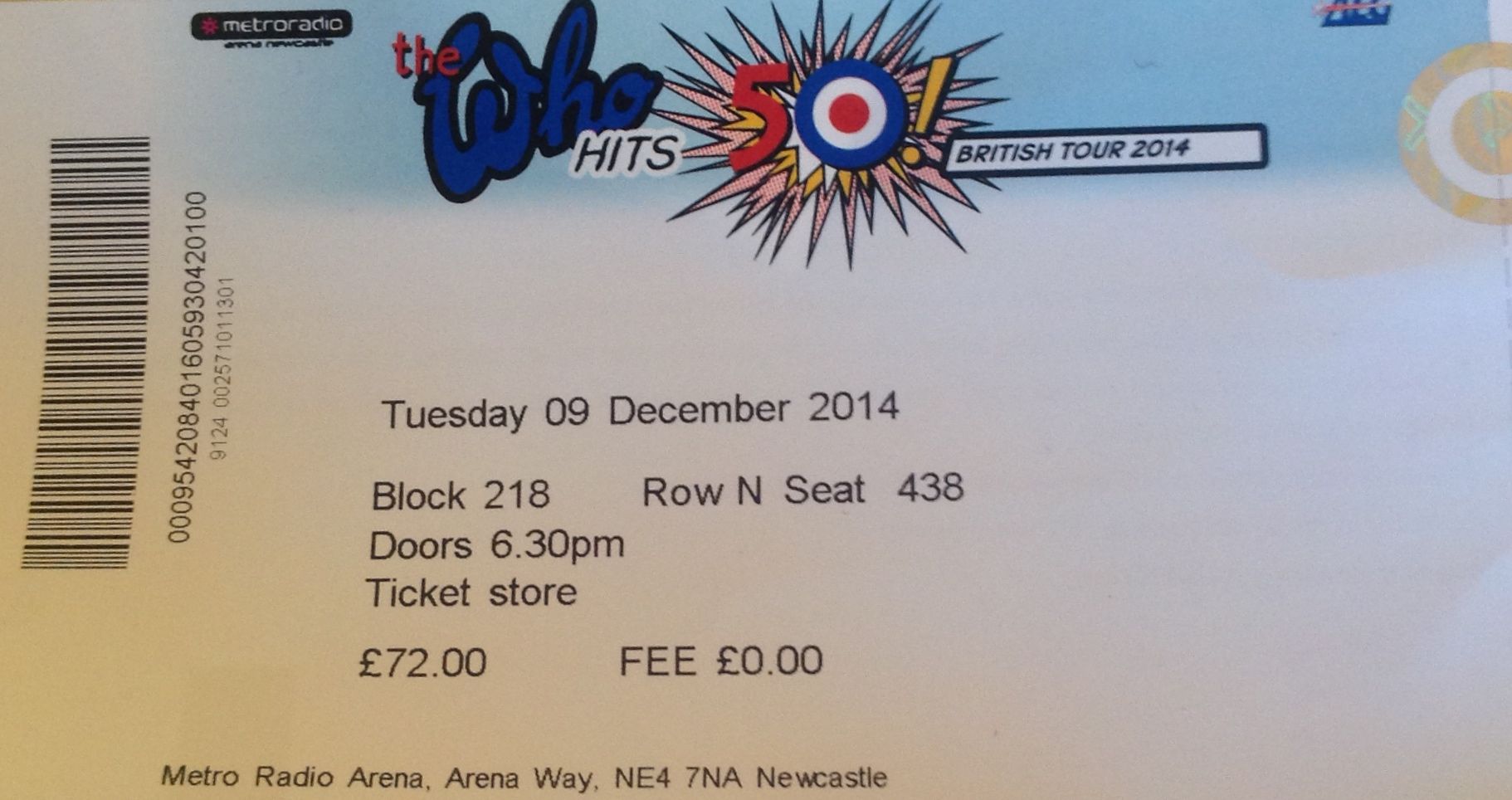
 What can I say! The Who returned to Newcastle as part of “The Who Hits 50 tour!” with a set jam-packed with classic songs drawn from across their amazing entire catalogue. I went along with my mate Norm to see the rock legends, and we were both really looking forward to the gig. They didn’t let us down, and then some. This was the 19th occasion on which I have seen the Who in concert, the first being at Newcastle Odeon in 1971. I knew that the concert would be good, but was surprised just how excellent the band were last night. Support came from local band Maximo Park who warmed the crowd up with a short set. The arena was pretty full, although not sold out. The Who started their set shortly after 8.30pm, sauntering on to the stage, Roger holding his cup of tea. “Go For It Pete” a voice from the front shouted. Townshend explained that these days his actions are limited to windmill arm swinging, a little jigging (he demonstrated both) and insulting the front row (which he admitted to gaining great enjoyment from). Then the familiar chords of “I Can’t Explain” rang through the arena and The Who were off, in full swing, taking us right back to where it all started. This was followed swiftly by “Substitute”; two classic slabs of 60s pop/rock, which they always opened their set with during the 70s. Roger’s voice was strong and solid, and the mike saw lots of twirling throughout the evening. Next up was “The Seeker”, not often played live, followed by “Who Are You” and “The Kids Are Alright”, with Roger on acoustic guitar; those great harmonies always get me. Pete explained how he wrote great pop songs like “The Kids Are Alright” (also mentioning “Legal Matter” in the same context) in his small attic studio in London in the 60s, usually in connection with stories about his latest girlfriend. He went on to tell us how he then moved into “artrock”, as way of introducing “I Can See for Miles”. Classic. One of their best songs, and a pure gem from the 60s. Pete was very animated throughout the concert and talked to the crowd a lot. He joked about “Pictures of Lily” and explained that “Cry If You Want” (can’t say I remember that one) was covered by the Merseys (and Bowie? I think). Next was “Behind Blue Eyes” with Roger in fine voice, followed by “You Better You Bet”. Then, with one of the band on mouth harp and another on jaw’s harp, we were in the 70s and “Join Together”. Roger made reference to their last tour, which was “Quadrophenia”, as and introduction to a short segment from that album: “I’m One”; “5:15”; “Bell Boy” (with video footage of Keith Moon playing the bellboy part, his grinning face staring at us from giant screens behind the band) and “Love, Reign O’er Me”. John Entwistle also featured, in a great close-up video of an extended bass solo, the screen showing his fingers speeding up and down the neck of his guitar.
  The crowd gave the videos of the late great Moon and Entwistle massive cheers. Townshend was really on fire by now, thumping his guitar, and windwill arm twirling, again and again and again. His temper also flared at one point; something obviously wasn’t right with his guitar so he threw, slamming it flat face down onto the floor. He continued to sing without a guitar, until a guy quickly arrived with a replacement. “Eminence Front” from “It’s Hard” brought us into the 80s. Then Pete introduced “A Quick One (While He’s Away)”, explaining that his first mini opera was written quickly to fill up space on an album, and was his initial attempt at a long themed piece of music. He went on to tell us that it features in the Stones Rock’n’Roll circus film, and that we should watch it if we haven’t yet seen it. I’ve always liked this track, and enjoyed seeing them play it live, I don’t think they have played it on tour since 1970 or so. A “Tommy’ segment followed: “Amazing Journey”; “Sparks”; “Pinball Wizard”. Pete’s hand was bleeding badly by now, his twirling and chord smashing had resulted in him cutting a finger; there was blood all over the scratch plate of his Fender Strat. The set closed with “See Me, Feel Me”; “Baba O’Riley”; and the anthemic “Won’t Get Fooled Again”. For the encore, they played “Magic Bus”, finishing at 11pm. A 2 and a half hour set from classic rock band who were simply on fire; it was one of the best performances I have seen from them in many years. A long set, but never boring; it went over so quickly. Pure class.
9 Dec
Uriah Heep Newcastle City Hall 4th March 1979
Uriah Heep Newcastle City Hall 4th March 1979
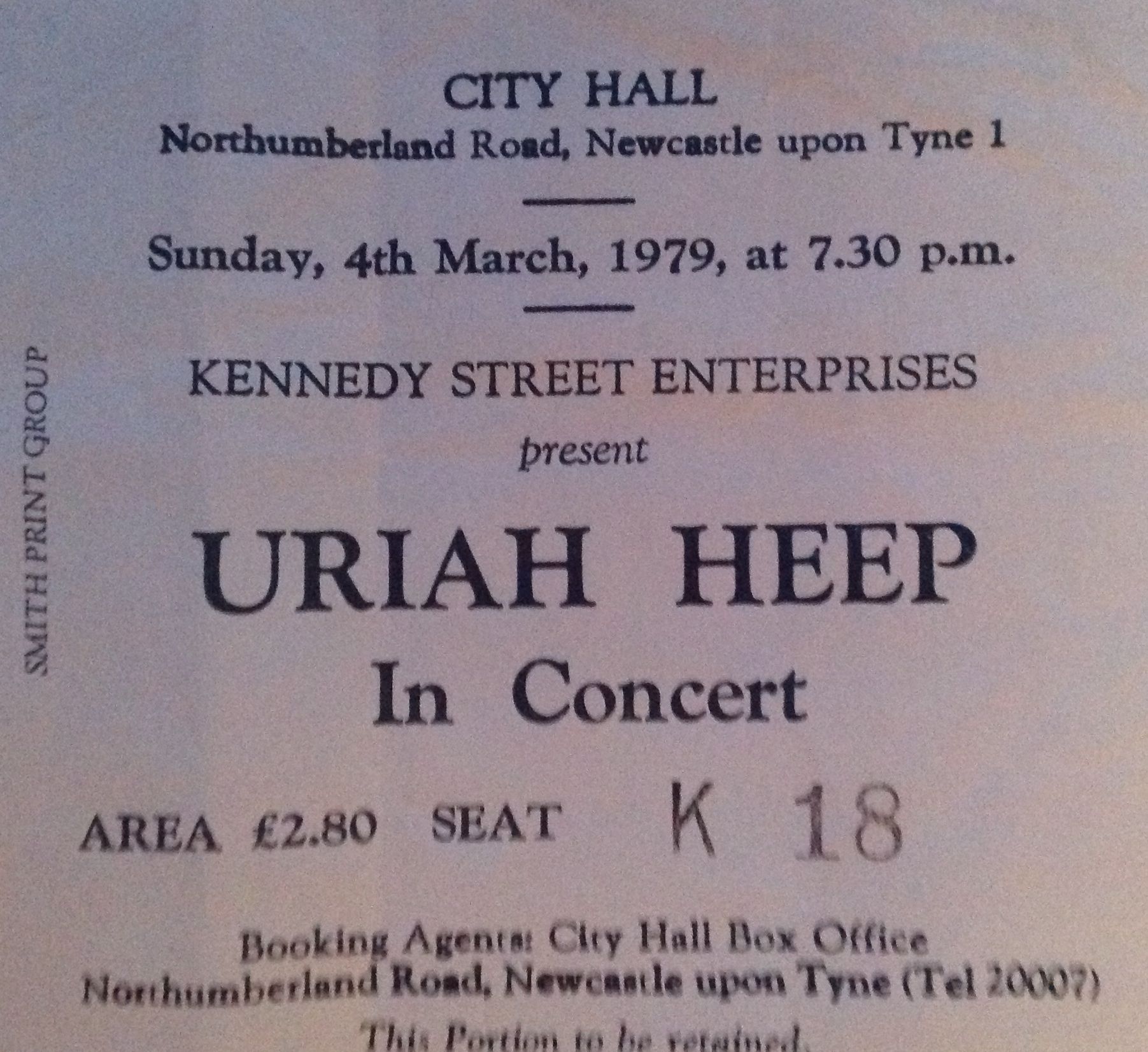 Support from Bram Tchaikovsky
I saw the John Lawton era Uriah Heep once more, at a concert in 1979 at Newcastle City Hall. At the end of 1978 Heep released Fallen Angel, their third studio album with this lineup lineup. The album was well received although it did not chart and Mick Box said that he thought it was “Too poppy.” Uriah Heep continued to tour and were as always, great in concert, but behind the scenes there was unrest. Ken Hensley was writing most of the material and as a result he was earning much more than his colleagues. Box is quoted as saying: “Everything he wrote, he had to use… And if you insist in using everything you end up with substandard albums.” But the relationship between Hensley and new singer John Lawton was the worst problem within the band. There was apparently “constant friction between the two, resulting in the nearest thing to violence the group had seen” and Lawton was eventually sacked in August 1979 after a festival in Belgium. Long time drummer Lee Kerslake also left the band shortly afterwards, after a row with the management, over the constant apparent insistence on the use of Ken Hensley’s songs.
 The replacements were ex Lone Star front man John Sloman on vocals, a young rock singer, and drummer Chris Slade from Manfred Mann’s Earth Band. However, Ken Hensley was soon unhappy with the new singer…but more of that tomorrow. It must have been fun to be a member of Uriah Heep at the time 🙂
Support for the 1979 tour, including the City Hall show, was guitarist/singer Bram Tchaikovsky who was at the time fronting his new power pop band, having recently left the successful punk/pub rock band, The Motors (Airport!)
Typical Uriah Heep setlist from 1979: Look at Yourself; Easy Livin’; Stealin’; Falling In Love; Woman Of The Night; Lady In Black; The Wizard; July Morning; Free Me; One More Night; I’m Alive; Who Needs Me; Sweet Lorraine; Free ‘N’ Easy; Gypsy
8 Dec
Uriah Heep Newcastle City Hall 30th Nov 1977
Uriah Heep Newcastle City Hall 30th Nov 1977
 Support from Fury.
Uriah Heep were on a roll, and released their next “Innocent Victim” shortly after “Firefly”. 1977 was a very successful year for the band. The single “Free Me” was a big international hit (making it to No. 1 in New Zealand), and in Germany “Innocent Victim” sold over a million copies and became Uriah Heep’s most successful, and the rereleased single “Lady in Black” was a big hit. Although “Lady in Black” originates from the early days of the band, having originally been released in 1971, it didn’t feature regularly in their live set until 1977. Written by Ken Hensley, and featuring him on vocals and acoustic guitar, it’s a classic Heep song, with its tale of the mysterious lady and of battles of old. 
I saw Uriah Heep for the third time in November 1977 at Newcastle City Hall. Support came from rock band Fury. It was another great gig. Uriah Heep remained an excellent live act throughout this period, and would play many of their classic tracks.
A typical Uriah Heep concert in late 1977 would probably contain the following songs: Do You Know; Stealin’; Look At Yourself; Lady In Black; The Wizard; July Morning; Sympathy; Who Needs Me; Easy Livin’; Gypsy; Sweet Lorraine)
“She came to me one morning, one lonely Sunday morning,
Her long hair flowing in the mid-winter wind.
I know not how she found me, for in darkness I was walking,
And destruction lay around me from a fight I could not win.”
(Lady in Black, Ken Hensley, 1971)
7 Dec
Rough Diamond (David Byron) Sunderland Polytechnic Wearmouth Hall 1977
Rough Diamond Sunderland Polytechnic Wearmouth Hall 1977
I’m going to take a side-step out of my Uriah Heep bloggings to say a little more about their great first vocalist David Byron.
In 1977, after leaving Uriah Heep, Byron formed a new band Rough Diamond along with former Humble Pie guitarist Clem Clempson and ex-Wings drummer Geoff Britton. The remaining members were Willie Bath (bass) and Damon Butcher (keyboards). Rough Diamond were hailed as a new “supergroup” by the Melody Maker, who featured them on their front cover. They recorded one album and toured the USA, opening for Peter Frampton. The album was not a big success, peaking at No. 103 in the US charts. Rough Diamond also played a small number of UK dates, one of which was at Sunderland Polytechnic’s Wearmouth Hall.
I was quite excited at the prospect of seeing David Byron again, and had also seen Clempson with Humble Pie and knew that he was an excellent guitarist. I figured Wearmouth Hall would be packed with Heep fans, particularly as the concert was one of a handful of gigs, and if I remember correctly, the only one in the north of England. So I persuaded Marie that we had to go along early, to make sure that we got in. How wrong I was. When we arrived the place was empty, and by the time Rough Diamond took to the stage, it still wasn’t very full; there were probably 100 or so people there. It’s always seems a bit strange seeing “name” acts in smaller halls. They tend to bring massive set-ups, and fill the hall with equipment and sound. Seeing Rough Diamond was a bit like that. The stage was set with a massive back line of brand new looking amps; it seemed that someone was investing heavily in the new “supergroup”. They were also incredibly loud, ear-splittingly so (which was just great 🙂 one more band to include in my lawsuit for rock fan deafness ). The concert was interesting, in that all the individual elements were in place, but yet they was something missing. David Byron was in excellent voice, and delivered a great performance for the small crowd, and Clem Clempson, as expected, played some excellent rock/blues. The rest of the band were fine. The set consisted of songs from their new album. I don’t recall if any Heep songs were played, although something in the back of mind tells me that they may have played “Sweet Lorraine” and a cover of Free’s “The Hunter”. I remember one slower rock ballad “Sea Songs” as being a highlight. The songs were ok, and it was a good gig, but not exceptional. Often such “supergroups” don’t live up to their promise, the result does not match the sum of the parts. Makes me think of when I saw Paul Rodgers and Jimmy Page in The Firm; they both performed great, but overall I left a little underwhelmed. Still it was a great opportunity to see David Byron again, and in such a small venue.
Rough Diamond split shortly afterwards. They were together for less than one year. David Byron went on to form his own band. Reports suggest that Mick Box and Trevor Bolder invited Byron to re-join Uriah Heep in 1981, after Ken Hensley left (it was Hensley who insisted on Byron’s dismissal), but Byron refused.
David Byron passed away on Thursday, 28 February 1985 as a result of alcohol problems and liver disease. He was 38 years old. Subsequently in concert, Uriah Heep would often dedicate “The Wizard” to him.
I like to remember David Byron when he was at his best, fronting Uriah Heep, standing magnificent and proud, stage centre, surrounded by dry ice, singing “July Morning”, his voice clear, powerful, and sweet. We will never experience his like again.
6 Dec
Uriah Heep Newcastle City Hall 9th March 1977
Uriah Heep Newcastle City Hall 9th March 1977
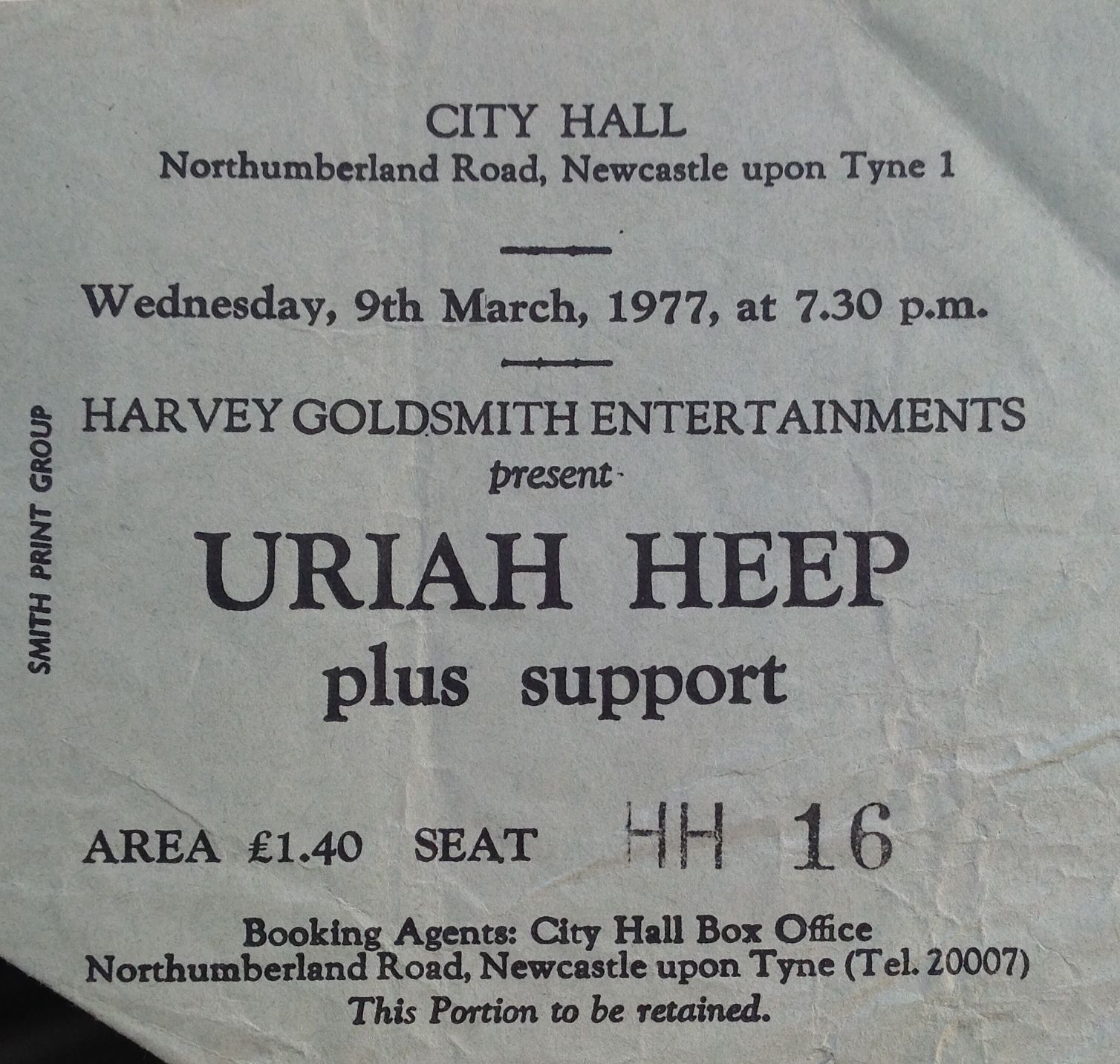 Support Woody Woodmansey’s U Boat
1977 saw a new revitalised Uriah Heep and the release of their 10th album “Firefly”. David Byron had been sacked from the band, and John Wetton also left, their replacements being John Lawton and Trevor Bolder (ex David Bowie and the Spiders from Mars) respectively. My mates and I couldn’t wait to see how the new line-up shaped up, so we went along to see them at the first opportunity we got, which was at Newcastle City Hall in March 1977. The tour programme has a pretty honest account of how Ken Hensley (who seemed to take the role of leader at the time) recognised the need for change in the band, and without explicitly naming names, how he instigated the necessary changes. Major changes like this in the line-up are interesting, and risky times for a band. Sometimes it works, sometimes not. Sometimes it gives a band such a boost, such a refresh, and a need to come back fighting, that it transforms them. I saw that happen with Purple when they exploded back with Coverdale, and Genesis when they came back strong post-Gabriel. And it isn’t just about how well the new guy can sing. It’s about the whole package, the image, the look, the performance, and how well the new guy gets on with the rest of the band, and whether they “fit”. Well something (almost) like that happened with Uriah Heep. They knew that the fans and critics were watching them and that the new tour could make or break the band, and they pulled out all the stops. In some John Lawton didn’t look quite right. He looked like a cross between a club singer and a straight rocker, with his open neck shirt and leather trousers. Mick Box: “Image-wise he wasn’t quite what we were looking for, but his pipes were perfect and so we went for the music end of it.” Ken Hensley: “He had a voice that I thought would give a new dimension.” Lawton had a great voice, which suited Heep. And Trevor Bolder was already known and also seemed to fit the band live. All seemed good. “Firefly” isn’t their greatest album, but it is ok, and their live set contained all the classics, including Lady in Black and the Wizard, both of which weren’t often played in the early 70s. Great stuff. Heep were back.
Support came from Trevor Bolder’s fellow ex-Spider, and Bowie sideman, Woody Woodmansey and his new band U Boat.
SetList (something like): Do You Know; Stealin’; Look At Yourself; Lady In Black; The Wizard; July Morning; Firefly; Sympathy; Who Needs Me; Easy Livin’; Gypsy; Sweet Lorraine
The next time I saw Uriah Heep was at the Reading Festival in August 1977, when they played third on the Friday night bill before Eddie and the Hot Rods and Golden Earring. They were then back at the City Hall again in November 1977, so I got hree helpings of Heep in one year; happy days.
 Vintagerock's Weblog.