Yes Reading festival 23rd August 1975
 This is probably my favourite Yes show. Not because it was their best performance, although it was pretty good. No, this show just felt right; one of those moments in time that worked. Yes were one of the biggest bands in the UK at the time, Reading was the most iconic festival of the mid-70s, and Yes headlined the Saturday night, which was seen as the “main” night. The rest of the line-up was strong, and the festival sold out in advance, which was unusual.
There was something special about Yes’ set that night. Although I’d already seen the band twice that year, I was still excited about seeing them. The crowd waited in anticipation, for what seemed like a long time; there was an hour or more delay while Yes set up their equipment and apparently insisted on using their own mixing desk, rather than the festival gear, which every other band used. It was worth the wait, although it started to rain, and continued to do so throughout Yes’ set. Yes had a spectacular laser show, the green lights cascading through the rain and across the field. The set was similar to that which they had played throughout the Relayer tour, although I think they played one new song “High Vibration” which was to appear on their next album “Going for the One”. Jon Anderson was amazing, his small figure picked out by the stage lights, and his gentle, sharp, shrill, sweet voice drifting over the field in the cool evening. “Close to the Edge” and “And You and I” we’re classic. Yes played until well after midnight which was the curfew, and their performance was, in the end, cut short. They returned to play a triumphant “Roundabout”. I think they also started to play “Sweet Dreams” but were prevented from doing so.
Robert Fripp of King Crimson was present and in a 1979 interview summed up his evening thus: “I went to the Reading Festival in August, 1975. A band came on stage who were actually friends of mine [I assume he is referring to Yes]. Anyway, we’d been waiting an hour-and-a-half while their laser show was being set up. I went out to the front. It began to rain. I was standing in six inches of mud. It was drizzling. A man over here on my right began to vomit. And a man over here on my left pulled open his flies and began to urinate on my leg.” A typical festival then 🙂
Dave Holmes tells a great story (on Forgotten Yesterday’s site): “Imagine my horror……,.when, at 12:23 as I recall, emerging from stage left, came the small, grey-suited and grey-haired figure of… my Dad! He walked straight up to Jon Anderson, mid-song, actually took the microphone off him, and made some kind of announcement to the audience about having to finish the concert. The rest of the band looked stunned and stopped playing. The stage lights went off, the crowd started booing and throwing cans of piss at the stage. That was the end of the set and the festival for the year. I didn’t know what to do, I was dying of shame…”
Happy days.
Setlist: Sound Chaser; Close to the Edge; And You and I; High Vibration; The Gates of Delirium; Leaves of Green; I’ve seen all Good People; Mood for a Day; Long Distance Runaround; Clap; Ritual (Nous Sommes du Soleil). Encore: Roundabout
Posts Tagged ‘prog rock’
6 Mar
Yes Reading festival 23rd August 1975
5 Mar
Yes Stoke City Football Club 17th May 1975
Yes Stoke City Football Club 17th May 1975
 Support acts: Sensational Alex Harvey Band; Ace; Gryphon.
A month after seeing Yes at Newcastle City Hall I was off to see them again, this time at Stoke City Football ground. I drove down to the concert with my mate, both of us looking forward to seeing Yes again, and the added attraction of the amazing Sensational Alex Harvey Band. As soon as we arrived we found the nearest pub, where we were surprised to meet a bunch of lads from home, who were huge SAHB fans. We then had an argument about the relative merits of Yes versus Alex Harvey and co; such matters seemed very important at the time.
We entered the stadium and found a place on he pitch. First up was Gryphon whose medieval folk amused us; for some reason a lute, a bassoon and a tin whistle made a perfect start to the day. The weather was ok, quite sunny as I recall. Next was Ace, who pleased the crowd by playing “How Long” twice; once during the set, and again as an encore. Then came Alex.
A large Glaswegian contingent had travelled South to support Alex, Zal and the lads. They got very drunk and England vs Scotland scuffles started to break out among the crowd down at the front, close to the stage. Alex was having none of this. He stopped the song, I think it was “Framed”, pointed and stared the culprits and told them “Stop! No violence, or we don’t play any more” and the fighting ceased, just like that. Such was the power that Alex Harvey held over his audience. This was SAHB at their menacing best; Alex in his hooped t-shirt and jeans, scarf around his head, reading his philosophy to us from an old leather-bound book, Chris Glen wearing a jock strap of his jeans, and Zal in his green leotard complete with full evil harlequin make-up. Wonderful. “Don’t make wars. Don’t fight wars. And don’t pisch in the water”. They stole the show.
 Other memories of the day: lots of people openly smoking joints. A little guy in the middle of the crowd sitting with a stash of dope selling it to anyone who passed by. A young guy wearing a battered top hat, posing as a member of the drug squad, grabbing hold of people and “arresting them”, then laughing and telling them it was just a joke after all.
There was a long wait before Yes took to the stage, during which time the heavens opened and it started to pour with rain. The stage crew were brushing rain from the stage and trying to cover the band’s gear with polythene sheets. Yes eventually took to the stage, and had lots of problems with the sound, caused by rain on the equipment. Steve Howe, in particular, seemed to suffer a couple of small shocks from his guitar, and was obviously worried about the danger of electrocution. In the end, after soldiering on for 40 minutes or so, Yes abandoned the show, Jon Anderson promising us that they would return and play a free gig (I’m still waiting and still have my ticket stub, guys).
Then it was back into my little old red MG Midget, and up the A1. A great day.
The next time I saw Yes was three months later, this time at the Reading festival. I’ll write about that tomorrow.
Yes setlist (cut short due to rain): Sound Chaser; Close to the Edge; The Gates of Delirium; I’ve Seen All Good People; Mood for a Day; Long Distance Runaround; Clap; Ritual (Nous Sommes du Soleil); Roundabout
4 Mar
Yes Newcastle City Hall 17th April 1975
Yes Newcastle City Hall 17th April 1975
 Support: Gryphon
Yes returned to the City Hall to play three sold out shows in Spring 1975. Patrick Moraz had replaced Rick Wakeman, after the keyboard wizard had departed our prog heroes because of his dissatisfaction with the “Topographic Oceans” epic. I’d seen Patrick Moraz play in Refugee, taking the Keith Emerson role in the band which Lee Jackson and Brian Davison formed after the Nice split. So I knew how good a keyboard player he was. The line-up of Yes was now Jon Anderson, Chris Squire, Steve Howe, Alan White and Moraz. Yes had just released their seventh album “Relayer”. Steve Howe described Relayer as “very modern, European style of music, and Patrick brought in a South American flavour as well. It was a very international record”.
Support for the tour was Gryphon, a prog-rock band who fused Renaissance music with electric folk, playing medieval and modern instruments. I went to the final concert of the three-night run.
 After the marathon performance of “Topographic Oceans” on their previous tour, I was pleased, and somewhat relieved, that this time Yes chose to play a set which consisted of songs from throughout their career. “Close to the Edge” and “And You and I” were becoming concert favourites, and both songs showcased epic performances by Jon Anderson. “Mood for a Day” had replaced “Clap” as a vehicle for Steve Howe’s virtuosity, and “Long Distance Runaround” and “Roundabout” were ( and still are) classic Yes songs. I remember being particularly pleased that “Sweet Dreams” was played as the final encore, although a little disappointed that “Yours is no Disgrace” did not feature. A classic Yes gig, with the band back on form. I saw Yes on two further occasions in 1975, at Stoke football ground and at the Reading festival. I’ll write about the Stoke concert tomorrow.
Setlist:The Firebird Suite (intro music); Sound Chaser; Close to the Edge; To Be Over; The Gates of Delirium; I’ve Seen All Good People; Mood for a Day; Long Distance Runaround; Clap; And You and I; Ritual (Nous Sommes du Soleil)
Encore: Roundabout; Sweet Dreams
3 Mar
Yes and Tales from Topographic Oceans Newcastle City Hall 8th December 1973
Yes and Tales from Topographic Oceans Newcastle City Hall 8th December 1973
 The next time I saw Yes was during the “Tales from Topographic Oceans” tour when it called at Newcastle in December 1973. Yes returned to the City Hall for two sold out concerts on two consecutive nights. I went to the first night’s performance, along with a group of mates. This tour was a bold, possibly foolish, move by the band; they decided to play the whole of their new concept album during the second half of the concert. In many ways, this represented the ultimate in prog-rock pomposity and self-indulgence, and was one of several factors that made some young music fans tire of the bands of the time, and which would ultimately result in the emergence of punk rock. The first half of the concert was devoted to a run-through of Yes’ previous opus “Close to the Edge” which is a much more palatable musical piece than “Topographic Oceans”; the title track “Close to the Edge” is lengthy with meandering instrumental parts and several segments, but it does at least have a recurring melody and is actually a “song”. “Topographic Oceans” did not make for easy listening that evening. At the time it confused me.
 Was I witnessing a masterpiece, a ground-breaking piece of popular music which raised the level of the genre and truly synthesised rock composition with classical music? I must admit I found it hard going, and it is still one of my least favourite Yes albums. Of course the musical dexterity and technical virtuosity of the players was clear and fully on display that evening, but the soul of the music was lost in that very virtuosity. The day was saved by an encore of “Roundabout” which reminded me that the sharp, bright innovative Yes who astounded me a few years earlier still did exist, and that they could still fuse rock, jazz and pop and blend that mix with lyrics which hinted at hippy ideals and values, and yet at the same time confused me and took me through so many twists and turns.
Rick Wakeman tells a story of how he also lost faith in Yes in the mid-70s and famously ordered a take away curry, had it delivered to the City Hall, and ate it on stage while seated, surrounded by his vast array of keyboards and synthesisers and wearing his customary glitter cloak. This event may well have happened at this concert.
I longed to hear “Yours is no Disgrace”, “Astral Traveller” or “Starship Trooper”. More on Yes tomorrow.
Set 1: Introduction (The Firebird Suite): Close to the Edge; Siberian Khatru; And You and I; Close to the Edge
Set 2: Tales from Topographic Oceans: The Revealing Science of God (Dance of the Dawn); The Remembering (High the Memory); The Ancient (Giants under the Sun); Ritual (Nous Sommes du Soleil)
Encore: Roundabout
2 Mar
Yes Live 1969 – 1971
Yes Live 1969 – 1971
 I am going to spend a week or so reflecting on the Yes concerts I have attended. I’ve seen Yes 14 times and have always been a fan, although there are times that I lost touch with the band and their ever-changing line-ups. I am going to start with a little self-indulgence by recapping on three Yes concerts that I have already written about, as the band were supporting another act.
I was luckily enough to see Yes in the very early days. The first proper gig I attended was Yes (along with Roy Harper) supporting the Bonzo Dog Doo Dah Band at Sunderland Empire on 8th March 1969. Yes were simply a revelation for me that night; they fascinated me with their bright, sharp, jazzy mix of rock and pop. And they played some songs that I knew: “Something’s Coming” from West Side Story and The Beatles’ “Eleanor Rigby”. They also played the excellent “No Opportunity Necessary, No Experience Needed”, the Richie Havens song which appears on Yes’ second album, opens with the theme from the film “The Big Country”, and remains one of my favourite songs to this day. Yes had yet to release their first album, and the line up at that time was Jon Anderson, Chris Squire, Bill Bruford, Peter Banks and Tony Kaye. I was impressed by how Jon and Chris were dressed; Jon in a cool cheesecloth smock top and Chris sporting a natty hat and impressive flares and fringed boots.
 The next time I saw Yes was once again at Sunderland Empire, supporting the Nice on 1st February 1970. By now they were playing material from their second album “Time and a Word”; the set again included the excellent “No Opportunity Necessary, No Experience Needed”, “Then”, “Sweet Dreams” (an early single which has featured in their set off and on to this day), and “Astral Traveller”. There was an acoustic part to their set which featured the track “Time and a Word”.
I saw Yes again in 14th January 1971, supporting Iron Butterfly at Newcastle City Hall. By the time of this gig, guitarist Peter Banks had been replaced by Steve Howe, and the rest of the line-up was Jon Anderson (vocals), Bill Bruford (drums), Chris Squire (bass) and Tony Kaye (keyboards). Rick Wakeman was to join the band later that year. They were just about to release their classic third lp “The Yes Album”, and the set featured tracks from that new album and their previous two releases. They were just great that night. Their entrance on stage was heralded by the powerful “Also Sprach Zarathustra”. I think they opened with “Astral Traveller” and I also recall “Yours Is No Disgrace”, and “Clap” as highlights.  I was just blown away by Steve Howe’s performance of the latter song, and was fascinated by the semi-acoustic Gibson, complete with f holes, that he was playing. I remember the whole hall clapping along while he played. The song which most sticks in my mind was their version of Simon and Garfunkel’s “America”, which was simply majestic; almost symphonic. Yes went down well with the crowd; it was very clear that they already had a lot of fans and that they were on the verge of major success.
That major success soon arrived. Later in 1971, Rick Wakeman joined, and Yes released their fourth album “Fragile”. “Fragile” was the band’s greatest success to date, reaching No. 7 in the UK, and included one of their most well-known songs “Roundabout”. Yes returned to the City Hall later in 1971 (thanks to Mitch for the picture of his flyer for that gig); for some reason I missed that gig. The next time I saw Yes was at the time of their 6th album “Tales from Topographic Oceans”. I’ll write about that show tomorrow.
19 Feb
Roger Waters plays Dark Side of the Moon Hyde Park 1st July 2006
Roger Waters plays Dark Side of the Moon Hyde Park 1st July 2006
 Hype Park Calling Festival 2006
Main Stage: Roger Waters (featuring special guest Nick Mason); Texas; Starsailor; Breaks Co-op; Chris Difford
Stage 2: The Lightning Seeds; Robert Cray; Suzanne Vega; Blackbud; Rocco DeLuca and the Burden
I booked a cheap hotel room online for David and I to stay in for this event. The room was not far from Marble Arch. We arrived at Kings Cross and tool the tube over to the hotel. When we arrived the guy on reception apologised and explained that there had been some mix-ups with bookings and that he was going to have to move us to another hotel nearby. He offered to drive us there, and took us through a maze of streets, where we arrived at a run-down seedy looking hotel. He took us to our room which was upstairs and left. As we looked around the room we realised how we had got the booking so cheap….the bathroom had no door and the beds were worn and scruffy. Still, we decided it was only going to be for one night, so we shrugged our shoulders and walked over to Hyde Park; we still weren’t far from the Marble Arch entrance to the event.
Hyde Park Calling was a new festival. Roger Waters headlined the Saturday night and the Who were doing the honours on the Sunday night. The supporting line-up was strong. I remember we watched and enjoyed Texas, and some of the Lightning Seeds.
 The main event was Roger Waters who was playing Dark Side of the Moon in its entirety, along with Floyd buddy Nick Mason on drums. The show featured an elaborate stage design by Mark Fisher (who was behind the design of Pink Floyd’s The Wall shows), and included giant puppets, large video screen displays and a 360° quadraphonic sound system. Roger’s performance was divided into two sets: the first featured Pink Floyd material and songs from Roger’s solo career, and the second The Dark Side of the Moon in its entirety, plus encores. The songs were performed true to the recording, and the sound was crisp and clear from where we stood about half way back in the park. What better way to spend a summer evening than listening to the Floyd’s classic album. A guy in front of us was incredibly drunk, and insisted on singing all of the words to the songs right into our faces. Sometimes he would stop singing, hug us and tell us how great Pink Floyd were.
After the show we meandered back through the streets to our seedy hotel room. We were up early next morning and back on the train home.
Setlist. Set 1: In the Flesh; Mother; Shine On You Crazy Diamond (Parts I-V); Have a Cigar; Wish You Were Here; Set the Controls for the Heart of the Sun; Southampton Dock; The Fletcher Memorial Home; Perfect Sense (Parts 1 and 2); Leaving Beirut; Sheep
Set 2 The Dark Side of the Moon, with Nick Mason: Speak to Me; Breathe; On the Run; Time; Breathe (Reprise); The Great Gig in the Sky; Money; Us and Them; Any Colour You Like; Brain Damage; Eclipse
Encore: The Happiest Days of Our Lives; Another Brick in the Wall Part 2; Vera; Bring the Boys Back Home; Comfortably Numb
Roger Waters band: Roger Waters (vocals, bass guitar and acoustic guitar), P.P. Arnold (backing vocals), Graham Broad (drums and percussion), Jon Carin (keyboards), Andy Fairweather-Low (guitar), Carol Kenyon (backing vocals and lead vocals on “The Great Gig in the Sky”), Dave Kilminster (guitar), Katie Kissoon (backing vocals), Ian Ritchie (saxophone), Harry Waters (Hammond organ, synthesiser, and Roger Waters’ son), and Snowy White (guitar).
18 Feb
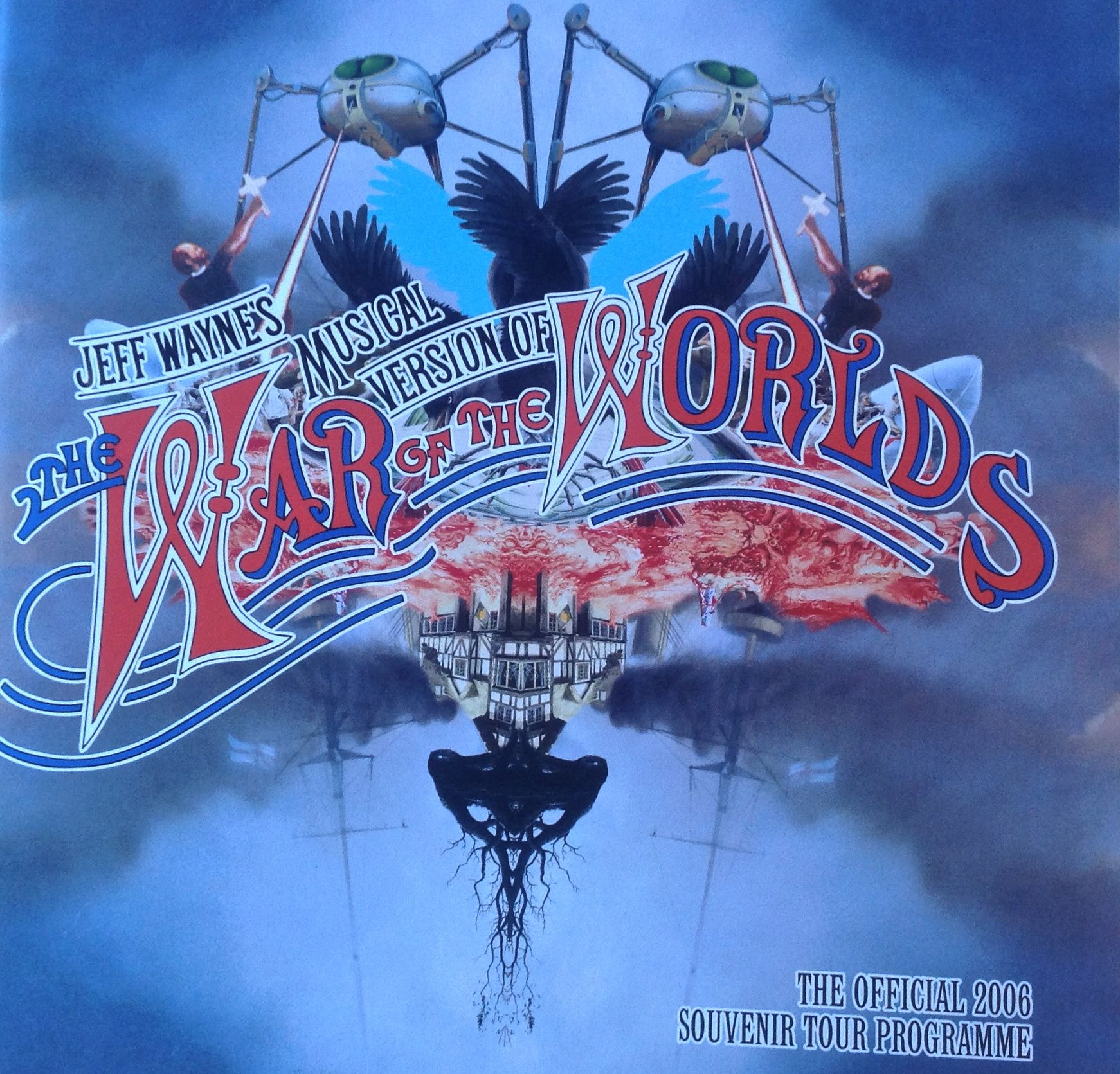
War of the Worlds Newcastle Arena 27th April 2006
War of the Worlds Newcastle Arena 27th April 2006
 I have the War of the Worlds album, so couldn’t resist going to see the concert. The pre-show publicity says it all: “For the first time ever, this highly anticipated classic album will now be staged as a full live production, featuring Jeff Wayne conducting The Black Smoke Band and the 48-piece ULLAdubULLA Strings. Moody Blues frontman Justin Hayward will feature in the show and, through the magic of modern technology, Richard Burton will be SEEN and heard in his role as ‘The Journalist’ in the musical spectacular of the year. To set the scene, Pink Floyd’s legendary set designer, Jonathan Parke, will be bringing the Martian invasion to life. Since it’s original release in June of 1978, ‘Jeff Wayne’s Musical Version of The War Of The Worlds’ has grown into a true classic; garnering a new generation of devoted followers whilst still inspiring the faithful listeners from the past decades. Inspired by the HG Wells novel, the album features a compelling blend of prog rock and classical and literary influences….the album has enjoyed huge success and critical acclaim across the globe with around 13 million records sold and numerous accolades acquired. The War Of The Worlds initially spent over 260 consecutive weeks in the UK albums charts (now approaching 300)…”
Jeff Wayne: “I have waited for almost 28 years to present The War of The Worlds – combining the excitement of live performance complemented by various technological ingredients that will hopefully give our audiences, a night to remember.”
 The show featured an all-star cast: A “virtual” Richard Burton: a large bust of the Journalist with a projected image; Justin Hayward; Alexis James; Chris Thompson; Russell Watson; Tara Blaise and Rachael Beck (all on spoken words and vocals)
The Black Smoke Band: Jeff Wayne (conductor), Chris Spedding (guitar), Herbie Flowers (bass), Tom Woodstock (guitars, keyboards), Laurie Wisefield (guitars, mandolin), Accy Yeats (drums), Julia Thornton (percussion, harp, keyboards), Steve Turner, Neil Angilley & Kennedy Aitchison (keyboards).
The Performance:
The Coming of the Martians: The Eve of the War, Horsell Common and The Heat Ray, The Artilleryman and The Fighting Machine, Forever Autumn, Thunder Child
The Earth Under the Martians: The Red Weed (Part 1), The Spirit of Man, The Red Weed (Part 2), Brave New World, Dead London, Epilogue.
The concert was very much a musical as much as it was a rock performance. It was a hugely enjoyable experience; very spectacular, although a little “lost” in the vastness of an arena setting. And “Forever Autumn” as sung by Justin Hayward is a beautiful song.
27 Jan
Wishbone Ash Newcastle City Hall 11th October 1978 “No Smoke Without Fire”
Wishbone Ash Newcastle City Hall 11th October 1978 “No Smoke Without Fire”
 No support act “Wishbone Ash will on stage 8.00pm”
It is 1978 and Wishbone Ash have returned, making the UK their home again. Early in the year they recorded their ninth studio album: “No Smoke Without Fire”. It was the heaviest Wishbone Ash album in many years, featuring the rocky single “You See Red” and the lengthy multi-part prog-rock epic “The Way of the World.” “No Smoke Without Fire” was released in October 1978. In the same month Wishbone Ash toured the UK to promote the new lp. The UK music papers and the charts were full of punk and new wave, but classic rock fans continued to support Wishbone Ash, and they played to sold out venues across the country. The tour featured a lengthy set by the band, with no support act. 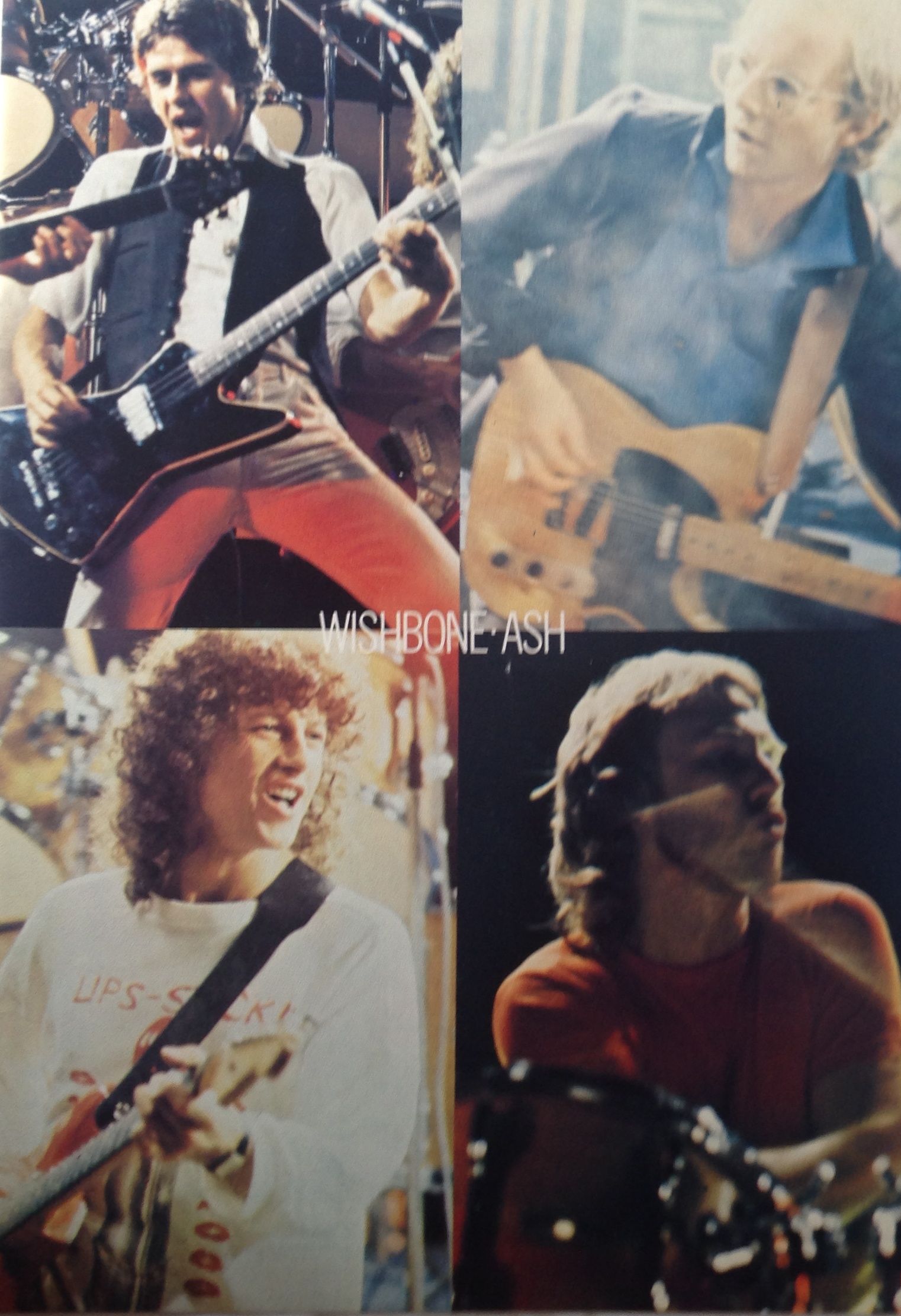 New songs “You See Red” and “The Way of the World” came over well live, and we were treated to all the old favourites. “You See Red” was released as a single, with a live version of concert favourite “Bad Weather Blues” on the B side. The advert in Melody Maker read: “Over the last few years ‘Bad Weather Blues’ has been a highly popular feature of all Wishbone Ash gigs. Now for the first time, this song is available on record, as a 10 minute live version. ‘Bad Weather Blues’ was written by Andy Powell, originally recorded for the Locked In album in 1975, but although it never made that album, it went on to become a live favorite used as an encore number.”
Setlist (based on typical setlist for the 1978 tour): The King Will Come; Warrior; Errors of my Way; You See Red; FUBB; Front Page News; The Way of the World; Phoenix; Anger in Harmony; Time Was; Runaway; Lady Whiskey; Jailbait; Queen of Torture; Blowin’ Free; Bad Weather Blues.
After the 1978 tour Wishbone Ash took a year out, before returning with their next album and tour in 1980.
“Well, I’ve been away, I said I been away for so long
Tell me, have you, have you done me wrong?
Can I tell by the look that’s in your eyes?
Have you kept your loving locked away inside?
Can you shake the dust from off my shoes and
Take away these bad weather blues?”
(Wishbone Ash, Bad Weather Blues)
22 Jan
Wishbone Ash Newcastle City Hall 24 June 1973 “Live Dates”
Wishbone Ash Newcastle City Hall 24 June 1973 “Live Dates”
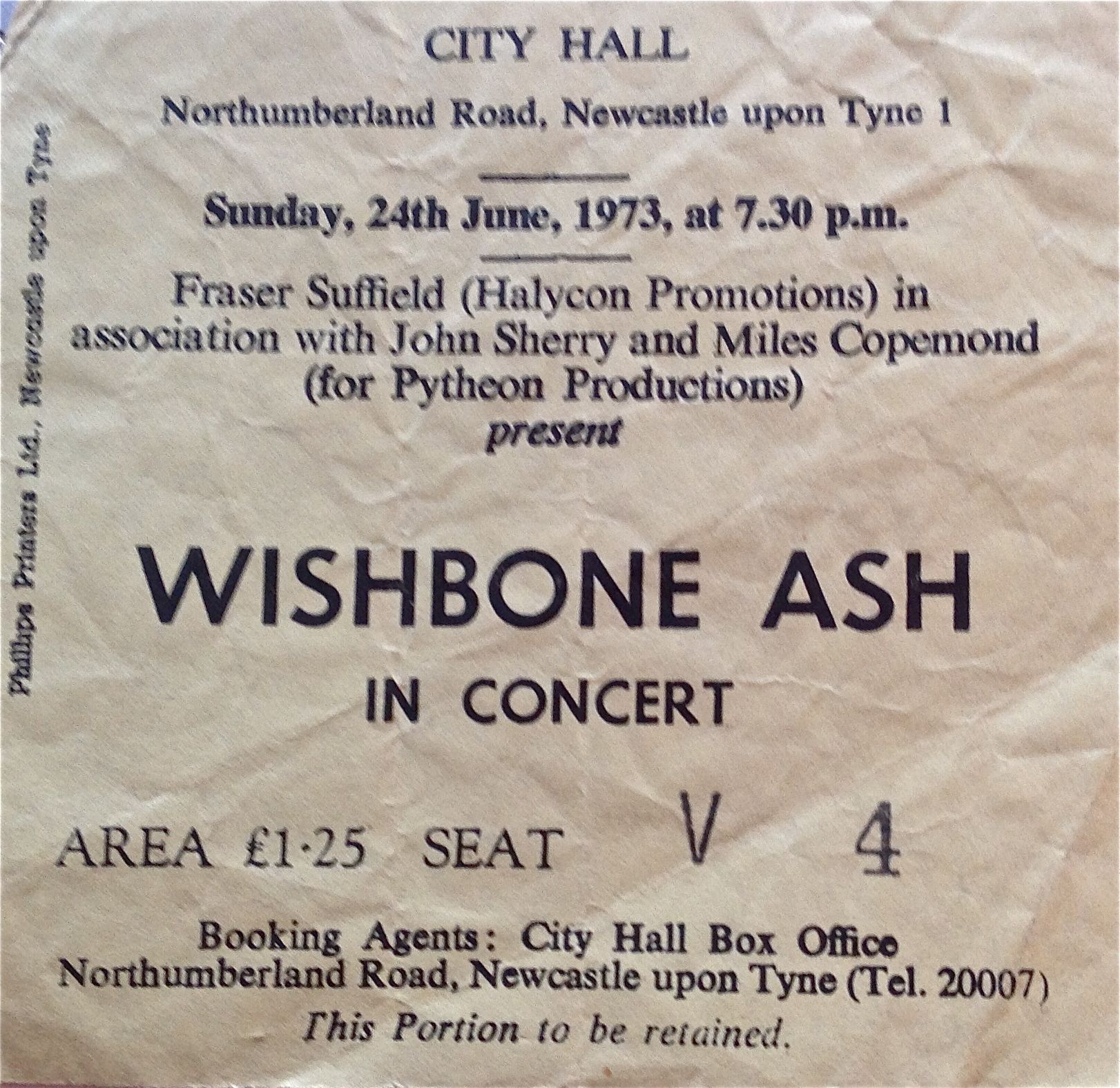 Wishbone Ash released their fourth album “Wishbone Four” in early 1973. It represented a departure from the sound of their first three albums and their most successful release “Argus”; there was less evidence of their trademark twin guitars, and more of a focus on harmonies and songs. A group of school mates were absolutely massive Wishbone Ash fans, and went straight out and bought it, but we all felt that it didn’t quite reach the standard which had been set by “Argus”. The music on “Four” had more of a folk-rock sound, although the album did contain a couple of rockers more typical of their earlier music, notably “No Easy Road” which had been a single in 1972, and which I’d seen them perform at Sunderland Mecca, and “Rock ‘n Roll Widow”. A few of the songs from the album were played live at the time, including “So Many Things to Say”, “Ballad of the Beacon” and “Everybody Needs a Friend”.
Wishbone Ash were back touring the UK in June 1973, and recorded a double live album at concerts in Croydon Fairfield Halls, Reading University, Portsmouth Guildhall and Newcastle City Hall, using The Rolling Stones Mobile Recording Studio.  I attended the Newcastle gig, during which three tracks: “Warrior”, “Blowingg Free” and “Throw Down the Sword” were recorded for the album. We didn’t know about the recording until we got into the City Hall. We could see a couple of mikes hanging from the ceiling (aah, such was the technology in those days 🙂 ). Then it was announced over the PA, to a big crowd cheer, that they were going to be recording the show for a future live album. The place was packed and the capacity crowd gave Wishbone Ash a tremendous reception, cheering before and after each song, all of us hoping that our voices might be heard on the lp.
Set list (thanks Mitch): The King Will Come, Warrior, Throw Down The Sword, Ballad Of The Beacon, Rock N Roll Widow, Everybody Needs A Friend, The Pilgrim, Blowin’ Free, Jail Bait, Doctor, So Many Things To Say, Baby What You Want Me To Do, Phoenix.
Encores: No Easy Road, Where Were You Tomorrow, Lady Whiskey.
I’ve just listened to my copy, but couldn’t pick out my own cheering 🙂 This was the last time that I would see the classic Wishbone Ash line-up of Ted Turner (guitar, vocals), Andy Powell (guitar, vocals), Martin Turner (bass, vocals) and Steve Upton (drums) (at least for many years, until later reunions). Ted Turner left the band later in 1973, and Wishbone Ash decamped to the USA to record their fifth album. They returned to the UK with some new songs and a new guitarist in late 1974. I’ll write about that tour tomorrow.
21 Jan
Wishbone Ash Live in 1972
Wishbone Ash Live in 1972
 I’ve been putting off writing about Wishbone Ash, partly because I knew this was going to take some organising (I have seen the band 20+ times), but also because I wanted to be sure to do as good a job as possible, as the band and their music mean a lot to me. So this is going to be a bit of a marathon, but I promise to combine some of the concerts. It will still probably take me a week or so.
I was, for some reason, slow in getting into Wishbone Ash, and missed some of the early chances I had to see them. The first real memory I have is of a group of friends coming into school one Monday morning, raving about this new up and coming band that they had been to see at Newcastle Mayfair the previous Friday night. It was late 1971, and that band was Wishbone Ash. We were all aspiring guitarists, so guitar bands were “our thing”, and they were telling me how Wishbone Ash had twin guitarists, who played carefully worked out guitar parts which complemented each other. I was so jealous, and from then on I made it my business to listen to their music, and committed to go and see them the next chance I got. That chance came in early 1972 when Wishbone Ash next played the City Hall.
Roll on to 12th February 1972, and I was at the City Hall to see Wishbone Ash. The venue was probably around 75% full, and support came from the excellent Glencoe who featured Norman Watt Roy on bass and John Turnbull (from Newcastle) on guitar. I’d see John before in Bell and Arc, and he and Norman went on to be members the Blockheads, with Ian Dury. Tickets were 50p. Wishbone Ash had just finished recording their third, classic, album “Argus”, which was released in April 1972, and their set featured new songs which were to feature on that lp. Seeing Wishbone Ash around this time was watching a band at the peak of their creativity, and with a set of classic rock songs which no-one could match. They would start with “Time Was” which was the perfect opener, starting quiet and melodically and slowly building into a rockier song, Martin Turner centre-stage, Gibson Thunderbass bass hung low, singing the lead vocal, and the others adding those gentle harmonies.  They would, of course, always play “Blowin’ Free” with its intricate (and tricky to play, at least for me 🙂 ) twin guitar opening riff and its catchy singalong, almost pop, chorus. The first time I heard “Jail Bait” I thought its thumping beat and screaming guitar riffs sounded so fresh and so different; in concert it was a great rocker, often reserved for later in the set. New tracks “The King Will Come”, “Warrior” and “Throw Down the Sword” usually featured and remain prog-rock classics. “The King Will Come” is classic Wishbone Ash from that period. And then they might play the “The Pilgrim” with its duelling guitars, and the epic “Phoenix” building to a crescendo as the mythical bird is reborn, rising from the ashes and the flames. At first I found “Phoenix” too long, with too many twists, but over time it too has become a favourite. There were also straight rockers like “Lady Whiskey” and “Where were you tomorrow”. My favourite at the time was the jazzy “Blind Eye” from their debut eponymous album. Andy Powell would have his signature Gibson Flying V and stand stage left, while the longer haired, quiet Ted Turner would be stage right with his Fender Strat. They were excellent, and musical perfection.
 The next time I saw Wishbone Ash was on 27th May 1972. I was standing on a rainy Saturday afternoon, in a windswept field at the Lincoln Festival, watching them battle against poor sound, and an audience who were cold, wet and tired. The Sounds poster of Andy Powell which I have on my wall, and which is pictured here, was photographed at Lincoln.
I saw once more in 1972, when they called at Sunderland Locarno on 16th September. By now everyone had heard and bought Argus, and the placed was packed. Everyone I knew went, and Wishbone Ash were excellent. Support came from American folk-rock group FF & Z (Fishbaugh, Fishbaugh and Zorn). Pete Zorn from the band is now a longstanding member of Richard Thompson’s touring band and was also a member of Driver 67 who had a 1979 UK Top 10 hit with “Car 67”.
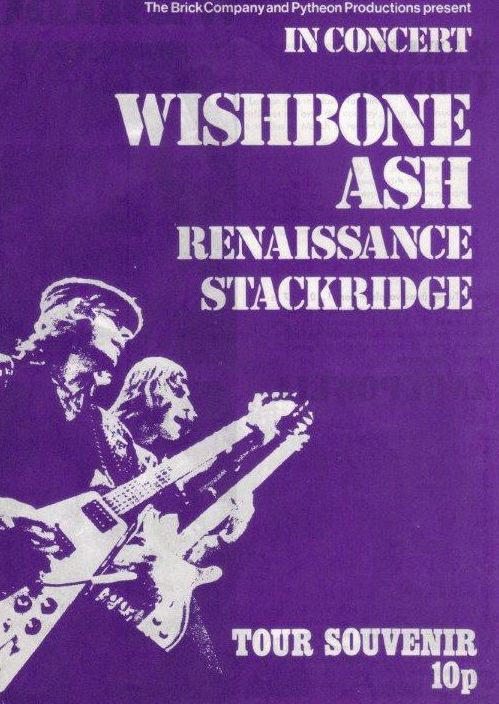
Thanks to Mitch for sending me a photo of his Wishbone Ash programme which comes from an earlier gig, with a great line-up, although Mitch tells me that only Stackridge supported, and Renaissance did not appear. Note the price of the programme: 10p!
Newcastle February 1972 set list (thanks Mitch): Time Was, Jail Bait, Warrior, Throw Down The Sword, The Pilgrim, The King Will Come, Phoenix.
Encores – Blind Eye, Where Were You Tomorrow.
More Wishbone Ash tomorrow.
 Vintagerock's Weblog.