Steve Hackett Newcastle City Hall 1979 and 1980
 Steve Hackett left Genesis in 1977, somewhat frustrated with the level of input he was having to the band’s album and shows. Steve was composing his own songs, and released his first solo album Voyage of the Acolyte in 1975 while he was still with Genesis. His first post Genesis album was Please Don’t Touch in 1978. In 1979 Steve put together a touring band, consisting of his brother John Hackett on flute, guitar and bass pedals, long-time collaborator keyboardist Nick Magnus, bassist/vocalist Dik Cadbury, drummer John Shearer and vocalist Peter Hicks. I saw Steve in concert at Newcastle City Hall in 1979 when he was promoting the Spectral Mornings album and again in 1980, when he was promoting the Defector album.
  I remember those gigs as some fine, beautiful music; largely instrumental. It was clear from the concerts just how much Steve had contributed to the Genesis sound. I haven’t been to see Steve Hackett in concert since those days, and I am tempted to go and see him again. He is touring this year with a Genesis Revisited set. He is returning to the 70s Genesis catalogue, playing some of the classic songs which he contributed to. The tour calls at the North East twice, at the Sage Gateshead in May (which is now sold out) and back at the City Hall in October. It must be some years since he has played the City Hall; I think I’ll go along and see him back at that great venue, which needs us to support it to secure its future. Setlist from the 1980 Newcastle gig: Every Day; The Red Flower Of Tachai Blooms Everywhere; Tigermoth; Kim; Time to Get Out; The Steppes; Narnia; Acoustic Set; Sentimental Institution; Jacuzzi; Spectral Mornings; A Tower Struck Down; Clocks – The Angel of Mons; Please Don’t Touch; The Show; It’s Now Or Never; Hercules Unchained
Posts Tagged ‘music’
24 Mar
Steve Hackett Newcastle City Hall 1979 and 1980
23 Mar
Johnny Marr Manchester Ritz 22 March 2013
Johnny Marr Manchester Ritz 22 March 2013
 Laura is a big Smiths fan. She has seen Morrissey several times and saw Johnny Marr play with the Cribs, and loves anything to do with the Smiths. This was our first opportunity to see Johnny solo, so as soon as tickets went on sale, we bought a couple for this home coming gig, which sold out quickly. We drove down to Manchester yesterday afternoon with plenty of time to spare, to allow for bad weather. Diving wasn’t too bad, although it was very slow going across the M62 because of snow and long queues. We arrived in Manchester around 5pm and went for a pizza in Revolution. Manchester Ritz is a great, quite small, venue in the centre of the city. Laura and I have been there once before to see Suede, a few years ago. We entered the venue around 7.15pm, in time to catch support act Furs, a London-based band who played some pretty good 60s tinged music. Laura bought a signed vinyl copy of Johnny’s new album; The Messenger, and I bought a set of badges. Johnny Marr took to the stage at 8.30pm to a great roar from his home crowd. The Ritz looms large in Smith history, as it was the first venue they played back in the early 80s, a fact that Johnny made reference to. The set was a mix of songs from the new album, Smiths songs and songs from his time with Electronic, the dance supergroup that he formed with Bernard Sumner of New Order.
  The new songs are good, with a few pretty strong tunes, but it was (of course) the Smiths tracks that got the best reception from the Manchester crowd. Laura was particularly pleased that he chose to play London, as it is a relatively unknown Smiths song. Standouts for me were a great version of I Fought the Law ala the Clash (took me back), and an astounding version of How Soon is Now? Johnny handles vocal duties himself, and did a great job too. There was mega singing along and dancing to How Soon is Now? and There is a Light. A pretty special night, which we both really enjoyed. Johnny Marr finished at 10pm prompt; there was a curfew as the Ritz turns into a club night at 10.30pm on a Friday. The snow was coming down quite heavily as we drove back across the M62 and the journey was pretty scary; thankfully we got home safe around 1am. Setlist: The Right Thing Right; Stop Me If You Think You’ve Heard This One Before; Upstarts; Sun And Moon; Forbidden City; European Me; London; Lockdown; The Messenger; Generate! Generate!; Say Demesne; Bigmouth Strikes Again; Word Starts Attack; New Town Velocity; I Want the Heartbeat. Encore: I Fought The Law; Getting Away With It; How Soon Is Now?; There Is A Light That Never Goes Out.
22 Mar
Steve Howe in concert 1994 and 2010
Steve Howe in concert 1994 and 2010
 Steve Howe is an excellent guitarist with his own, very individual style. He cites several guitarists as influences including Les Paul, Barney Kessel and Chet Atkins. When I first saw Steve in Yes in 1971 I was struck by the Gibson ES-175D that he was playing. About this guitar, Howe said: “No one was playing archtop, hollowbody guitars in a rock band. People laughed at me and thought I was really snooty. To me, it was an object of art, it wasn’t just a guitar”. I was blown away by his performance of “The Clap” that night, and have remained a fan ever since. The way that he blends jazz and classical influences with rock defines his uniques style. A few years later I was equally impressed by “Mood for a Day”. I spent ages trying to learn to play it, and never got past the first few minutes.
  I have seen Steve twice in solo concert, both times with my mate Will. The first time was a concert in a small room in South Shields Temple Park Leisure centre, with support from Isaac Gullory. The second was at the Sage more recently when he performed with the Steve Howe trio which features his son Dylan Howe on drums and Ross Stanley on Hammond organ. The trio is very jazz oriented, but still perform versions of some Yes classics. For me a Steve Howe concert isn’t complete without “The Clap” or “Mood for a Day” (and ideally both!).
21 Mar
Sammy Hagar Newcastle City Hall 1982
Sammy Hagar Newcastle City Hall 1982
Support from Grand Prix
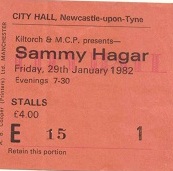 This was the last time I saw Sammy Hagar in concert. By 1982 he had released 7 solo albums, and was continuing to have success both in the UK and the USA. His solo career was to come to an end a couple of years later when he joined Van Halen. I saw Halen a couple of times with Dave Lee Roth as lead singer, but I never saw them with Sammy Hagar. Support for this tour, the Standing Hampton tour, came from Grand Prix who were
 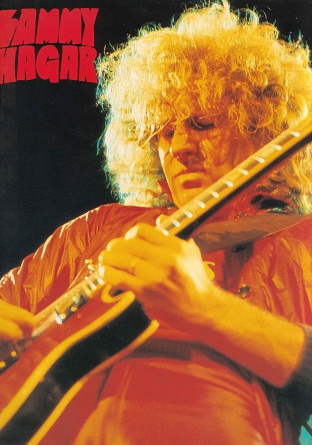 “A British Pomp Rock band of high repute; coming to prominence during the NWOBHM era, but purveyed a slicker, AOR tinged melodic Rock that gave the act distinction amongst their more rustic counterparts.” (from ww.rockdetector.com). Grand Prix featured ex-Sad Cafe keyboardist Phil Lanzon, who is now in Uriah Heep (and who I saw last week at Stockton). Setlist from the Glasgow gig of the tour: Heavy Metal; This Planet’s on Fire (Burn in Hell); Plain Jane; Baby’s on Fire; I’ll Fall in Love Again; Trans Am (Highway Wonderland); Sweet Hitchhiker; Love or Money; Inside Lookin’ In; Can’t Get Loose; Rock ‘n’ Roll Weekend; I’ve Done Everything for You; Rock Candy; Space Station #5. Encore: Whole Lotta Love; There’s Only One Way to Rock; Turn Up The Music; Red / Satisfied
20 Mar
Sammy Hagar Newcastle City Hall 1980
Sammy Hagar Newcastle City Hall 1980
Support from US heavy metal band Riot
 This tour was billed as the Loud and Clear tour. The original billing listed April Wine as the support act. If my memory serves me right (and it often doesn’t 🙂 ) April Wine dropped out as they elected to do their own headline tour, and they were replaced by US heavy metal merchants Riot. Sammy Hagar live was a full-on, raucous, high energy rock experience. Sammy had boundless energy and would run around the stage, slamming riffs out of his guitar. He would always give 110% and was great fun to see live.
  I found a setlist from 1980. I guess that the set at Newcastle will have been similar to this: Trans Am (Highway Wonderland); Love or Money; Miles From Boredom; Reckless; In the night; Young Girl Blues; Plain Jane; 20th Century Man; The Iceman; This Planet’s on Fire; Turn Up The Music; Red; Bad Motor Scooter. Encore: Bad Reputation; Space Station #5; Cruisin’ and Boozin’; Growing Pains. A live album exists from this period, which also includes some of the above songs. By the time of this tour Hagar had released 5 albums in 4 years, which is pretty good going. It was to be another couple of years before I saw him again at the City Hall.
19 Mar
Sammy Hagar Newcastle Mayfair 1979
Sammy Hagar Newcastle Mayfair 1979
Support from Def Leppard
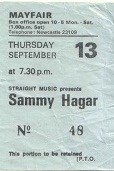 I first saw Sammy Hagar when he was with Montrose. They were a great hard rock band, and supported Status Quo at Newcastle City Hall on a tour in the early 70s. They delivered a strong set and actually gave the mighty Quo a bit of a run for their money. I also saw them in 1974 when they played at Charlton football ground, as one of the support acts for the Who. Their most famous song was Bad Motor Scooter which was apparently the first song that Sammy Hagar wrote. Hagar split from Ronnie Montrose in 1975 and pursued a solo career, going on to some considerable success in the late 70s and early 80s. One of his most well known songs from that solo period was Red, on which he built his own style, leading to his nickname of The Red Rocker. I remember red programmes, red clothing, and red guitars all became part of his shows around that time. Hagar live was a full-on high energy hard rock experience, fast and loud. He would always play Red, Bad Motor Scooter and Space Station No 5. Great stuff. This gig at the Mayfair had the added attraction of up and coming NWOBHM band Def Leppard as support act. More Def Leppard memories here https://vintagerock.wordpress.com/2012/10/04/def-leppard-newcastle-city-hall-1980/
18 Mar
Daryl Hall and John Oates Newcastle City Hall 1977
Daryl Hall and John Oates Newcastle City Hall 1977
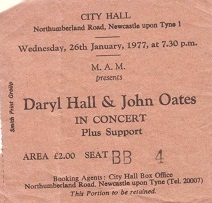 Hall and Oates were back in the UK for another tour less than a year after their first full trek around the country in 1976. They were now a little more well known although their biggest success in this country was yet to come. Hall and Oates were massively successful between the mid 70s and mid 80s. From their official website: “From the mid-’70s to the mid-’80s, Daryl and John would score six #1 singles, including “Rich Girl” (also #1 R&B), “Kiss on My List,” “Private Eyes,” “I Can’t Go For That (No Can Do) (also #1 R&B), “Maneater” and “Out of Touch”
  from their six consecutive multi-platinum albums—’76’s Bigger Than Both of Us, ’80’s Voices, ’81’s Private Eyes, ‘82’s H2O, ‘83’s Rock N Soul, Part I and ‘84’s Big Bam Boom. The era would also produce an additional 5 Top 10 singles, “Sara Smile,” “One on One,” “You Make My Dreams,” “Say It Isn’t So” and “Method of Modern Love.”” Although the previous paragraph refers to their success in the USA, Hall and Oates have also had over 20 UK chart entries.
 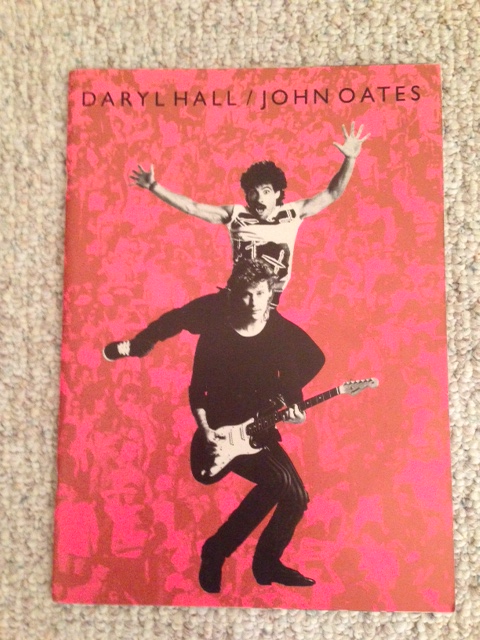 The facts that I find when I do a little research on acts for this blog often surprise me. I remember, of course, hits like “I Can’t Go for That (No Can Do)”, “Maneater” and “Family Man”, all of which reached the top 20, but I didn’t know that they had had so many hits in the UK. I enjoyed the two Hall and Oates concerts that I attended in 1976 and 1977, but haven’t seen them since those days. My friend John saw them more recently at on the Big Bam Boom tour in 85 at a concert in the Montreal Forum, and sent me a scan of the programme (see right). John says: “This was probably at the peak of their success, fueled by heavy rotation on MTV they became the best selling duo of all time with a succession of hit singles and albums. I actually liked them a lot and while I did not see them in the late 70’s I became a fan around that time with She’s Gone, Sara Smile and Rich Girl”
17 Mar
Daryl Hall and John Oates Newcastle City Hall 1976
Daryl Hall and John Oates Newcastle City Hall 1976
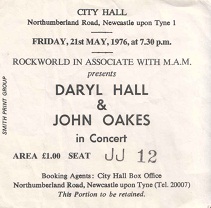 I first heard of Daryl Hall and John Oates in 1976, when there single “She’s Gone” was released. They seemed to quickly become a very trendy band and those who were in “the know” told me how good this band were. Those who were into the disco movement, and frequented local clubs like Annabel’s, were raving about the blue-eyed soul of these guys. So when they toured and came to the City Hall, Marie and I went along to see what all the fuss was about. Hall and Oates were still relatively unknown to the general public and most concert-goers at the time, however they still managed to attract a reasonable crowd. Support came from the Chanter Sisters. Note the misspelling of “Oakes” rather than “Oates” on the ticket, another pointer to the fact that Hall and Oates were not that well known.
  Hall and Oates had played a well received UK debut concert at the New Victoria Theatre in London in 1975, but this was their first full UK tour. She’s gone rose to Number 7 in the UK chart and the band were starting to grow their own audience in the UK. My memories of this are of a great gig, with strong vocals by Daryl Hall. I didn’t know any of the material other than She’s Gone, so found it a little hard going at times, but overall I felt it was a good show. A DVD of the guys live from that period exists. They perform some of their greatest blue-eyed soul hits from their early hit albums “Bigger Than The Both Of Us”, “Abandoned Luncheonette” and “War Babies”. Track Listing: Rich Girl; Do What You Want, Be What You Are; Is It a Star; Abandoned Luncheonette; Ennui on the Mountain; Gino the Manager; Sara Smile; Room to Breathe; Johnny Gore and the C Eaters. I guess the set at the City Hall in 1976 will have consisted of some of those songs, although I am certain that they also plated She’s Gone. I hadn’t realised that Rich Girl was so early; I certainly hadn’t heard it at the time, but it looks like they may well have played it at the gig I attended in 1976.
16 Mar
Steve Hillage Newcastle City Hall 1979
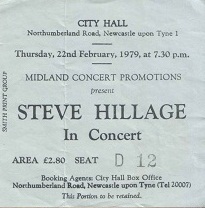 The last time that I saw Steve Hillage in concert was in 1979 at Newcastle City Hall. By then he had released seven solo albums, was several albums on from his classic L lp and the audience was dwindling a little. The things I remember most about Steve in concert are his epic performances of the songs from L and his use of what is termed “glissando guitar”. I wasn’t sure of the origin or meaning of the term so I googled it. Many thanks to Chris D from the seven string forum for explaining glissando guitar for me: “I think this got called “glissando guitar” first by Daev Allen from Gong, who as far as I know pioneered this technique. Steve Hillage also used this a lot. Glissando is the musical term meaning “slide” but glissando guitar isn’t “slide guitar” as you know it.The sound you get is a lush drifty synth/string effect, it sounds cool & is easy to do, although trying to explain it seems complicated”. It seems the technique involves removing the tremolo arm and jiggling it across the strings while using a wah wah pedal for effect. Whatever it is, it certainly gave a unique sound to much of Steve’s guitar work at the time.I have also been reading quite a lot about System 7, Steve’s latest band. I didn’t realise how influential he has been in the dance scene and it the acceptance of dance at Glastonbury. So I making myself another promise which is to try to see System 7 when the opportunity next arises. Support act for the 1979 tour was Trevor Rabin who would go on to join Yes. Typical setlist from the 1979 tour: “The Salmon Song”, “Unzipping The Zype”, “Hurdy Gurdy Glissando”, “Light In The Sky”, “1988 Aktivator”, “Unidentified (Flying Being)”, “UFO Over Paris”, “Activation Meditation”, “The Glorious Om Riff”, “Activation Meditation”, “It’s All Too Much”, “Electrick Gypsies”, “Talking to the Sun”
15 Mar
Steve Hillage Newcastle City Hall 1977
Steve Hillage Newcastle City Hall 1977
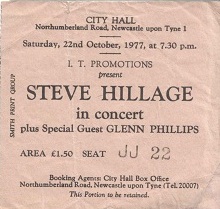 Steve Hillage toured a lot during the late 70s. I attended most, but not all, of the gigs he played in Newcastle during that period. He called at the City Hall twice in some years, and I didn’t catch all of those gigs. I did attend his 1977 concert at the City Hall, and pretty fine it was too. Steve was a guy of several faces: the quiet bearded hippy from Gong, the somewhat unlikely guitar hero who emerged during the late 70s, and he even popped up onstage at the Reading festival as a special guest of Sham 69, which was a very unlikely pairing (and didn’t go down well with some of the skinheads in the crowd, as I recall).
  A further side of Steve has emerged in recent times, as the leader of electronic ambient new music visionaries System 7. During the years I am blogging about here, Steve was very much a guitar man, releasing a clutch of pretty fine albums, and playing some pretty good gigs. Support came from Glen Philips on this 1977 tour. The tour waa to promote Steve’s latest album Motivation Radio and the set was drawn from that album and his previous album L. I found a setlist from the Glasgow gig of the tour on the Glasgow Apollo site. I would imagine the set at Newcastle will have been similar to this: It’s All Too Much; The Golden Vibe; Unidentified (Flying Being); Light in the Sky; Radio; Aftaglid; Electrick Gypsies; The Salmon Song; Solar Musick Suite; Saucer Surfing; Searching for the Spark; Hurdy Gurdy Man; Hurdy Gurdy Glissando; Not Fade Away
 Vintagerock's Weblog.