Velvet Revolver Newcastle Arena 15th January 2005
 Support from The Datsuns
Velvet Revolver were formed in 2002 by ex Guns N’ Roses bandmates Slash (guitar), Duff McKagan (bass), and Matt Sorum (drums), Dave Kushner (from Wasted Youth on second guitar) and ex Stone Temple Pilot Scott Weiland (vocals).
They recorded a soundtrack single for the Hulk called “Set Me Free” in 2003 and released their second single “Slither” in 2004, along with their debut album “Contraband”. They toured the UK for the first time in 2005, calling at Newcastle Arena with support from the Datsuns. Their music was a mix of STP and G N’ R which brought a “sense of danger and beauty to modern rock.” A respectable sized rock crowd gathered in the Arena for the gig, which was an enjoyable experience and a chance to see Slash up relatively close.
Setlist: Sucker Train Blues; Do It for the Kids; Headspace; Superhuman; Illegal I Song; Crackerman (Stone Temple Pilots); Dirty Little Thing; Fall to Pieces; Big Machine; It’s So Easy (Guns N’ Roses); Sex Type Thing (Stone Temple Pilots); Set Me Free; Used to Love Her (Guns N’ Roses); You Got No Right; Mr. Brownstone (Guns N’ Roses); Slither
Posts Tagged ‘classic rock’
20 Dec
Velvet Revolver Newcastle Arena 15th January 2005
19 Dec
Van Der Graaf Generator live 1971 to 1977
Van Der Graaf Generator live 1971 to 1977
 I always found Van Der Graaf Generator to be a tricky and complex band. They come from the dark and deep side of prog which they inhabit with King Crimson. I totally loved some of their songs, but found others too dark, strange, jerky and lengthy for my liking. My favourites were, and remain, “Killer”, “Refugees” and “Darkness”. “Killer” is an epic prog classic, which was played again and again at my local Locarno ballroom in the early ’70s. Its narrative tells the story of a lonely killer whale: “So you live in the bottom of the sea, and you kill all that come near you ….but you are very lonely, because all the other fish, fear you …..”. I would group “Refugees” and “Darkness”‘ together; both are beautiful, slow ballads. “Refugees” tells a poignant story of hope, and of Mike and Susie who are “refugees, walking away from the life that we’ve known and loved”; they “walked alone, sometimes hand in hand……smiling very peacefully” and ends “Now we are alone….” “Darkness”, as its title suggests is a moody, fascinating piece: “Day dawns dark, it now numbers infinity. Life crawls from the past, watching in wonder. I trace its patterns in me. Tomorrow’s tomorrow is birth again.” Deep, heavy stuff. VDGG live were equally dark, complex and intense. I found their performances fascinating, uplifting, yet also frustrating and troubling; sometimes even slightly scary. The focus was always the intense and passionate performance of Peter Hammill, swirling organ, and lengthy (sometimes too lengthy in my view) sax solos. The classic line-up, which I saw twice in the period between 1971 and 1972 was Peter Hammill (vocals, piano), Hugh Banton (organ), Guy Evans (drums) and David Jackson (sax, flute). The first time I saw VDGG was at a concert at Newcastle City Hall, where they were supported by Lindisfarne and Genesis (a great triple bill 🙂 ). It was a Charisma package tour, and the tickets were all of 30p, but we had vouchers from Northern Arts which entitled us to half price entry. That was a great evening, and a bargain at 15p! I blogged of that concert some time ago. I next saw them at Sunderland Locarno on 3rd March 1972. Another great gig. The band then split for a period, reforming a couple of years later. I remember going to one of the shows on their “comeback” tour at Newcastle Polytechnic on 24th October 1975. I saw them again the following year at the Reading Festival on 28th August 1976, where they played a short festival set of Masks, Childlike Faith in Childhood’s End, Still Life, The Sleepwalkers and closed with Killer. By 1977 the line-up had changed. David Jackson and Hugh Banton had left and Nic Potter had joined on bass, along with Graham Smith, formerly of the excellent String Driven Thing on violin (check out String Driven Thing’s great song “Its a Game” which was covered by none other than the Bay City Rollers). I saw that line-up at a gig at Redcar Coatham Bowl on 30th October 1977. VDGG reformed a few years ago, and I have blogged on a performance I attended in Manchester a couple of years ago.
Van Der Graaf Generator are, without question, one of the most important and influential bands to come out of the prog rock genre.
18 Dec
Venom Newcastle City Hall 3rd October 1985
Venom Newcastle City Hall 3rd October 1985
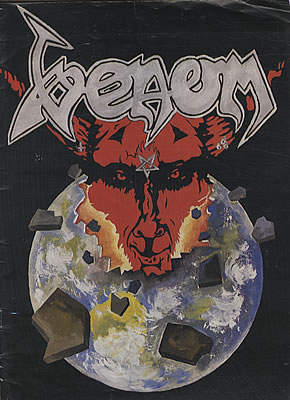 Venom are, according to their official site: “the original inventers and founders of Black Metal, the creators of Thrash, Speed, Death and Power Metal, the deadliest force ever to hit the music scene, the original sinners playing the Devil’s music at its highest intensity, the ultimate Rock n’ Roll band in the universe, Venom, hell f**ing yeah!!!!!!!.” Venom, as you might have gathered play LOUD, fast, evil, rock. They have songs called “Die Hard”, “The Seven Gates of Hell”, “Don’t Burn the Witch”, “Welcome to Hell” and “Bloodlust”. Wow! I think you may get the idea.
Venom hail from the 70’s and the North East of England, namely Newcastle, and were formed by Conrad Lant (aka: Cronos). Cronos wanted to create the ultimate metal band that was “heavier and more over the top than anything anyone had ever seen or heard before, more Satanic than Black Sabbath, louder than Motörhead, with a pyrotechnic show to rival Kiss, and with even more leather and studs than Judas Priest”. Great concept. Cronos completed his line-up and his plans for metal world domination with Jeffrey “Mantas” Dunn on guitar, and Tony “Abaddon” Bray on drums, and Venom released their debut album in 1982. Venom made their debut at the Hammersmith Odeon in London in 1984. They always said that their stage show was so massive and that they’d never play a UK date until they could headline at a venue that could house “every last pyro and effect”. “We did it to shove two fingers up at the music industry” recalls Cronos. “we were told… there was a certain way of doing things in this industry. You had to get in a van and do all the s**t hole clubs… I said ‘Bollocks!!!, then booked the Hammersmith Odeon in London and sold it out.”
 I saw them with my mate Dave at the City Hall in 1985. According to the ticket support came from Exodus and Chariot, who I have no recollection of. The gig was not that well attended, with an estimated 400 people in the 2,400 capacity hall. From the programme: “Good evening hellspawn, to the most unholy unacceptable and unspeakable blitz of metal you will ever see in your comparatively paltry lives. You are about to experience the grossest amount of sonic assault, volatile visuals and plain power Uber….you are about to experience Venom, the most magnificently powerful metal monster in the world….Ladies and Gentlemen, from the depths of Hell — Venom.”
Venom live were LOUD with scary screaming vocals over a fast thrash metal noise, and flames, explosions and other crazy pyrotechnics. Think a twisted version of Motorhead + Kiss + Sabbath + Slipknot.
An experience like no other. Truly epic.
Setlist: Too Loud (For the Crowd); Black Metal; Die Hard; Nightmare; Countess Bathory; The Seven Gates of Hell; Teacher’s Pet / Poison / Teacher’s Pet; Buried Alive; Don’t Burn the Witch; In Nomine Satanas; Welcome to Hell; Warhead; Schizo; Satanachist.
Encore: Leave Me in Hell; Bloodlust; Witching Hour
16 Dec
The Undertones live in 1979 & 1980
The Undertones live in 1979 & 1980
 I first saw the Undertones at a gig in Middlesbrough Rock Garden on 4th March 1979. The place was completely jam packed and the band were simply incredible. There was a garage pop sensibility about this band, with Feargal’s wonderful warbling vocals, great tunes with instantly catchy hooks, cutting buzz guitar, and honest quirky songs about teenage angst and day to day life. The Undertones were a flash of welcome relief from the heavier political sentiments of many of the punk acts of the time. Their performances were pure raw energy, and they looked like (and were) young guys who had just stepped out of their front room rehearsals. The Rock Garden gig came soon after the release of the momentous “Teenage Kicks” single and before the release of their equally important first album. The original line-up of the band was Feargal Sharkey (vocals), John O’Neill (rhythm guitar), Damian O’Neill (lead guitar), Michael Bradley (bass) and Billy Doherty (drums).
 A few months later and the Undertones had been in the UK Top 20 with “Jimmy Jimmy” and were headlining theatres and civic halls up and down the country. I saw them at Newcastle City Hall on 8th October with support from Tenpole Tudor (“Swords of 1,000 Men”).
They were back in the charts in 1980 with “My Perfect Cousin” and the wonderful “Wednesday Week” which was my favourite song of theirs. The Undertones returned to Newcastle City Hall on 8th June 1980 for another glorious performance. Support this time came from the Moondogs, who were a fellow Northern Irish band.
15 Dec
UB40 live 1980 to 1982
UB40 live 1980 to 1982
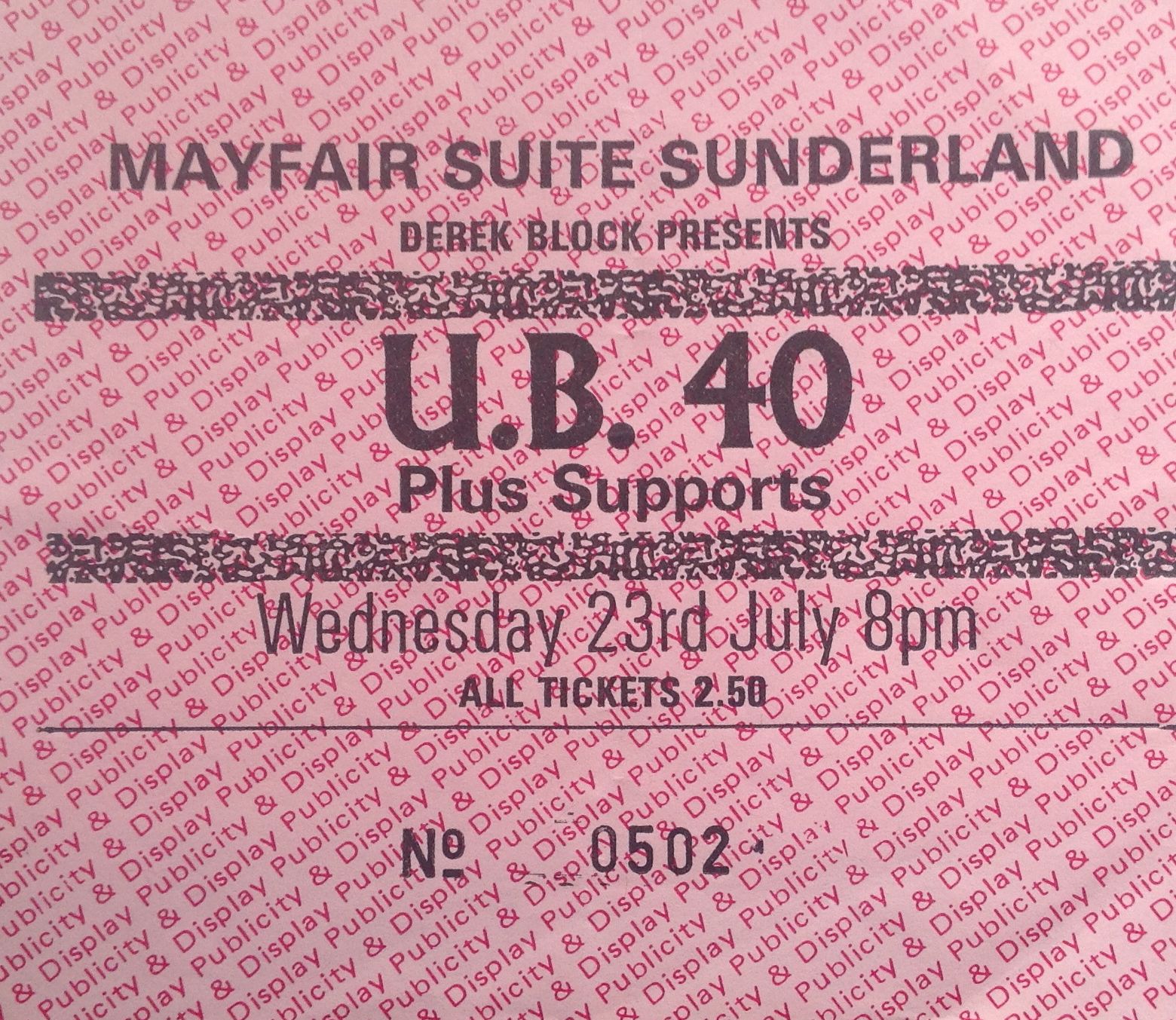 UB40 emerged out of the renewed interest in reggae during the punk and new wave movement of the late 70s and early 80s. UB40 were formed by Robin Campbell, his younger brother Ali, Earl Falconer, Brian Travers, James Brown, and Norman Hassan, who were all friends in Birmingham. They recruited Michael Virtue and Astro and aligned themselves to left-wing political ideals, naming themselves after an unemployment benefit form. I first saw them live during the summer of 1980 around the time of their debut single “King / Food For Thought” which reached the UK Top 5. I saw UB40 twice in the same week at Sunderland Mayfair on 23rd July 1980, and then supporting the Police at Milton Keynes Bowl on 26th July 1980.
UB40’s music was very different to anything else at the time. Political lyrics, sung over reggae rhythms with some lengthy instrumental passages, with horn solos and some rap and scat singing. Visually they were also very different, with so many musicians on stage. I remember going to the Sunderland gig having only heard “Food for Thought” and being pleasantly surprised by their performance.
 UB40’s first album “Signing Off” was released in September 1980. The album cover shows a yellow British UB40 unemployment benefit card from which the band took their name, stamped with the words SIGNING OFF, signally that the band were leaving the world of unemployment and had arrived on the music scene. “Signing Off” went to No. 2 in the UK and stayed on the album chart for 72 weeks. I saw UB40 twice more, at Newcastle City Hall on 9th June 1981 & 19th January 1982. Both of these were great, fun gigs.
UB40 setlist from 1980: Tyler; My Way of Thinking; Burden of Shame; Strange Fruit; Adella; One In Ten; I Think It’s Going to Rain Today; Summertime; King; 25%.
Encore: Food For Thought; Little by Little
“Ivory Madonna dying in the dust, Waiting for the manna coming from the west.
Barren is her bosom, empty as her eyes, Death a certain harvest scattered from the skies.” (Food for Thought, UB40, 1980)
14 Dec
Uriah Heep Carlisle Sands Centre 30th October 2004
Uriah Heep Carlisle Sands Centre 30th October 2004
 Support from Doogie White’s White Noise
Thanks for sticking with my during my week of ramblings on Uriah Heep. This will be my last post on that mighty, great band (at least until I see them again).
It was 2004 and I was suffering Heep withdrawal. I had foolishly lost touch with the band and it had been 19 years since I last saw them perform at a gig at Newcastle Mayfair. I read that they were touring the UK, and saw the nearest concert to me was at Carlisle Sands Centre, so I decided to go along. Carlisle is a 60 or so mile drive, and the Sands Centre is a leisure centre cum concert venue just outside the city centre. I arrived in time to catch support act Doogie White and White Noise. The ticket lists Manfred Mann’s Eartband as support, but this wasn’t the case. Doogie White was the singer in a later line-up of Blackmore’s Rainbow, and his set contained quite a few Rainbow favourites.
The 2004 line-up of Uriah Heep was Mick Box (guitar), Lee Kerslake (drums), Trevor Bolder (bass), Phil Lanzon (keyboards) and Bernie Shaw (vocals). Shaw and Lanzon both joined the band in 1986, and Shaw is now their longest serving vocalist. It was really great to see Uriah Heep again. I wasn’t sure how many old songs they would play, and whether I would know many, but I need not have worried. They started with Easy Livin’, and also played Stealin’, Gypsy, The Wizard and July Morning. The encores were Bird of Prey and Lady in Black. Shaw is an excellent front man with a great voice, and does justice to those classic Heep songs. It all came back to me, and I was once again a big fan. I’ve seen Uriah Heep on four further occasions since then, in Stockton, Workington, Newcastle and Holmfirth, and have already blogged about those shows. During that period Trevor Bolder has sadly passed away, and Lee Kerslake has retired from the band. Mick Box continues to lead the band. Long may they continue to rock.
Setlist: Easy Livin’; Shadows of Grief; Pilgrim; The Other Side of Midnight; Stealin’; Wise Man; The Wizard; Devil’s Daughter; Sunrise; Gypsy; July Morning; Look at Yourself
Encore: Bird of Prey; Lady in Black
12 Dec
Uriah Heep Newcastle Mayfair 1982 & 1985
Uriah Heep Newcastle Mayfair 1982 & 1985
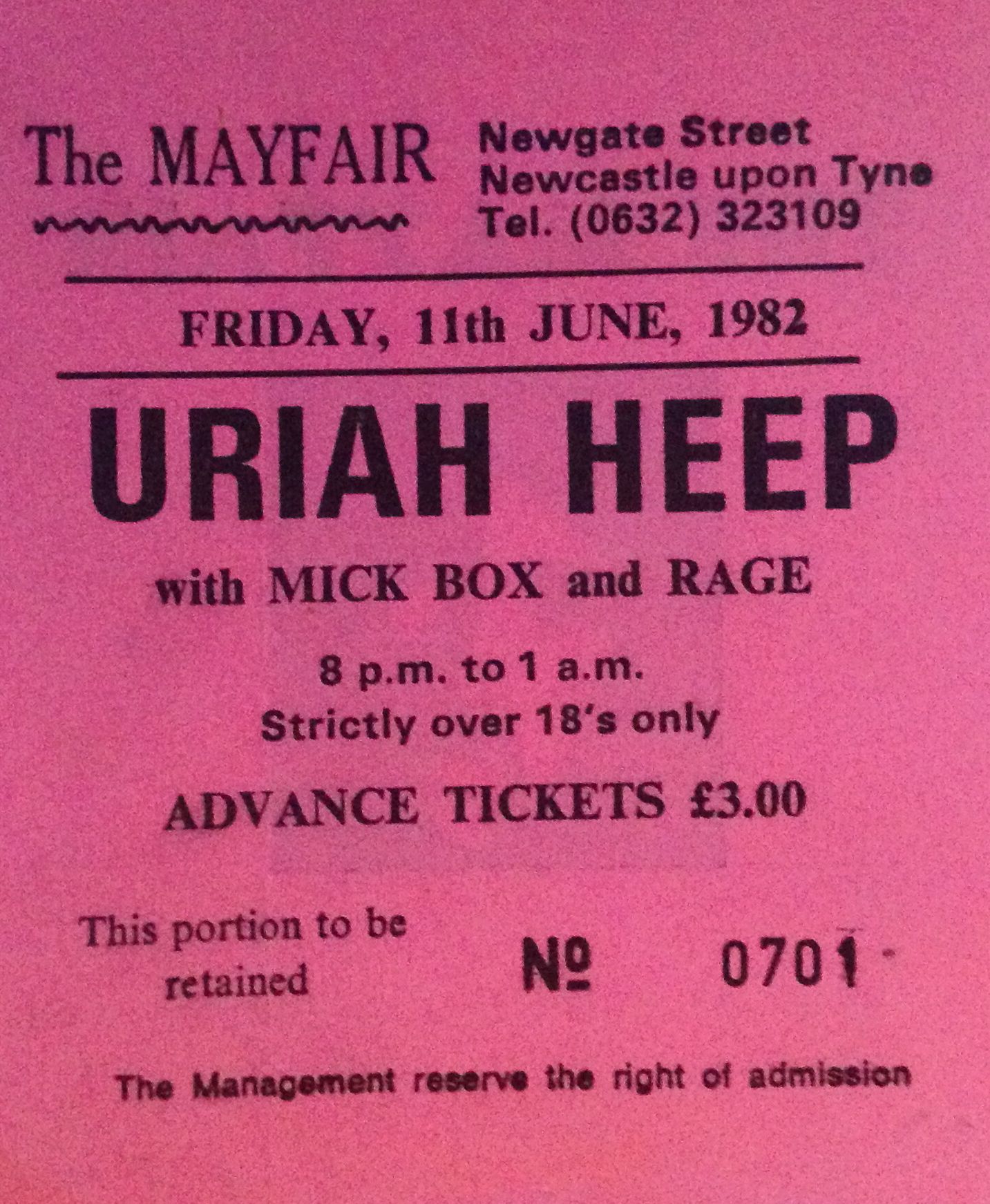 So….the mighty Uriah Heep were reduced to one member, guitar wizard extraordinaire Mick Box, who “locked myself in my flat for two days and drank myself senseless in complete self-pity.” Like any true wizard Box was not to be defeated and he soon began to forge a mystic plan for the future of Heep. He contacted his old mate and former Heepster drummer Lee Kerslake who was now with Ozzy Osbourne in Blizzard of Oz. Kerslake rejoined Uriah Heep,bringing bass player Bob Daisley with him. They were joined by ex Heavy Metal Kids keyboard player John Sinclair and vocalist Peter Goalby from Trapeze. The new Heep line-up shared the song writing duties and produced the 1982 album “Abominog” which was well received by fans and critics. Uriah Heep were well and truly back and went out on tour. Their success was, in part, helped by a resurgence in interest in heavy rock, as result of the emergence of the NWOBHM (New Wave Of British Heavy Metal). Their sound was moving more in a hard rock / heavy metal direction and away from the swirling operatic progisms of “Demons and Wizards”. I first saw the new line-up at Newcastle Mayfair in June 1982. Note how the ticket declares the concert as bing by “Uriah Heep with Mick Box”, so that punters knew what to expect. Support came from NWOBHM band Rage. I went along not sure what to expect from Uriah Heep, and half prepared to be disappointed, but I was seriously impressed by the new line-up. All credit to Mick Box, who could have given up at that point, but rebuilt the band which he continues to lead to this day.
 I saw Uriah Heep again a couple of months later in August 1982 when they appeared low down the bill at Donington Monsters of Rock festival. The line-up was, in order of appearance, Anvil, Uriah Heep, Hawkind, Saxon, Gillan and Status Quo.
My next Heep experience was when they returned to the Mayfair in 1985. By this point Bob Daisley had left and Trevor Bolder had returned to the fold. Note how the ticket cleverly uses the font from “Uriah Heep Live”. Sadly that concert came just over a week after the passing of the great David Byron.
1985 Set List: Sell Your Soul; Stealin’; The Other Side Of Midnight; Too Scared To Run; Rockarama; Angel; The Wizard (dedicated to David Byron); July Morning; Bad Blood; Party Time; Gypsy; Easy Livin; That’s The Way That It Is; Look At Yourself
11 Dec
Uriah Heep Newcastle City Hall 6th Feb 1980
Uriah Heep Newcastle City Hall 6th Feb 1980
Support from Girlshool
 It must have been pretty confusing being a member of Uriah Heep in the late 70s and early 80s. There were so many comings and goings. Let me recap on the Heep saga that I have been telling for the past few days. John Lawton was now an ex-Heepster having been ousted by Heep main man Ken Hensley. Enter a new young guy John Sloman fresh to Heeping, and last seen (by me anyway) singing about the “Bells of Berlin” in the excellent rock band Lone Star. A month or so later long-time drummer Lee Kerslake jumped off the Heep ship. Enter Chris Slade from Manfred Mann’s Earth Band. The new line-up recorded the “Conquest” lp, which was released in February 1980 and went out on their 10th Anniversary Tour, with NWOBHM rockers Girlschool as support. I saw the band at their concert at Newcastle City Hall, and was pretty impressed by the new Heep, who excelled themselves as usual, playing a set of crowd-pleasing Heep classics. Sloman has a pretty impressive vocal range and a great rock voice.
However, Ken Hensley was less than happy with this new Heep line-up, and felt that they were moving too far along a straightforward rock track: “The band had chosen John and I had opposed that decision. He was a good musician and he looked great but I thought he had little going for him vocally. The way that he interpreted songs was totally different to the way I had written them….we weren’t re-establishing our musical direction..” (from bio on official Uriah Heep site)
 Ken Hensley decided to leave the band on June 8th, 1980 after the previous night’s gig in Cascais, Portugal (which marked the end of a huge chapter in the band’s history).T his was probably as big a blow to the future of Uriah Heep as the departure of David Byron had been 4 years or so earlier. Hensley was the main songwriter in the band, and along with Mick Box, one of only two remaining original members. Nonetheless, this was Heep, and change was always happening, so onward they went. Gregg Dechert, a Canadian who had worked with John Sloman, was brought in on keyboards and they immediately went on a UK tour. The tour called at Sunderland Mayfair on 12 Nov 1980, where they were supported by NWOBHM bands Spider and Samson. To be honest I have scant memories of that gig, but think I was present. After finishing the tour John Sloman decided that he had enough of being a Heepster and left the band. At this point Mick Box asked David Byron to rejoin, but David turned the offer down. Trevor Bolder then also decided to leave and joined Wishbone Ash (are you following this ? 🙂 ). The band essentially disintegrated and Uriah Heep were down to one member, Mick Box.
More of the Heep saga tomorrow!
Typical Heep set list for 1980: Stealin’; Look at Yourself; Free ‘n’ Easy; No Return; The Wizard; July Morning; Free Me; It Ain’t Easy; Lady In Black; Won’t Have To Wait Too Long; Carry On; Feelings; Sweet Lorraine; Easy Livin’; Do You Feel Alright; Gypsy; Suicidal Man
10 Dec
The Who Newcastle Arena 9th Dec 2014
The Who Newcastle Arena 9th Dec 2014
Support from local heroes Maximo Park
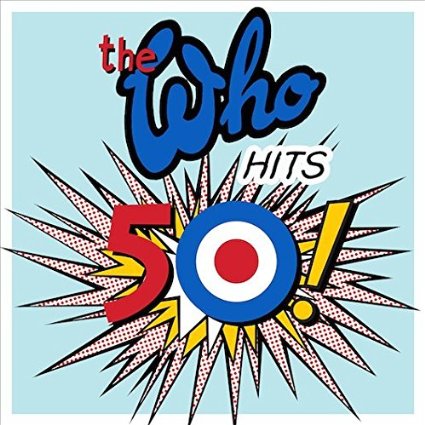 What can I say! The Who returned to Newcastle as part of “The Who Hits 50 tour!” with a set jam-packed with classic songs drawn from across their amazing entire catalogue. I went along with my mate Norm to see the rock legends, and we were both really looking forward to the gig. They didn’t let us down, and then some. This was the 19th occasion on which I have seen the Who in concert, the first being at Newcastle Odeon in 1971. I knew that the concert would be good, but was surprised just how excellent the band were last night. Support came from local band Maximo Park who warmed the crowd up with a short set. The arena was pretty full, although not sold out. The Who started their set shortly after 8.30pm, sauntering on to the stage, Roger holding his cup of tea. “Go For It Pete” a voice from the front shouted. Townshend explained that these days his actions are limited to windmill arm swinging, a little jigging (he demonstrated both) and insulting the front row (which he admitted to gaining great enjoyment from). Then the familiar chords of “I Can’t Explain” rang through the arena and The Who were off, in full swing, taking us right back to where it all started. This was followed swiftly by “Substitute”; two classic slabs of 60s pop/rock, which they always opened their set with during the 70s. Roger’s voice was strong and solid, and the mike saw lots of twirling throughout the evening. Next up was “The Seeker”, not often played live, followed by “Who Are You” and “The Kids Are Alright”, with Roger on acoustic guitar; those great harmonies always get me. Pete explained how he wrote great pop songs like “The Kids Are Alright” (also mentioning “Legal Matter” in the same context) in his small attic studio in London in the 60s, usually in connection with stories about his latest girlfriend. He went on to tell us how he then moved into “artrock”, as way of introducing “I Can See for Miles”. Classic. One of their best songs, and a pure gem from the 60s. Pete was very animated throughout the concert and talked to the crowd a lot. He joked about “Pictures of Lily” and explained that “Cry If You Want” (can’t say I remember that one) was covered by the Merseys (and Bowie? I think). Next was “Behind Blue Eyes” with Roger in fine voice, followed by “You Better You Bet”. Then, with one of the band on mouth harp and another on jaw’s harp, we were in the 70s and “Join Together”. Roger made reference to their last tour, which was “Quadrophenia”, as and introduction to a short segment from that album: “I’m One”; “5:15”; “Bell Boy” (with video footage of Keith Moon playing the bellboy part, his grinning face staring at us from giant screens behind the band) and “Love, Reign O’er Me”. John Entwistle also featured, in a great close-up video of an extended bass solo, the screen showing his fingers speeding up and down the neck of his guitar.
 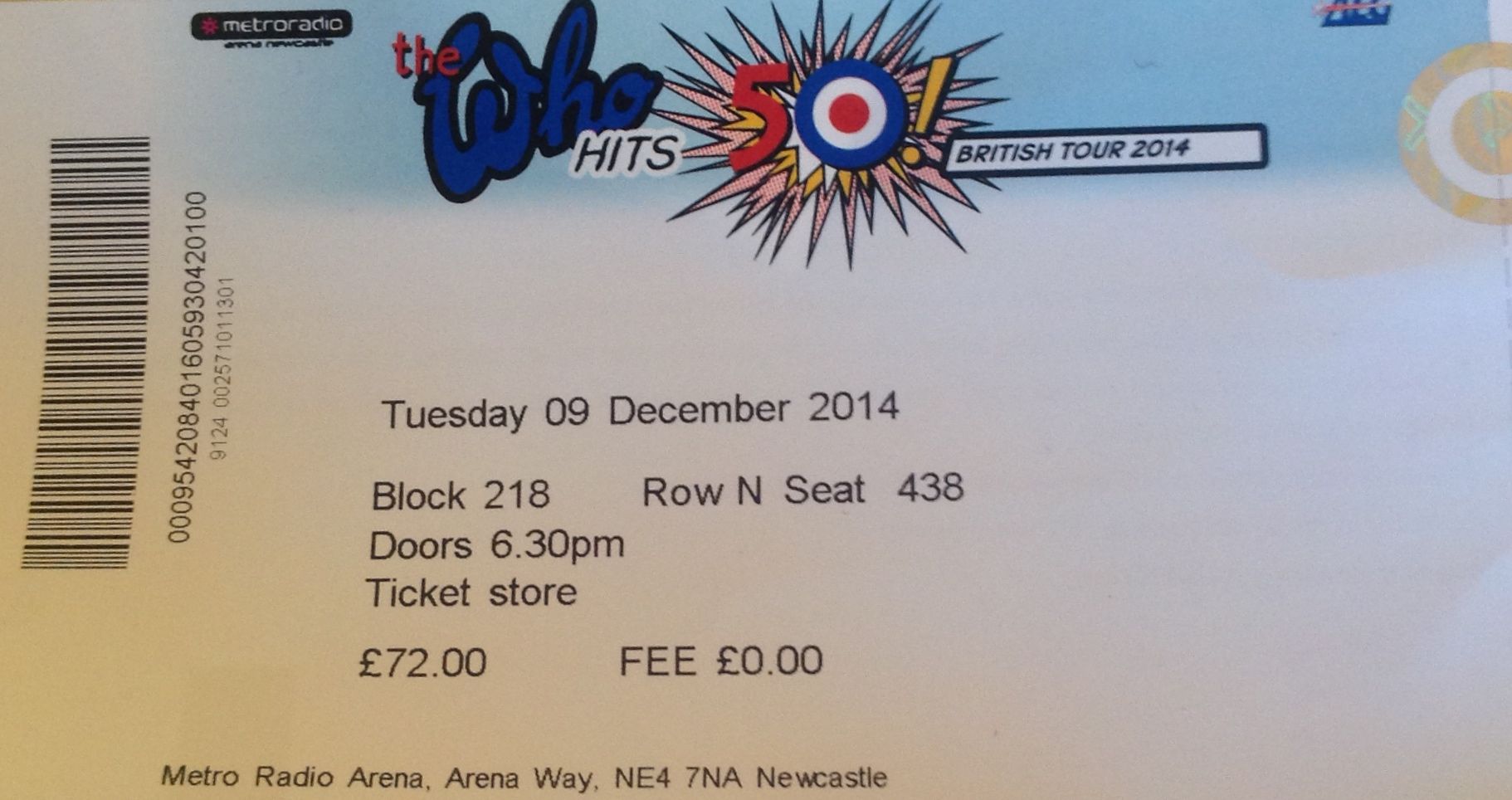 The crowd gave the videos of the late great Moon and Entwistle massive cheers. Townshend was really on fire by now, thumping his guitar, and windwill arm twirling, again and again and again. His temper also flared at one point; something obviously wasn’t right with his guitar so he threw, slamming it flat face down onto the floor. He continued to sing without a guitar, until a guy quickly arrived with a replacement. “Eminence Front” from “It’s Hard” brought us into the 80s. Then Pete introduced “A Quick One (While He’s Away)”, explaining that his first mini opera was written quickly to fill up space on an album, and was his initial attempt at a long themed piece of music. He went on to tell us that it features in the Stones Rock’n’Roll circus film, and that we should watch it if we haven’t yet seen it. I’ve always liked this track, and enjoyed seeing them play it live, I don’t think they have played it on tour since 1970 or so. A “Tommy’ segment followed: “Amazing Journey”; “Sparks”; “Pinball Wizard”. Pete’s hand was bleeding badly by now, his twirling and chord smashing had resulted in him cutting a finger; there was blood all over the scratch plate of his Fender Strat. The set closed with “See Me, Feel Me”; “Baba O’Riley”; and the anthemic “Won’t Get Fooled Again”. For the encore, they played “Magic Bus”, finishing at 11pm. A 2 and a half hour set from classic rock band who were simply on fire; it was one of the best performances I have seen from them in many years. A long set, but never boring; it went over so quickly. Pure class.
9 Dec
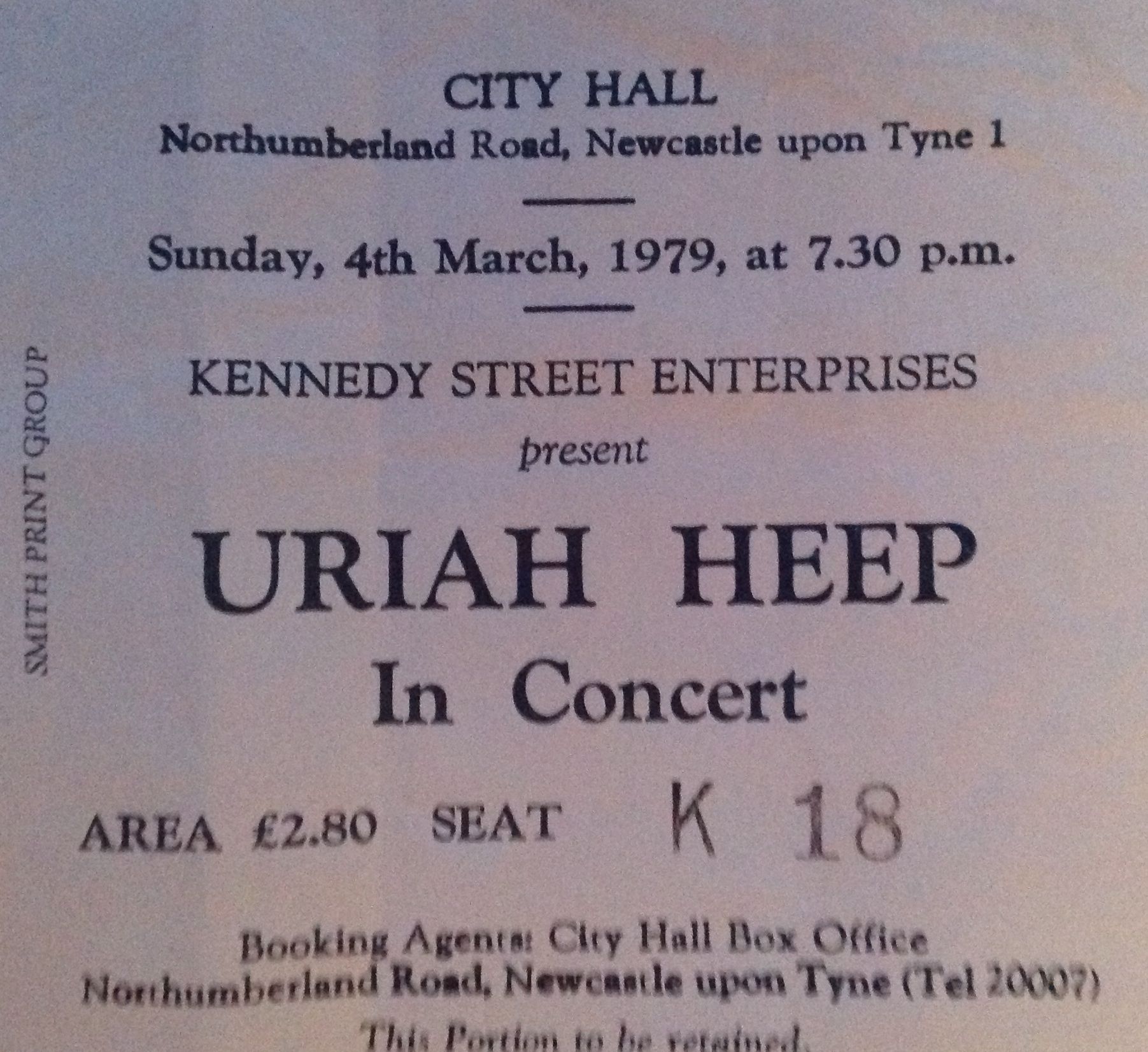
Uriah Heep Newcastle City Hall 4th March 1979
Uriah Heep Newcastle City Hall 4th March 1979
 Support from Bram Tchaikovsky
I saw the John Lawton era Uriah Heep once more, at a concert in 1979 at Newcastle City Hall. At the end of 1978 Heep released Fallen Angel, their third studio album with this lineup lineup. The album was well received although it did not chart and Mick Box said that he thought it was “Too poppy.” Uriah Heep continued to tour and were as always, great in concert, but behind the scenes there was unrest. Ken Hensley was writing most of the material and as a result he was earning much more than his colleagues. Box is quoted as saying: “Everything he wrote, he had to use… And if you insist in using everything you end up with substandard albums.” But the relationship between Hensley and new singer John Lawton was the worst problem within the band. There was apparently “constant friction between the two, resulting in the nearest thing to violence the group had seen” and Lawton was eventually sacked in August 1979 after a festival in Belgium. Long time drummer Lee Kerslake also left the band shortly afterwards, after a row with the management, over the constant apparent insistence on the use of Ken Hensley’s songs.
 The replacements were ex Lone Star front man John Sloman on vocals, a young rock singer, and drummer Chris Slade from Manfred Mann’s Earth Band. However, Ken Hensley was soon unhappy with the new singer…but more of that tomorrow. It must have been fun to be a member of Uriah Heep at the time 🙂
Support for the 1979 tour, including the City Hall show, was guitarist/singer Bram Tchaikovsky who was at the time fronting his new power pop band, having recently left the successful punk/pub rock band, The Motors (Airport!)
Typical Uriah Heep setlist from 1979: Look at Yourself; Easy Livin’; Stealin’; Falling In Love; Woman Of The Night; Lady In Black; The Wizard; July Morning; Free Me; One More Night; I’m Alive; Who Needs Me; Sweet Lorraine; Free ‘N’ Easy; Gypsy
 Vintagerock's Weblog.