Anderson Bruford Wakeman Howe Whitley Bay Ice Rink 20th October 1989
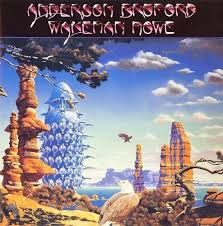 By 1988 Jon Anderson had become disillusioned with Yes, who now consisted of himself, Trevor Rabin on guitar, Tony Kaye on keyboards, Chris Squire on bass and Alan White on drums. Rabin and Squire were taking the band in a more rock-oriented direction, and Anderson wished to return to the more traditional Yes sound. He left the band, initially intending to record a solo album. He was soon joined by previous Yes members Bill Bruford, Rick Wakeman and Steve Howe. The band recorded one album, “Anderson Bruford Wakeman Howe” and went out on tour, advertising the shows as “An Evening of Yes Music Plus”. Chris Squire and co filed a law suit which attempted to prevent them using the name “Yes” in any of the publicity, however the tour went ahead. The UK leg of the tour started with a concert at Whitley Bay Ice Rink, then visited Edinburgh Playhouse, Birmingham NEC and closed with three nights at Wembley Arena. The Whitley Bay show was not very well publicised: I think it was added to the itinerary at the last minute, and as a result it was poorly attended. The cold, cavernous ice rink was never a great concert venue, and the sound wasn’t good. However, it was wonderful to hear those Yes classics again. They started by going back to the early days with “Time and a Word”, played “And You and I”, “Close to the Edge” and “Heart of the Sunrise”, and the more recent “Owner of a Lonely Heart”. Steve Howe performed both “Clap” and “Mood for a Day”. They also played several new songs which featured on the “Anderson Bruford Wakeman Howe” album. The encores were “Roundabout” and “Starship Trooper”. The four Yes members were augmented by additional musicians including Tony Levin on bass. The concert reminded me just how great Yes were; “Heart of the Sunrise” is a particular favourite of mine, and I remember being knocked out by Jon’s performance of that song in particular at Whitley Bay.
Set 1: The Young Person’s Guide to the Orchestra (intro); Time and a Word; Owner of a Lonely Heart; Teakbois; Clap/Mood for a Day (Steve Howe); Gone But Not Forgotten/Catherine Parr/Merlin The Magician (Rick Wakeman); Long Distance Runaround; Birthright; And You and I; I’ve Seen All Good People;
Set 2: Close to the Edge; Themes; Brother of Mine; The Meeting; Heart of the Sunrise; Order of the Universe; Roundabout
Encore: Starship Trooper
9 Mar
Anderson Bruford Wakeman Howe Whitley Bay Ice Rink 20th October 1989
8 Mar
Yes Newcastle City Hall 2nd December 1980
Yes Newcastle City Hall 2nd December 1980
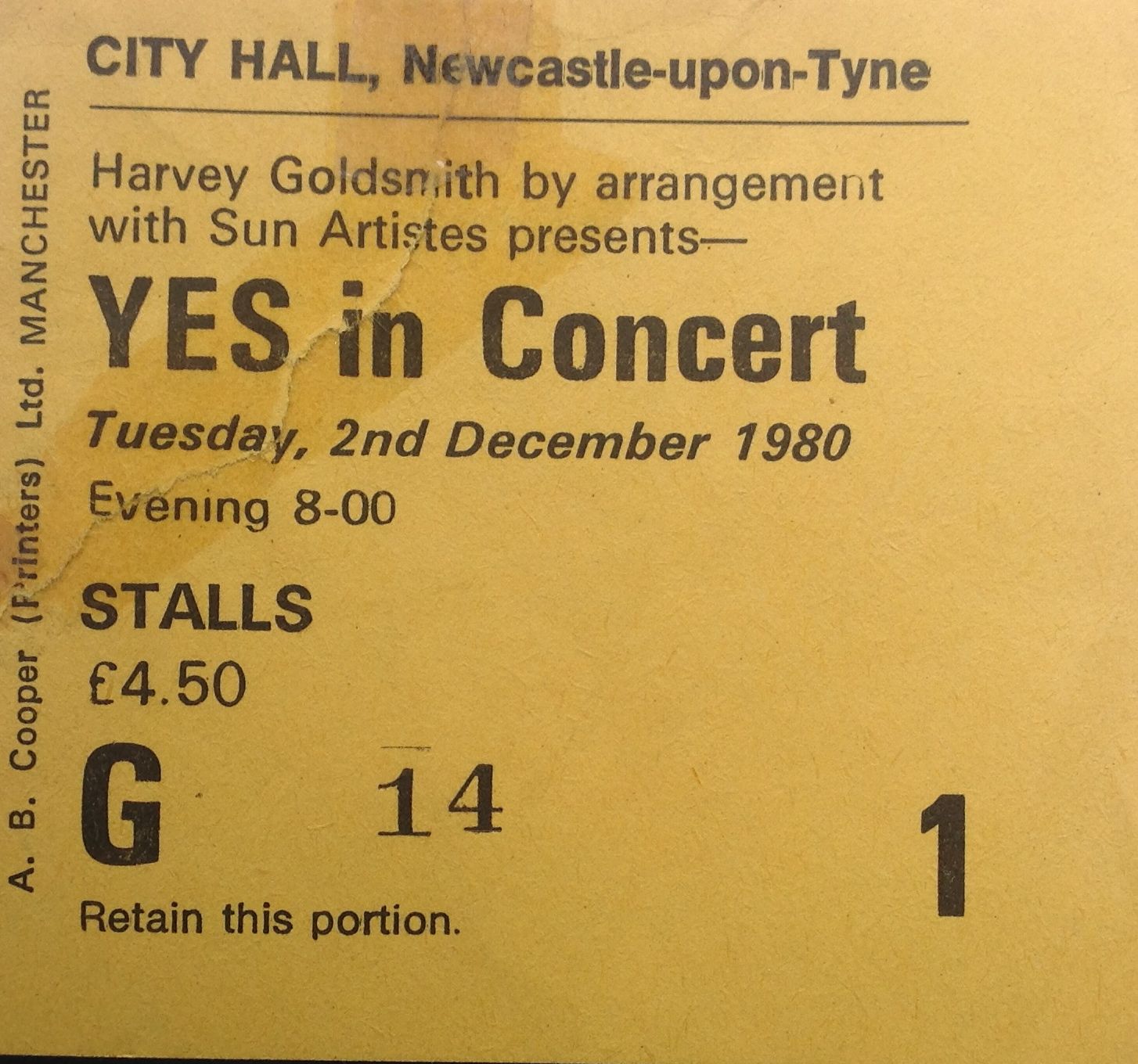 I missed the next couple of Yes tours. I had tickets for the “Going for the One” tour (with Donovan support) at Glasgow Apollo, but passed on it to see the Tubes at Newcastle that night. I also missed out on the Tomator Tour in 1978, which stopped off for four nights and a matinee at Wembley Arena; Yes’ only UK dates on that tour. I remember one of my mates went down to London for the matinee, returning the same evening. The next time I saw Yes was when they returned to Newcastle City Hall for three nights, as part of the Drama tour. By then Jon Anderson and Rick Wakeman had departed and been replaced by Trevor Horn and Geoff Downes of Buggles and “Video Killed the Radio Star” fame. The line-up was thus Chris Squire, Steve Howe, Alan White, Horn and Downes. Horn took vocal duties and Downes keyboards and synthesisers.
We went to the first concert of the three night run, and the City Hall was far from full. The line-up change was just too much for many Yes fans. There was (and still is) a very strong allegiance to Jon Anderson, and any line-up without him can never feel quite right. The fact that Jon and Rick had been replaced by Buggles seemed a step too far; the musical gap between the two bands was far too great. It didn’t feel right. We wondered what on earth this new line-up of Yes could possibly be like. 
Actually it was pretty good. Trevor Horn looked nervous, and his voice didn’t quite fit the Yes classics, but he did a great job in what must have been a very difficult situation. Geoff Downes was surrounded by keyboards and synths including a computer; which was probably the first time I’d seen anyone use one on stage. The set drew heavily from their new album “Drama” which featured the new line-up. I remember wondering if they would play “Video Killed the Radio Star”; they didn’t, but they apparently did play the song one night on the USA tour. They did play “Yours Is No Disgrace”, “And You and I”, “Starship Trooper” and “Roundabout”. I remember one of the new songs; “Into the Lens” was particularly good. An interesting concert. Chris Squire (now the only original member) definitely saw himself as the leader of the band; the programme made this very clear, starting with a picture of Chris and a statement about how he founded Yes. Yes split shortly afterwards, and would soon enter a very confusing phase of endless line-up changes. I lost touch with the band during that period. Their visits to the UK would become less frequent, as they concentrated on the American concert stage.
Setlist: Apocalypse; Does It Really Happen?; Yours Is No Disgrace; Into the Lens; Clap; And You and I; Go Through This; Man in the White Car Suite; We Can Fly From Here (a Buggles song); Tempus Fugit; Amazing Grace / Whitefish; Machine Messiah
Encore: Starship Trooper; Roundabout; White Car (a cappela)
7 Mar
The Enid Leeds Holy Trinity Church 6th March 2015
The Enid Leeds Holy Trinity Church 6th March 2015
 The Enid are truly back, ignoring their critics (as always), and playing their own brand of symphonic prog-rock in the way that only they can. But this time the critics are unanimous in their praise:
“The Enid have reaffirmed their place among the pantheon of Prog Gods” (Rachel Mann, Prog Magazine).
“The quintessentially English prog group” (Tim Jones, Record Collector Magazine).
“The most majestic rock band of all time” (Band On The Wall).
Enid founder Robert John Godfrey has assembled a new line-up which rivals all previous incarnations of the band. The musician is, without exception, superb and, in Joe Payne, they have discovered a front man who is simply astounding in his stage-craft, performance and vocal ability. They have recently completed a new album, “The Bridge”, which they are touring with at the moment. Robert John Godfrey calls “The Bridge” a “musical allegory” and says of it: “Bridging the gap between the arts and entertainment; the shallow and the deep; the brash and the sensitive. A place where history meets the future. A plea for open mindedness, tolerance and natural justice at a time when the world is sleep walking into the unknowable.”
Last night I went to see The Enid perform their “Bridge” show in Holy Trinity Church Leeds. The show was sold-out and the venue was perfect; Holy Trinity is an active Georgian church in the centre of Leeds. I drove down to Leeds and arrived around 7.30pm, the show was due to start at 8pm. The church was already full and I found myself a seat in a pew towards the back, making sure I had a clear view through the pillars.
Singer Joe Payne says of the new tour concept: “When we first discussed making an album of classical music, I insisted we perform this music exclusively in intimate seated venues. I grew up in the theatre, and hadn’t had much of a rock background before meeting The Enid. So I was determined to re-explore my roots and put on a really extravagant show….The set list must tell a story. The show must run seamlessly. No more ‘now we’re going to play this one, and then we’re going to play that one’. There will certainly be pieces from across The Enid’s back catalogue, but ultimately art must trump nostalgia. These shows will be our most ambitious since the Salome Ballet in the 1980s!”
The concert started in darkness with a grainy screen, mimicking the opening of a 1950s cinema newsreel, and with the traditional Enid anthem “Land of Hope and Glory” (ah, memories of the Reading festival and previous Enid triumphs). Then a video of Joe Payne, dressed as our vintage monarch, delivers a message “We are One. We Can Take It. We are One. We are Many” to her people. Godfrey opens “One and the Many” with quiet, exquisite piano, and then, creeping out of the darkness, appears a hooded Joe Payne; singing as he walks from the back of the church, in the highest, scariest yet sweetest soprano voice. I can’t describe how powerful this opening was.
 The mood was set for the rest of the evening. The performance was stunning, outstanding, mesmerizing. Each song “bridged” to the next with a short (semi-political) video, displayed on the multi-media screen behind the band. The visuals were superb, perfectly complementing the performance. So many influences came through; classical, prog-rock, Eastern, opera, church choirs, musical theatre, early-Genesis; yet the music is of its own. Concept pieces like this often come over as contrived and pretentious, and thus ultimately fail; this one doesn’t; it succeeds on every level. The Enid have created a show which exceeds all the superlatives that have been written about it, and lives up to the hype. In a couple of years they have gone from playing to a handful of people to selling out venues of a few hundred. I heard one guy say that he had flown from France for the show. Another said that he has seen the Enid three years ago at Leeds Irish Centre and that there were around 6 people in the audience.
At the end of the performance the audience stood and gave Godfrey and his creation thunderous applause, which lasted for several minutes. The encore was “In the Region of the Summer Stars” from their debut album.
I don’t recall exactly when I last saw the Enid. It was probably in the mid-’70s at either Newcastle Mayfair or the Reading festival, where they became big favourites. At that time they played all instrumentals. The Enid of today is a very different animal. I don’t think I have ever seen a band re-emerge in such a strong and perfect way.
The concert finished around 10.45pm. I drove home up a windy A1 and A19; back home around 12.30am.
The Enid are: Robert John Godfrey (keyboards), Joe Payne (vocals), Max Read (guitar, bass), Dave Storey (drums, percussion), Jason Ducker (guitar) and Dominic Tofield (bass, percussion, guitar).
Act I: Land of Hope and Glory; One and the Many; Terra Firma; Earthborn; Witch Hunt; Space Surfing; Malacandra; Dark Hydraulic
Act II: Wings; Something Wicked This Way Comes; Execution Mob; Leviticus; Someone Shall Rise; Judgement; Shiva
Encore: In the Region of the Summer Stars.
One of the best performances I have seen by any band in many, many years.
6 Mar
Yes Reading festival 23rd August 1975
Yes Reading festival 23rd August 1975
 This is probably my favourite Yes show. Not because it was their best performance, although it was pretty good. No, this show just felt right; one of those moments in time that worked. Yes were one of the biggest bands in the UK at the time, Reading was the most iconic festival of the mid-70s, and Yes headlined the Saturday night, which was seen as the “main” night. The rest of the line-up was strong, and the festival sold out in advance, which was unusual.
There was something special about Yes’ set that night. Although I’d already seen the band twice that year, I was still excited about seeing them. The crowd waited in anticipation, for what seemed like a long time; there was an hour or more delay while Yes set up their equipment and apparently insisted on using their own mixing desk, rather than the festival gear, which every other band used. It was worth the wait, although it started to rain, and continued to do so throughout Yes’ set. Yes had a spectacular laser show, the green lights cascading through the rain and across the field. The set was similar to that which they had played throughout the Relayer tour, although I think they played one new song “High Vibration” which was to appear on their next album “Going for the One”. Jon Anderson was amazing, his small figure picked out by the stage lights, and his gentle, sharp, shrill, sweet voice drifting over the field in the cool evening. “Close to the Edge” and “And You and I” we’re classic. Yes played until well after midnight which was the curfew, and their performance was, in the end, cut short. They returned to play a triumphant “Roundabout”. I think they also started to play “Sweet Dreams” but were prevented from doing so.
Robert Fripp of King Crimson was present and in a 1979 interview summed up his evening thus: “I went to the Reading Festival in August, 1975. A band came on stage who were actually friends of mine [I assume he is referring to Yes]. Anyway, we’d been waiting an hour-and-a-half while their laser show was being set up. I went out to the front. It began to rain. I was standing in six inches of mud. It was drizzling. A man over here on my right began to vomit. And a man over here on my left pulled open his flies and began to urinate on my leg.” A typical festival then 🙂
Dave Holmes tells a great story (on Forgotten Yesterday’s site): “Imagine my horror……,.when, at 12:23 as I recall, emerging from stage left, came the small, grey-suited and grey-haired figure of… my Dad! He walked straight up to Jon Anderson, mid-song, actually took the microphone off him, and made some kind of announcement to the audience about having to finish the concert. The rest of the band looked stunned and stopped playing. The stage lights went off, the crowd started booing and throwing cans of piss at the stage. That was the end of the set and the festival for the year. I didn’t know what to do, I was dying of shame…”
Happy days.
Setlist: Sound Chaser; Close to the Edge; And You and I; High Vibration; The Gates of Delirium; Leaves of Green; I’ve seen all Good People; Mood for a Day; Long Distance Runaround; Clap; Ritual (Nous Sommes du Soleil). Encore: Roundabout
5 Mar
Yes Stoke City Football Club 17th May 1975
Yes Stoke City Football Club 17th May 1975
 Support acts: Sensational Alex Harvey Band; Ace; Gryphon.
A month after seeing Yes at Newcastle City Hall I was off to see them again, this time at Stoke City Football ground. I drove down to the concert with my mate, both of us looking forward to seeing Yes again, and the added attraction of the amazing Sensational Alex Harvey Band. As soon as we arrived we found the nearest pub, where we were surprised to meet a bunch of lads from home, who were huge SAHB fans. We then had an argument about the relative merits of Yes versus Alex Harvey and co; such matters seemed very important at the time.
We entered the stadium and found a place on he pitch. First up was Gryphon whose medieval folk amused us; for some reason a lute, a bassoon and a tin whistle made a perfect start to the day. The weather was ok, quite sunny as I recall. Next was Ace, who pleased the crowd by playing “How Long” twice; once during the set, and again as an encore. Then came Alex.
A large Glaswegian contingent had travelled South to support Alex, Zal and the lads. They got very drunk and England vs Scotland scuffles started to break out among the crowd down at the front, close to the stage. Alex was having none of this. He stopped the song, I think it was “Framed”, pointed and stared the culprits and told them “Stop! No violence, or we don’t play any more” and the fighting ceased, just like that. Such was the power that Alex Harvey held over his audience. This was SAHB at their menacing best; Alex in his hooped t-shirt and jeans, scarf around his head, reading his philosophy to us from an old leather-bound book, Chris Glen wearing a jock strap of his jeans, and Zal in his green leotard complete with full evil harlequin make-up. Wonderful. “Don’t make wars. Don’t fight wars. And don’t pisch in the water”. They stole the show.
 Other memories of the day: lots of people openly smoking joints. A little guy in the middle of the crowd sitting with a stash of dope selling it to anyone who passed by. A young guy wearing a battered top hat, posing as a member of the drug squad, grabbing hold of people and “arresting them”, then laughing and telling them it was just a joke after all.
There was a long wait before Yes took to the stage, during which time the heavens opened and it started to pour with rain. The stage crew were brushing rain from the stage and trying to cover the band’s gear with polythene sheets. Yes eventually took to the stage, and had lots of problems with the sound, caused by rain on the equipment. Steve Howe, in particular, seemed to suffer a couple of small shocks from his guitar, and was obviously worried about the danger of electrocution. In the end, after soldiering on for 40 minutes or so, Yes abandoned the show, Jon Anderson promising us that they would return and play a free gig (I’m still waiting and still have my ticket stub, guys).
Then it was back into my little old red MG Midget, and up the A1. A great day.
The next time I saw Yes was three months later, this time at the Reading festival. I’ll write about that tomorrow.
Yes setlist (cut short due to rain): Sound Chaser; Close to the Edge; The Gates of Delirium; I’ve Seen All Good People; Mood for a Day; Long Distance Runaround; Clap; Ritual (Nous Sommes du Soleil); Roundabout
4 Mar
Yes Newcastle City Hall 17th April 1975
Yes Newcastle City Hall 17th April 1975
 Support: Gryphon
Yes returned to the City Hall to play three sold out shows in Spring 1975. Patrick Moraz had replaced Rick Wakeman, after the keyboard wizard had departed our prog heroes because of his dissatisfaction with the “Topographic Oceans” epic. I’d seen Patrick Moraz play in Refugee, taking the Keith Emerson role in the band which Lee Jackson and Brian Davison formed after the Nice split. So I knew how good a keyboard player he was. The line-up of Yes was now Jon Anderson, Chris Squire, Steve Howe, Alan White and Moraz. Yes had just released their seventh album “Relayer”. Steve Howe described Relayer as “very modern, European style of music, and Patrick brought in a South American flavour as well. It was a very international record”.
Support for the tour was Gryphon, a prog-rock band who fused Renaissance music with electric folk, playing medieval and modern instruments. I went to the final concert of the three-night run.
 After the marathon performance of “Topographic Oceans” on their previous tour, I was pleased, and somewhat relieved, that this time Yes chose to play a set which consisted of songs from throughout their career. “Close to the Edge” and “And You and I” were becoming concert favourites, and both songs showcased epic performances by Jon Anderson. “Mood for a Day” had replaced “Clap” as a vehicle for Steve Howe’s virtuosity, and “Long Distance Runaround” and “Roundabout” were ( and still are) classic Yes songs. I remember being particularly pleased that “Sweet Dreams” was played as the final encore, although a little disappointed that “Yours is no Disgrace” did not feature. A classic Yes gig, with the band back on form. I saw Yes on two further occasions in 1975, at Stoke football ground and at the Reading festival. I’ll write about the Stoke concert tomorrow.
Setlist:The Firebird Suite (intro music); Sound Chaser; Close to the Edge; To Be Over; The Gates of Delirium; I’ve Seen All Good People; Mood for a Day; Long Distance Runaround; Clap; And You and I; Ritual (Nous Sommes du Soleil)
Encore: Roundabout; Sweet Dreams
3 Mar
Yes and Tales from Topographic Oceans Newcastle City Hall 8th December 1973
Yes and Tales from Topographic Oceans Newcastle City Hall 8th December 1973
 The next time I saw Yes was during the “Tales from Topographic Oceans” tour when it called at Newcastle in December 1973. Yes returned to the City Hall for two sold out concerts on two consecutive nights. I went to the first night’s performance, along with a group of mates. This tour was a bold, possibly foolish, move by the band; they decided to play the whole of their new concept album during the second half of the concert. In many ways, this represented the ultimate in prog-rock pomposity and self-indulgence, and was one of several factors that made some young music fans tire of the bands of the time, and which would ultimately result in the emergence of punk rock. The first half of the concert was devoted to a run-through of Yes’ previous opus “Close to the Edge” which is a much more palatable musical piece than “Topographic Oceans”; the title track “Close to the Edge” is lengthy with meandering instrumental parts and several segments, but it does at least have a recurring melody and is actually a “song”. “Topographic Oceans” did not make for easy listening that evening. At the time it confused me.
 Was I witnessing a masterpiece, a ground-breaking piece of popular music which raised the level of the genre and truly synthesised rock composition with classical music? I must admit I found it hard going, and it is still one of my least favourite Yes albums. Of course the musical dexterity and technical virtuosity of the players was clear and fully on display that evening, but the soul of the music was lost in that very virtuosity. The day was saved by an encore of “Roundabout” which reminded me that the sharp, bright innovative Yes who astounded me a few years earlier still did exist, and that they could still fuse rock, jazz and pop and blend that mix with lyrics which hinted at hippy ideals and values, and yet at the same time confused me and took me through so many twists and turns.
Rick Wakeman tells a story of how he also lost faith in Yes in the mid-70s and famously ordered a take away curry, had it delivered to the City Hall, and ate it on stage while seated, surrounded by his vast array of keyboards and synthesisers and wearing his customary glitter cloak. This event may well have happened at this concert.
I longed to hear “Yours is no Disgrace”, “Astral Traveller” or “Starship Trooper”. More on Yes tomorrow.
Set 1: Introduction (The Firebird Suite): Close to the Edge; Siberian Khatru; And You and I; Close to the Edge
Set 2: Tales from Topographic Oceans: The Revealing Science of God (Dance of the Dawn); The Remembering (High the Memory); The Ancient (Giants under the Sun); Ritual (Nous Sommes du Soleil)
Encore: Roundabout
2 Mar
Yes Live 1969 – 1971
Yes Live 1969 – 1971
 I am going to spend a week or so reflecting on the Yes concerts I have attended. I’ve seen Yes 14 times and have always been a fan, although there are times that I lost touch with the band and their ever-changing line-ups. I am going to start with a little self-indulgence by recapping on three Yes concerts that I have already written about, as the band were supporting another act.
I was luckily enough to see Yes in the very early days. The first proper gig I attended was Yes (along with Roy Harper) supporting the Bonzo Dog Doo Dah Band at Sunderland Empire on 8th March 1969. Yes were simply a revelation for me that night; they fascinated me with their bright, sharp, jazzy mix of rock and pop. And they played some songs that I knew: “Something’s Coming” from West Side Story and The Beatles’ “Eleanor Rigby”. They also played the excellent “No Opportunity Necessary, No Experience Needed”, the Richie Havens song which appears on Yes’ second album, opens with the theme from the film “The Big Country”, and remains one of my favourite songs to this day. Yes had yet to release their first album, and the line up at that time was Jon Anderson, Chris Squire, Bill Bruford, Peter Banks and Tony Kaye. I was impressed by how Jon and Chris were dressed; Jon in a cool cheesecloth smock top and Chris sporting a natty hat and impressive flares and fringed boots.
 The next time I saw Yes was once again at Sunderland Empire, supporting the Nice on 1st February 1970. By now they were playing material from their second album “Time and a Word”; the set again included the excellent “No Opportunity Necessary, No Experience Needed”, “Then”, “Sweet Dreams” (an early single which has featured in their set off and on to this day), and “Astral Traveller”. There was an acoustic part to their set which featured the track “Time and a Word”.
I saw Yes again in 14th January 1971, supporting Iron Butterfly at Newcastle City Hall. By the time of this gig, guitarist Peter Banks had been replaced by Steve Howe, and the rest of the line-up was Jon Anderson (vocals), Bill Bruford (drums), Chris Squire (bass) and Tony Kaye (keyboards). Rick Wakeman was to join the band later that year. They were just about to release their classic third lp “The Yes Album”, and the set featured tracks from that new album and their previous two releases. They were just great that night. Their entrance on stage was heralded by the powerful “Also Sprach Zarathustra”. I think they opened with “Astral Traveller” and I also recall “Yours Is No Disgrace”, and “Clap” as highlights.  I was just blown away by Steve Howe’s performance of the latter song, and was fascinated by the semi-acoustic Gibson, complete with f holes, that he was playing. I remember the whole hall clapping along while he played. The song which most sticks in my mind was their version of Simon and Garfunkel’s “America”, which was simply majestic; almost symphonic. Yes went down well with the crowd; it was very clear that they already had a lot of fans and that they were on the verge of major success.
That major success soon arrived. Later in 1971, Rick Wakeman joined, and Yes released their fourth album “Fragile”. “Fragile” was the band’s greatest success to date, reaching No. 7 in the UK, and included one of their most well-known songs “Roundabout”. Yes returned to the City Hall later in 1971 (thanks to Mitch for the picture of his flyer for that gig); for some reason I missed that gig. The next time I saw Yes was at the time of their 6th album “Tales from Topographic Oceans”. I’ll write about that show tomorrow.
1 Mar
Steppenwolf Newcastle Mayfair 6th October 1972
Steppenwolf Newcastle Mayfair 6th October 1972
 “Born to be Wild” was a big song in the early ’70s. We’d seen Easy Rider, with Peter Fonda riding his Harley to the song, and Slade would close their set with their version of the song. Everywhere we went it was played. So a chance to see the legendary American masters of biker rock and heavy metal thunder, Steppenwolf, in Newcastle Mayfair ballroom wasn’t to be passed on. The Mayfair was packed; I got myself a spot close to the stage and waited for what seemed like hours (and probably was) for the band to take the stage; bands came on late at the Mayfair, probably around 11pm, and the venue was open until 2am. There were a lot of songs which were unfamiliar to me, but I recognised the doomy anti-drug anthem (God Damn) “The Pusher”, and “Magic Carpet Ride” with its great swirling organ intro and which was a minor UK singles chart hit in the late ’60s. The encore was of course “Born to be Wild” and the Mayfair crowd did exactly that; went wild and crazy. Front man John Kay looked super cool; all in black leather with dark shades. Steppenwolf performed “Born to be Wild” on the Old Grey Whistle Test during their visit to England; you can see it here: https://www.youtube.com/watch?v=V_8hAfRrTJ0 I just watched it and it brought back great memories of the Mayfair gig.
A Steppenwolf setlist in 1972 would be something like this: Sookie Sookie; Ride With Me; Foggy Mental Breakdown; Tighten Up Your Wig; Ball Crusher; Shackles and Chains; Monster / Suicide / America; The Pusher
Encore: Magic Carpet Ride; Born to Be Wild; Hoochie Coochie Man
Line-up at the time: John Kay (vocals); Kent Henry (guitar); George Biondo (bass); Goldy McJohn (keyboards) and Jerry Edmonton (drums).
Steppenwolf split in 1972, but reformed in the mid-’70s. Marie and I saw the reformed band when the returned to the Mayfair in, I think, 1975.
“Like a true nature’s child, We were born, born to be wild, We can climb so high, I never wanna die.
Born to be wild, Born to be wild”
(Born to be Wild, Steppenwolf, 1968)
28 Feb
Yazoo Newcastle City Hall 19th November 1982
Yazoo Newcastle City Hall 19th November 1982
 Yazoo were the British synthpop duo formed by Depeche Mode member Vince Clarke (keyboards) and Alison Moyet (vocals). They came together in late 1981, and over the next 18 months they made two albums which blended Clarke’s synthesizers and pop tunes with Moyet’s bluesy vocals. They had big single hits with “Only You”, “Don’t Go” and “Nobody’s Diary”. From the official Yazoo site: “I put an ad in Melody Maker looking for a semi-professional band,” say Alison “Not someone who’d just had a massive hit album.” Vince: “I’d heard Alison perform under various guises and I knew she was an amazing singer,” Vince recalls. “I wanted songs to be sung with a lot of emotion. I didn’t know how it would work, but I wanted to try.” Schooled in the ideologies of the “splendidly low rent” punk scene, Alison was hardly looking for stardom: “Ambition was wanting to move up from being third on the bill at a pub to headlining at a pub,” she recalls. “Vince was an anomaly – he’d taken it to the next level with Depeche Mode and achieved success at a point when, for me, there was nothing cool about being on Top Of The Pops. But when he got in touch, there was a certain perverse appeal in trying something I’d never done before. It’s almost freak like, this idea of someone from Basildon moving out and actually doing something. I found it incredibly compelling.”
 On stage Yazoo incorporated a slide/film visual display, using seven slide projectors and film projectors. The films and slides were (back) projected onto five screens at the back of the stage. From a review of the time: “Three of the projectors produce most of the animated effects on the centre screen and there are approximately 350 different slides seen in each set. The screens are used to display various pieces of photography and graphics, which ‘sort of’ relate to the music.” A great concert by an excellent pop act. Yazoo split acrimoniously in May 1983; however they have reunited to play a series of concerts in recent years.
Setlist: Situation; Too Pieces; Goodbye Seventies; Winter Kills; Bad Connection; Tuesday; Bring Your Love Down (Didn’t I); Midnight; Chinese Detectives; In My Room; Don’t Go; The Other Side of Love; Ode to Boy; Only You; Situation.
 Vintagerock's Weblog.