Paul McCartney Knebworth 1990
 The next time I saw Paul McCartney was in 1985, at Live Aid in Wembley Stadium. On that occasion he sang “Let It Be”. There was no sound for the first verse of the song, and the crowd started booing. Paul must have wondered what was happening. I next saw McCartney as part of a multi-act bill at a massive show at Knebworth in 1990. This was the Silver Clef Award Winners Concert and had an amazing line-up including Pink Floyd, Cliff Richard & The Shadows, Tears for Fears, Eric Clapton, Dire Straits, Elton John, Genesis, Ray Cooper, Robert Plant (with guest Jimmy Page), and Status Quo. Pretty strong bill! I won a pair of free tickets in a competition; I think is was with KitKat, and Marie and I went down for the weekend. This was a great concert, which deserves a blog post of its own. I’ll save that for another day, and limit my reflections today to McCartney’s part of the day. Paul McCartney World Tour set out on a worldwide concert tour during 1989 and 1990, and the Knebworth show came towards the end of the tour. It was McCartney’s first major tour outing in ten years, and his first tour under his own name (rather than Wings). During this tour Paul finally embraced his Beatles legacy and for the first time, he played a substantial number of Beatles songs, including some written by John Lennon, as a tribute to his friend.
 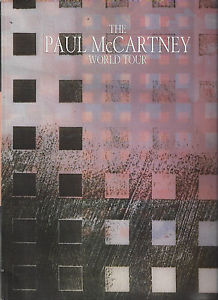 The band featured Paul and Linda McCartney, Hamish Stuart from the Average White band (backing vocals, guitars), Robbie McIntosh (guitar), Paul “Wix” Wickens (keyboards), and Chris Whitten (drums). The set at Knebworth was a shortened version to that featured on the rest of the tour, but still featured some great Beatles songs. Marie and I were towards the back of the field; I remember looking across the crowd as everyone sung along to Hey Jude and Strawberry Fields. A great moment, which was then followed by a set from Pink Floyd who closed the show. The programme for the tour is a lavish booklet, which was given out free of charge at the concerts. I didn’t see any at Knebworth, but managed to pick up a copy at a car boot sale a few years ago. It contains the tour itinerary, lengthy profiles of each band member, descriptions of the stage and logistics, and many pages of McCartney’s reflections upon his life and career, illustrated with many photographs. Setlist at the Knebworth concert: Coming Up; Back in the U.S.S.R.; I Saw Her Standing There; We Got Married;Birthday; Let It Be; Live and Let Die; If I Were Not Upon the Stage; Hey Jude; John Lennon Tribute Medley: Strawberry Fields Forever; Help!; Give Peace a Chance; Yesterday; Can’t Buy Me Love.
Posts Tagged ‘prog rock’
1 Dec
Paul McCartney Knebworth 1990
23 Nov
Manfred Mann’s Earth Band Newcastle City Hall 1978 and 1979 (and Reading 1976)
Manfred Mann’s Earth Band Newcastle City Hall 1978 and 1979 (and Reading 1976)
 Manfred Mann’s Earth Band were, to some extent, a natural progression from the highly successful Manfred Mann band which had all those 60s hits. The Earth Band saw a complete change of line-up, apart of course for Manfred himself, and a change in a style from straight pop to a rockier more progressive style. A hint of Manfred’s jazz influences, which he explored more fully in the predecessor band Manfred Mann’s Chapter Three, also emerged now and then. The Earth Band retained Manfred’s approach of reinterpreting the songs of other great artists (eg Dylan and Springsteen). I first saw Manfred Mann’s Earth Band at the Reading Festival in 1976. That was at the time of the “Roaring Silence” album.
  They had just released Springsteen’s “Blinded by the Light” as a single, which was to be their second UK chart entry (“Joybringer” was a hit in 1973). The line-up at the time was: Manfred Mann (keyboards, backing vocals); Colin Pattenden (bass); Dave Flettz (lead guitar); Chris Thompson (vocals, guitar) and Chris Slade (drums). Live favourites during this period were their interpretations of Springsteen’s “Spirit in the Night” and “Blinded by the Light”, and “Davy’s on the Road Again”. Manfred still played Dylan’s “Mighty Quinn” from his 60s catalogue, usually as part of the encore.
  I saw the band again at concerts at Newcastle City Hall in 1978 and 1979. The 1978 tour was promoting the “Watch” album and the 1979 outing was at the time of “Angel Station” (these were the Earth Band’s 8th and 9th albums). The line-up had changed a little by 1978 with Pat King playing bass. By 1979 John Lingwood was on drums, and Steve Waller was on guitar. My 1979 programme contains a flyer for a band called “Darling” who I imagine must have been the support act that year. Manfred Mann’s Earth Band were a great live act, and massively successful during the 70s.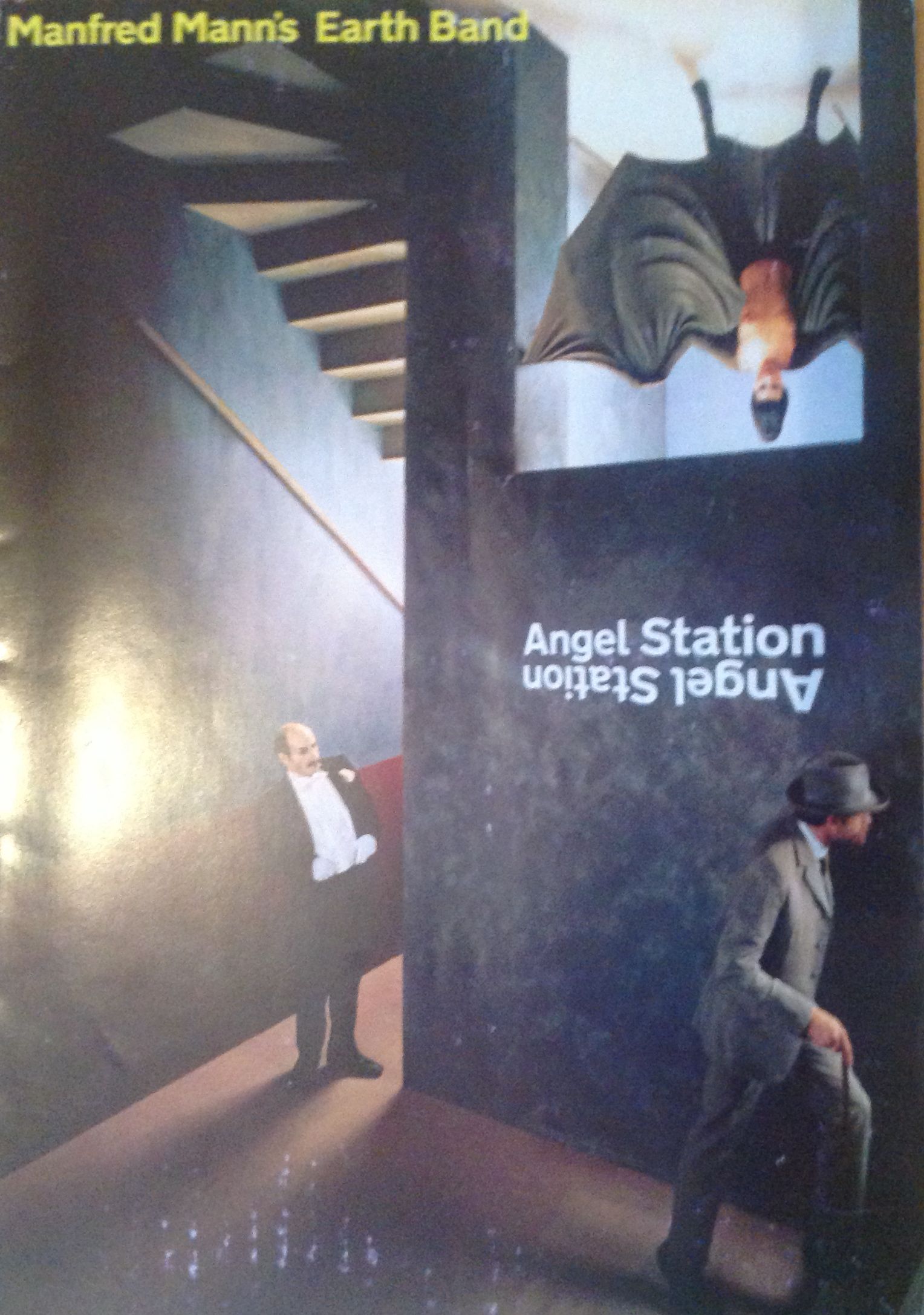
Manfred Mann’s Earth Band continue to play to this day, largely on mainland Europe with occasional visits to the UK; only Manfred remains from the 70s line-up. They are another band who I really need to make the effort to see again.
Typical set list (from a show in 1979): The Good Earth; Angels at My Gate; Davy’s on the Road Again; Chicago Institute; Spirit in the Night; Don’t Kill It Carol; Father of Day, Father of Night; Martha’s Madman; You Angel You; Blinded by the Light. Encore: Quinn the Eskimo (The Mighty Quinn); Eastbound Train (Hobo Bill); Step by Step.
18 Nov
Morgan. Gypsy, Morgan & Mark Ashton Sunderland Polytechnic Wearmouth Hall 27th May 1972
Gypsy, Morgan & Mark Ashton Sunderland Polytechnic Wearmouth Hall 27th May 1972
 I’ve spent this week reflecting on Mott the Hoople, as part of my coverage of bands I’ve seen in concert beginning with “M”, and in the run-up to seeing Mott in concert once again, at Newcastle City Hall last night. This brought to mind another Mott-related band, Morgan. Morgan were a prog-oriented band formed by keyboard player Morgan Fisher, in the period between his spell with chart-toppers The Love Affair and joining Mott the Hoople. I saw Morgan on a triple bill with Gypsy and Mark Ashton, at Sunderland Poly Students Union in May 1972.
Morgan were formed in 1972 by keyboardist Morgan Fisher, drummer Maurice Bacon (both of The Love Affair), bassist Bob Sapsed and singerTim Staffel (who came from Smile, the pre-Queen outfit of Brian May and Roger Taylor). They released their debut album in 1972 called “Nova Solis”. I’d never seen The Love Affair, and was looking forward to seeing Morgan. Their music was typical ’70s progressive rock. I remember Morgan himself being surrounded by lots of keyboards (the album features a Hammond organ, a Moog synthesizer, a mellotron, and piano). I was pretty impressed by them; they were quite like Yes, ELP, the Nice and King Crimson; all favourites of mine at the time. I remember going along hoping that they would play “Everlasting Love” (of course that was foolish and no of course they didn’t play it), and being quite pleasantly surprised just how different they were from The Love Affair.
First up that night was Mark Ashton, who had just left Rare Bird (of “Sympathy” fame) to follow a solo career. Headliners for the night were Gypsy, a psych rock band from Leicester. They were quite popular at the time, and gigged a lot up and down the country. I remember that I’d gone along mostly to see Morgan, and it is Morgan that stick in my mind as the best band of the three that night. It all seems so long ago now; it all seemed so new and exciting at the time. Morgan also appeared in the “Giants of Tomorrow” tent at the Lincoln Festival in 1972.
26 Oct
Roy Harper Manchester Bridgewater Hall 25th October 2013
Roy Harper Manchester Bridgewater Hall 25th October 2013
 It’s interesting seeing how time has affected some of my old heroes, as they reach their later years. In some cases their health has failed, and their performance and voice is a shadow of former glories; while for others, the years have been kinder and maturity and experience of stage and life have added to their concert outings. Roy Harper is in the latter category. He looks well; slim, fit, alert and his wit, sarcasm and performance are as engaging as they ever were. The young angry folk singer that I first saw almost 45 years ago seems a wiser, calmer soul, at peace with himself, his music and the friends who filled Manchester’s Bridgewater Hall to see him perform, chat with him. harangue him, and listen to songs old and new.
I arrived late, just before 8pm and a couple of minutes before Roy joined special guest Jonathan Wilson on stage. The roadworks have returned to the M62, and the pouring rain and spray slowed my journey across the Pennines. As Roy joined us, a lady came down to the front and handed him a couple of roses; he took hold of both her hands and thanked her before he started the first song. A fitting start to the evening. Like all Roy Harper concerts these days, there is a feeling of a coming together of friends, reinforced by the usual Harper banter between the man and his audience. “Show us your bus pas Roy” shouted one guy. “Hold on. I may just have it on me.” replied Roy. He did, and he held it up for all of us to see. Roy has been playing a short tour of three dates to promote his new album “Man & Myth” which has been receiving great reviews from critics and fans alike.  The tour started at the Festival Hall a few days ago, popped into his hometown of Manchester last night, and rounds off in Bristol tomorrow. Being the only northern date, it attracted fans from all over the north of England and several Scottish hecklers were in attendance. Roy has been accompanied by Jonathan Wilson and a string and brass section for the concerts. He opened with old favourite “Highway Blues”, and his set also featured several songs from the new record: The Enemy, Time Is Temporary, Heaven Is Here, January Man, and The Stranger. This was the first time that I’d heard the new tracks, and they all sounded strong, and quite typical Roy. There was a short interval. Roy also sang old favourites “Girl from the North Country”, “Another Day” and closed with “Me and My Woman”, all of which benefited from the strings and horns. He returned to sing a beautiful version of “When an Old Cricketer Leaves the Crease”, and thank us all for coming “I’d like to do it again; if the scales come out right and allow me”. He admitted to being quite nervous about playing in his home town. He needn’t have been. This was classic Roy at his best.
The concert finished just after 10.30pm. I was expecting to get home by 1am, but there was an accident on the A1 near the Harrogate turn off, which caused a 10 mile tail back and a 2 hour delay. I finally reached home at 3am.
20 Oct
Camel Harrogate Royal Hall Oct 19th 2103
Camel Harrogate Royal Hall Oct 19th 2103
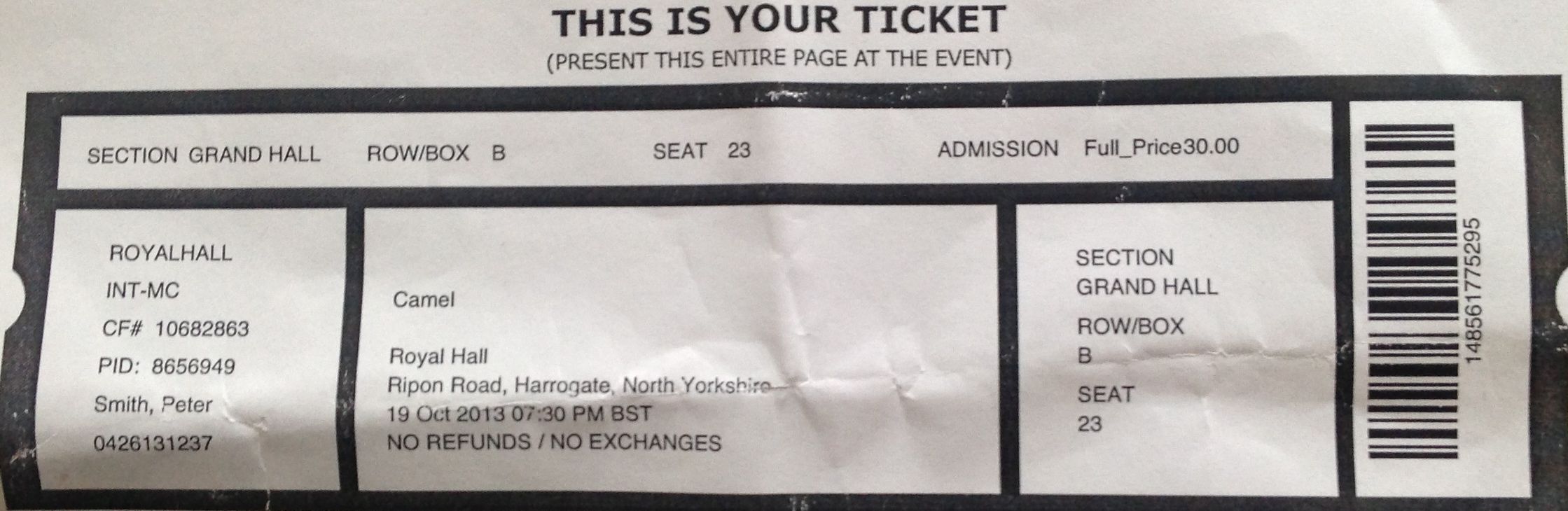
 Last night I renewed my acquaintance with the band Camel, who opened their UK tour with a concert at Harrogate Royal Hall. I saw Camel 5 or 6 times in the 70s, but can’t claim to be a massive fan. The last time I saw them was in 1979 at Newcastle City Hall. Camel guitarist front Andrew Latimer has been battling illness for many years, and for that reason the band have not performed for 10 years. He has regained his health and is taking Camel out on the Road, playing their epic Snow Goose album in full in tribute to his friend and former Camel original member Peter Bardens who died of cancer some years ago, and in celebration of a career spanning more than 40 years. The current line-up of the band is: leader and original member Andrew Latimer (guitar, vocals), long time band member Colin Bass (bass vocals), with Denis Clement (drums), Guy LeBlanc (keyboards) along with keyboardist and special guest Jan Schelhaus. A statement explains: “The evening pays tribute to former band member Peter Bardens, who died of cancer at the same time as frontman Latimer was battling a terminal illness. Ten years later, Latimer has regained health and is willing to celebrate a career that spans over four decades. This two-set show will also embrace compositions recorded throughout those years in a personal covenant of appreciation for a deeply rewarding life of music.”
The entire tour is sold out; the band retains a strong and loyal fan base.
My mate Norm decided to come along for the ride, and we drove down the A19; arriving around 7.30. I went straight into the Royal Hall, which is a beautiful restored old venue, and took my seat in the front row. The band had just taken the stage and were playing their classic Snow Goose album. Norm walked up the road to a local hostelry. I’ve been playing the Snow Goose for the past couple of weeks to familiarise myself with the tracks. This concept album is based on the short story by Gallico, and is classic 70s progressive rock; led by Latimer’s soaring guitar, and with the highs, lows, and intricacies that you would expect of the genre. Purely instrumental it stands as a great example of the period and of orchestral rock. Last night Camel performed the piece perfectly to the delight of the crowd who sat intently throughout, giving the band a tremendous ovation at the end of each section.
 “The Snow Goose: A Story of Dunkirk is a short novella by the American author Paul Gallico. It was first published in 1940 as a short story in The Saturday Evening Post, then he expanded it to create a short novella which was first published on April 7, 1941. The Snow Goose is a simple, short written parable on the regenerative power of friendship and love, set against a backdrop of the horror of war. It documents the growth of a friendship between Philip Rhayader, an artist living a solitary life in an abandoned lighthouse in the marshlands of wartime Essex because of his disabilities, and a young local girl, Fritha. The Snow Goose, symbolic of both Rhayader (Gallico) and the world itself, wounded by gunshot and many miles from home, is found by Fritha and, as the human friendship blossoms, the bird is nursed back to flight, and revisits the lighthouse in its migration for several years, as Fritha grows up. Rhayader and his small sailboat eventually are lost in the British retreat from Dunkirk, having saved several hundred men. The bird, which was with Rhayader, returns briefly to the grown Fritha on the marshes. She interprets this as Rhayader’s soul taking farewell of her (and realizes she had come to love him). Afterwards, a German pilot destroys Rhayader’s lighthouse and all of his work, except for one portrait Fritha saves after his death: a painting of her as Rhayader first saw her—a child, with the wounded snow goose in her arms.” (Wikipedia).
During the interval I popped out and met up with Norm, for a swift drink. In the second half of the show Camel played a selection of tracks from their large back catalogue. I should have invested more time listening to their material before the show, as most of the tracks were unfamiliar to me. Vocals were shared between Colin Bass and Latimer, but it was the latter who shone as the star of the show. His guitar playing was outstanding; I’d forgotten just how good he is. It looked like he was really enjoying himself, and that he couldn’t believe the crowd reaction. The stand out track for me was Mystic Queen from their first eponymous lp. Other tracks played included: Never Let Go, Echoes, Fox Hill (which was quite amusing) and closing song For Today. Encores were: Lady Fantasy and Never Let Go. After the gig I met up with Norm and we drove home, getting back around midnight. It was good to see Camel again. I need to spend some time listening to their early lps, as there are surely some gems therein.
13 Oct
Deep Purple Manchester Apollo Oct 12th 2013
Deep Purple Manchester Apollo Oct 12th 2013
 I decided at the last minute to go and see Deep Purple at Manchester Apollo last night. Its a couple of years since I’ve seen them and the nearest calling point of this year’s tour was Manchester. The concert wasn’t sold out, so I bought myself a standing ticket, printed it off on my computer. I was soon on my way down the A1 and across the M62 to Manchester, listening to “In Rock” as I drove down. I arrived just as support band Rockbox took to the stage. The Apollo seemed pretty full, with the stalls packed, and looking upstairs I could see very few empty seats. Rockbox were quite bizarre. They are a five piece; the singer used a loud hailer rather than a mike, and the four other guys were wearing red velvet school uniforms ala Angus Young, complete with devil horns and short trousers. The guitarist wore his amp in a satchel and had a speaker strapped to his belt. Two guys had drums hanging around their necks; one with a bass drum and the other with a snare and a couple of cymbals. And oh, there was also a guy with a huge horn, draped around him; I think it was a sousaphone. A pretty strange line-up and very different from the norm. Their set was all covers including Won’t get fooled again, Sgt Peppers, and Don’t stop me now. They went down well with the crowd, who found it good fun, and knew all the songs.
  I found a spot quite close to the stage, and Deep Purple came on bang at 9pm. They have just released a new CD “Now What?!” which is their 19th album, and their first for 8 years, and the set featured a few tracks from it. In fact, they started with a new song, which surprised me (and disappointed me a little as I was expecting usual opener Highway Star). Not to worry, however, as there were plenty of old classics for me. Each member took a solo during the set, which I usually find tiring, but last night the balance was OK, with each members instrumental piece working well, and not being over long. Favourites for me were (of course) all of the old ones: Strange Kind of Woman, Lazy, Into the Fire, Space Trucking, Smoke on the Water, and the encores Hush and Black Night. Ian Gillan’s voice was quite strong, with the usual screams intact. He is now in the habit of disappearing off stage between verses, presumably to take a rest, and a drink for his throat. They dedicated one of the new songs, Above and Beyond, to Jon Lord. Black Night closed the show at 10.45pm, and was just great. It took me a good 30 mins to get out of the car park; they pack the cars in nose to tail, so you are blocked in and can’t get out until everyone around you arrives at their car. I then got stuck in traffic driving through the city centre. I was home around 1.45am. It was good to see Deep Purple again, particularly in a relatively intimate venue. Just classic. The old ones are still the best. Setlist: Après vous; Into the Fire; Hard Lovin’ Man; Vincent Price; Strange Kind of Woman; Contact Lost (guitar Solo by Steve Morse); Uncommon Man; The Well-Dressed Guitar; The Mule (drum Solo by Ian Paice); Above and Beyond; Lazy; Hell to Pay (keyboard Solo Don Airey); Perfect Strangers; Space Truckin’; Smoke on the Water. Encore: Green Onions (Booker T. & The MG’s); Hush; (bass Solo by Roger Glover); Black Night
10 Oct
The Moody Blues Newcastle City Hall 1997 to 2006
The Moody Blues Newcastle City Hall 1997 to 2006
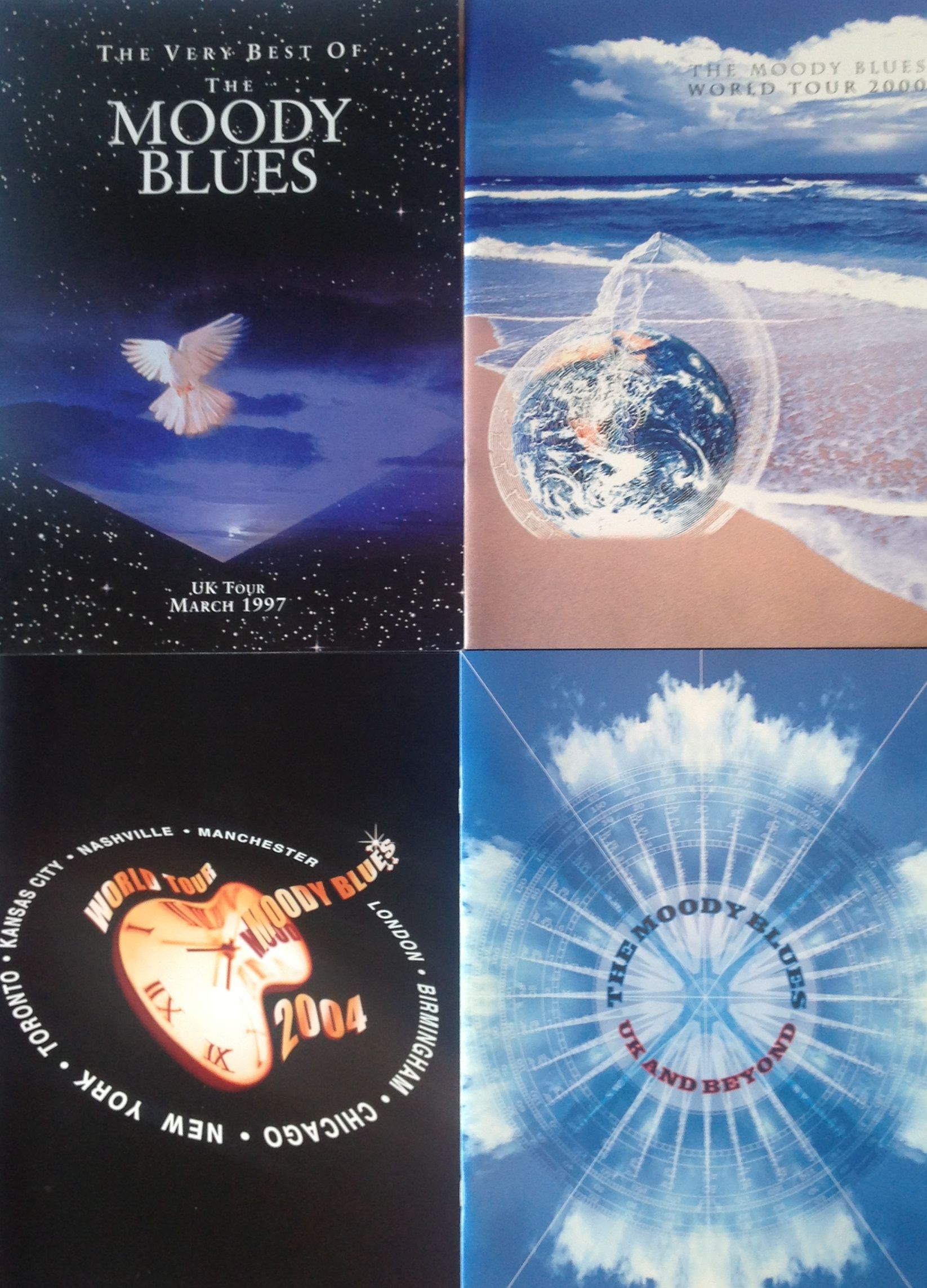
 I went to four Moody Blues concerts at Newcastle City Hall between 1997 to 2006: in 1997, 2000, 2004 and 2006. I saw them more recently at the same venue in 2008, and have already written about that concert. The line-up changed over the years, with Patrick Moraz leaving in 1991, and Ray Thomas retiring in 2002. The band continues with the trio of “original” members Justin Hayward, John Lodge and Graeme Edge. Of course the only member who has been with the band from the very start in drummer Graeme. Ray is a miss in the live shows, I found his songs quite different in style to those of Justin and John. Legend of a Mind (which I always thought was called “Timothy Leary’s Dead” 🙂 was a favourite of mine, even if does sound a little dated. I greatly enjoyed all of their gigs, even though the set was becoming predictable.
 Typical setlist: The Voice; Tuesday Afternoon; For My Lady; English Sunset; Words You Say; Strange Times; Steppin’ in a Slide Zone; Haunted; I Know You’re Out There; Story in Your Eyes. Intermission. Your Wildest Dreams; Isn’t Life Strange; The Other Side of Life; Nothing Changes; I’m Just a Singer; Nights in White Satin; Legend of a Mind; Question. Encore: Ride My See-Saw.
I’ve foolishly missed the Moody Blues the last couple of times that they have visited Newcastle. I must make the effort to see them next time. Nothing can touch the classic albums that the Moody Blues produced in the late 60s and very early 70s.
“Timothy Leary’s dead. No, no, no, no, He’s outside looking in. Timothy Leary’s dead. No, no, no, no, He’s outside looking in. He’ll fly his astral plane, Takes you trips around the bay, Brings you back the same day, Timothy Leary. Timothy Leary.” (Thomas, 1968).
9 Oct
The Moody Blues Newcastle City Hall 1981 and 1984
The Moody Blues Newcastle City Hall 1981 and 1984
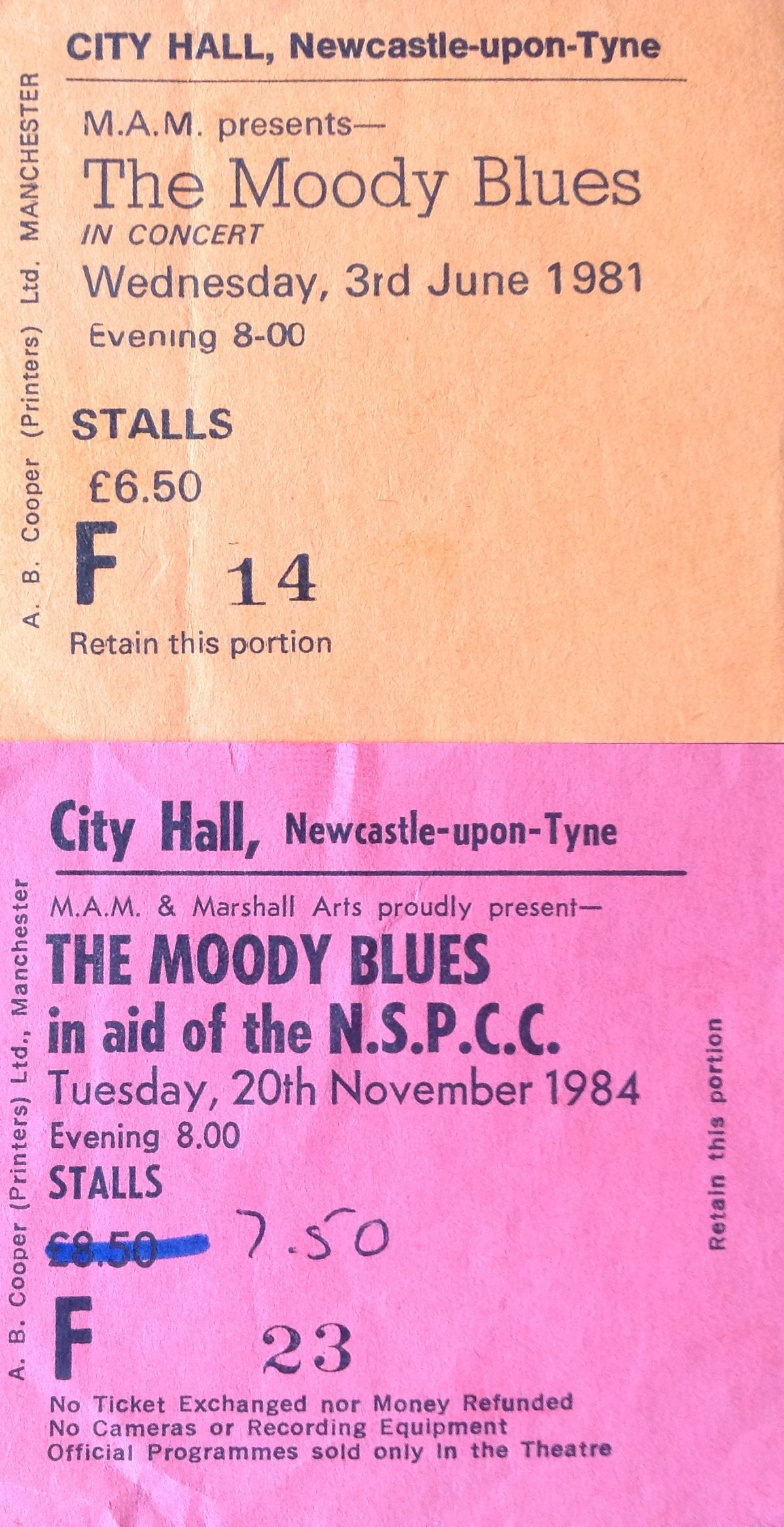 After not touring for a long time, the Moody Blues began to tour extensively, coming to the UK every couple of years. I saw them at Newcastle City Hall in 1981 and 1984. Their concerts started to take a similar format, which to some extent they still follow to this day, consisting of two sets with an intermission, and no support act. The setlist would consist of the classic tracks, with some new songs (less new songs these days). My favourite “Tuesday Afternoon” would come quite early in the evening, while one of the other songs I would wait to hear, “Nights in White Satin”, would be played towards the end of the show. The hit “Question” would be the last song, and the encore was always “Ride my See-Saw”, which is as much rock’n’roll as you will get in a Moody Blues concert. Predictable, yes, but also always high quality and always a good show. I find it strange how the Moodies have “disowned” their early incarnation, and never ever play Go Now or anything from their first album, “The Magnificent Moodies”. I have a copy of that 1965 debut lp, and its actually pretty good. I understand, of course, that the band changed out of all recognition in terms of membership and style in 1967, but it would still be good to see them play Go Now just once :), and, at least in the 1980s, two members (Ray Thomas and Graeme Edge) remained from that original 1960s line-up.
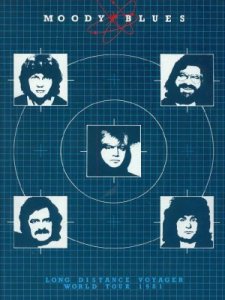 The 1981 tour was to promote “Long Distance Voyager” and the 1984 tour, which was in aide of NSPCC (the National Society for the Prevention of Cruelty to Children), promoted new lp (and they were still lps in those days) “The Present”. From the 1981 tour programme: “The Moody Blues blast off into musical orbit for ’81 with their first new album for two years, ‘Long Distance Voyager’ featuring ex-Yes Keyboard ace Patrick Moraz for the first time on record, in company with original members, Justin Hayward (vocals-guitar) Ray Thomas (flute) John Lodge (bass) and Graeme Edge (drums). Although the Voyager album is the group’s first original concept since ‘Octave’ in 1978, the group has been continuously in demand throughout the world and Moraz is already the veteran of several U.S. tours where the group retain legendary proportions.”
 From the 1984 tour programme: “The facts are that The Moody Blues have sold in excess of 30 million albums worldwide since their inception in 1964, that they have more platinum albums than any other surviving super-group and that their last release “Long Distance Voyager” was number one on the American charts. Their new LP, “The Present,” proves once again that The Moody Blues’ strong melodic structure within a rock framework has enduring appeal.”
Setlist from 1984: Gemini Dream; Sitting At The Wheel; Tuesday Afternoon; The Voice; Steppin’ In A Slide Zone; The Story in Your Eyes; Painted Smile; Reflective Smile; Veteran Cosmic Rocker; Driftwood. Intermission. Talking Out Of Turn; Running Water; Gypsy; Isn’t Life Strange; Blue World; I’m Just a Singer; Nights in White Satin; Legend of a Mind; Question. Encore: Ride My See-Saw
8 Oct
Blue Jays Newcastle City Hall 1975
Blue Jays Newcastle City Hall 1975
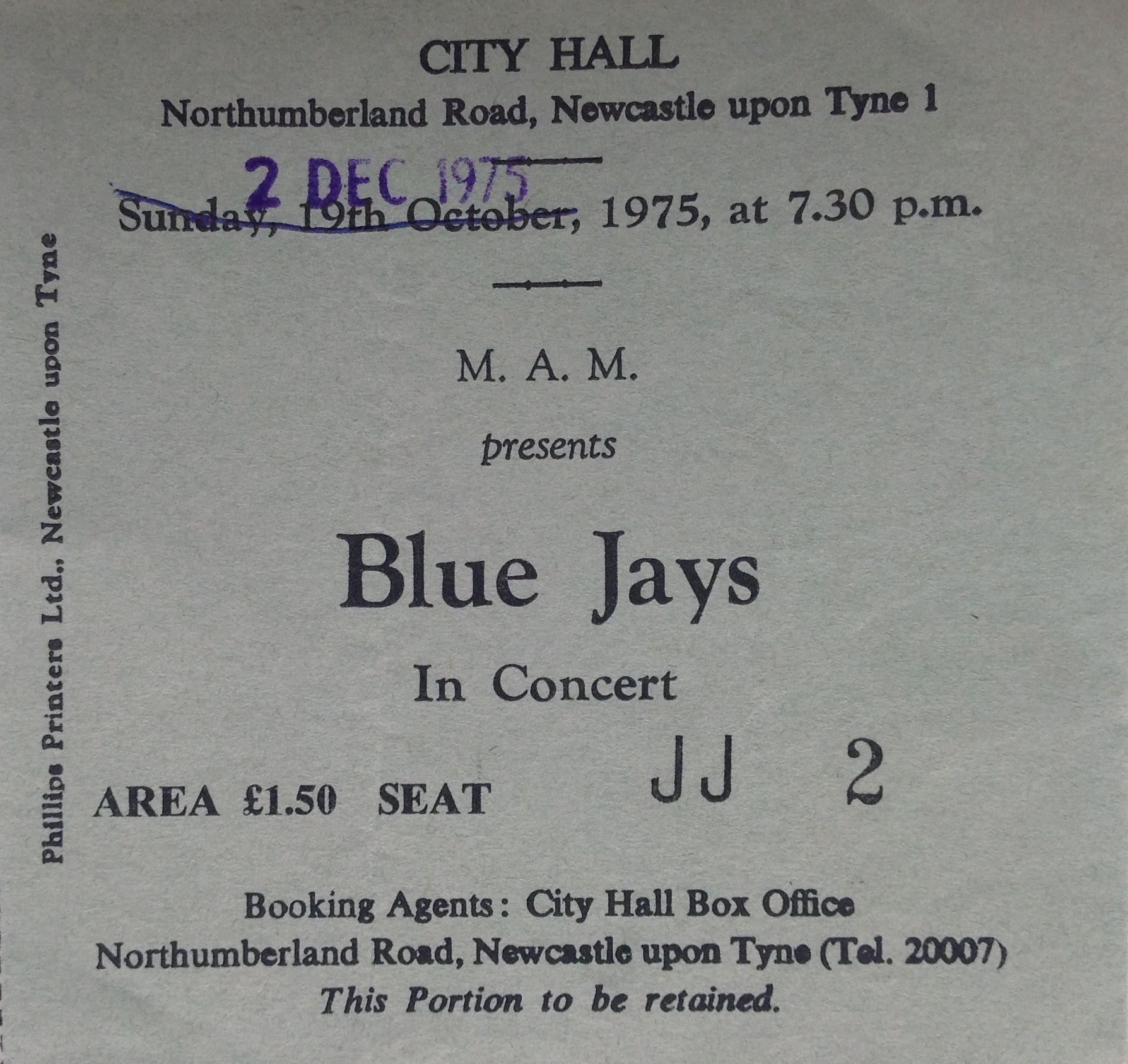 While we were waiting for The Moody Blues to return from their hiatus, Justin Hayward and John Lodge called at Newcastle City Hall, as the Blue Jays. Blue Jays is a 1975 album by Hayward and Lodge, which was recorded and released during the Moody Blues’ five-year break from recording, apparently in part for contractual reasons to fill the gap in Moodies output. According to Hayward: “I was under a lot of pressure from Decca to come up with something to release. So I actually went to America to do something with Mike [Pinder], between the two of us. Then Tony Clarke and John [Lodge] turned up at Mike’s house as well. Mike took me in the other room and said, “I don’t want to work with anybody else. I’m out of this project.” So then it became me and John and Tony Clarke, and we made an album called Blue Jays.” The title “Blue Jays” had a couple of meanings; first it is of course the name of a bird; secondly however it refers to the fact that the album was put together by the Moody Blues members whose names began with J; the (Moody) Blue J’s.
This was the closest we were going to get to seeing the Moodies in concert, indeed at that time I feared that they may never tour again, so my friend Ian and I took the opportunity to see two of their front men at our local venue.
The set comprised a mix of songs from the Blue Jays album, including the hit single Blue Guitar and some Moody Blues classics; including Nights in White Satin and Question. It was a great gig, and almost as good as seeing the full band (but not quite :)). Support came from Aj Webber.
 From the tour programme: “For Justin Hayward and John Lodge 1975 has been a year of change. At the end of the Moody Blues World Tour which ended in 1974 Justin and John took the first step on a road which has brought them to their current British tour. The step was an album conceived, written and recorded in their own Threshold recording studio. Today, the spirit of this album – which was baptised ‘Blue Jays’ – now begins to grow with Justin and John embarking upon a tour of Great Britain…Justin and John have a few good friends on the road with them. A few years ago during an American tour they met three musicians from Idaho – Jim Cockey, Tim Tompkins and Tom Tompkins. Jim, Tim and Tom have been part of the Threshold family ever since then – firstly through their own album, ‘Ever Sense The Dawn’ when they were a part of a band called Providence, and more recenly working with Justin and John on ‘BlueJays’. Two other old friends from the Threshold family are also with Justin and John on this journey – Mel Galley and Dave Holland from Trapeze.”
Setlist: Saved by the Music; Remember Me, My Friend; The Story in Your Eyes; This Morning; You; You and Me; My Brother; Isn’t Life Strange. Intermission. Who Are You Now; New Horizons; Emily’s Song; I Dreamed Last Night; Nights in White Satin; I’m Just a Singer; Blue Guitar; When You Wake Up. Encore: Question
7 Oct
The Moody Blues Glasgow Apollo 1979
The Moody Blues Glasgow Apollo 1979
 My parents got their first stereo system in the late 60s. It consisted of a Garrard turntable, a separate amplifier and a couple of speakers. Around the same time my uncle bought a lovely HMV Stereogram. It was a wonderful piece of equipment, which I now have in my record room upstairs, alongside a modern player and an old Dansette. I would play my records on our stereo system, and also take them down the street to play on my uncle’s Stereogram, to compare the sound and the stereo effects. The albums I had at the time were The Beatles White album, Tommy by the Who, the Crazy World of Arthur Brown, and Days of Future Passed by the Moody Blues. Days of Future Passed was my favourite. The album had been recorded to demonstrate the New “Deramic Sound System” and had set out to demonstrate the potential of stereo recording. The sound was unlike anything I had heard before. The symphonic arrangements, the blend of classic and rock, the way in which the sound was divided across the two stereo channels; it was like entering a whole new sonic world for the first time. And the songs; “Tuesday Afternoon”, “Dawn is a Feeling”, and “Twilight Time”, were just amazing. But best of all was “Nights in White Satin”. I love the song to this day, but from the moment I first heard it I was fascinated by its unearthly quality. It stood out from the rest of songs on the album.
The Moody Blues early 1970s UK tours missed Newcastle. They played the Odeon in 1969, but didn’t return to the North East until the early 1980s. They did play Leeds University a couple of times in the early 70s, but I was just a little too young to make the trip to Leeds to see them. They then went on a hiatus from 1974 to 1978. So I never got to see the Moody Blues until 1979 when they returned to promote their new album “Octave”. Their 1979 tour was short, only taking in three venues: Glasgow Apollo, Stafford Bingley Hall, and Wembley Arena. I had waited so long to see this band, so decided to make the trip to Glasgow Apollo for the concert.
 The “Octave” album featured the classic Moodies line-up of Justin Hayward on guitar and vocals, John Lodge on bass and vocals, Ray Thomas on vocals and flute, Graeme Edge on drums, and Mike Pinder on organ and synthesiser. Mike Pinder decided that he didn’t wish to tour, and was replaced by Patrick Moraz, who had just left Yes.
On the day of the gig, I picked up Marie from work at 4pm and we drove straight up to Glasgow. I got lost somewhere in the city, as I often have to this day, and we arrived late, missing the support act. Support came from the late Jimmie Spheeris who was an American singer-songwriter and released four albums in the 1970s. We had seats upstairs, with a pretty good view of the stage. The Moodies had a big sound system, with massive speakers hanging from the roof. It was the first time I’d seen anything on this scale in a concert hall. The set was a mix of old favourites, and tracks from “Octave”. Although the sound system was huge, I remember thinking that the sound level was quite quiet for a “rock” band. “Nights in White Satin” was my favourite, along with the last song “Question”. The encore was “Ride me See-Saw” which it has been each time I saw them.
It was great to see the Moody Blues after such a long wait, and they didn’t let me down. The Moodies toured a lot since the late 70s, often calling at Newcastle, and I have seen them several times since that night. I’ll reflect on those concerts over the next few days.
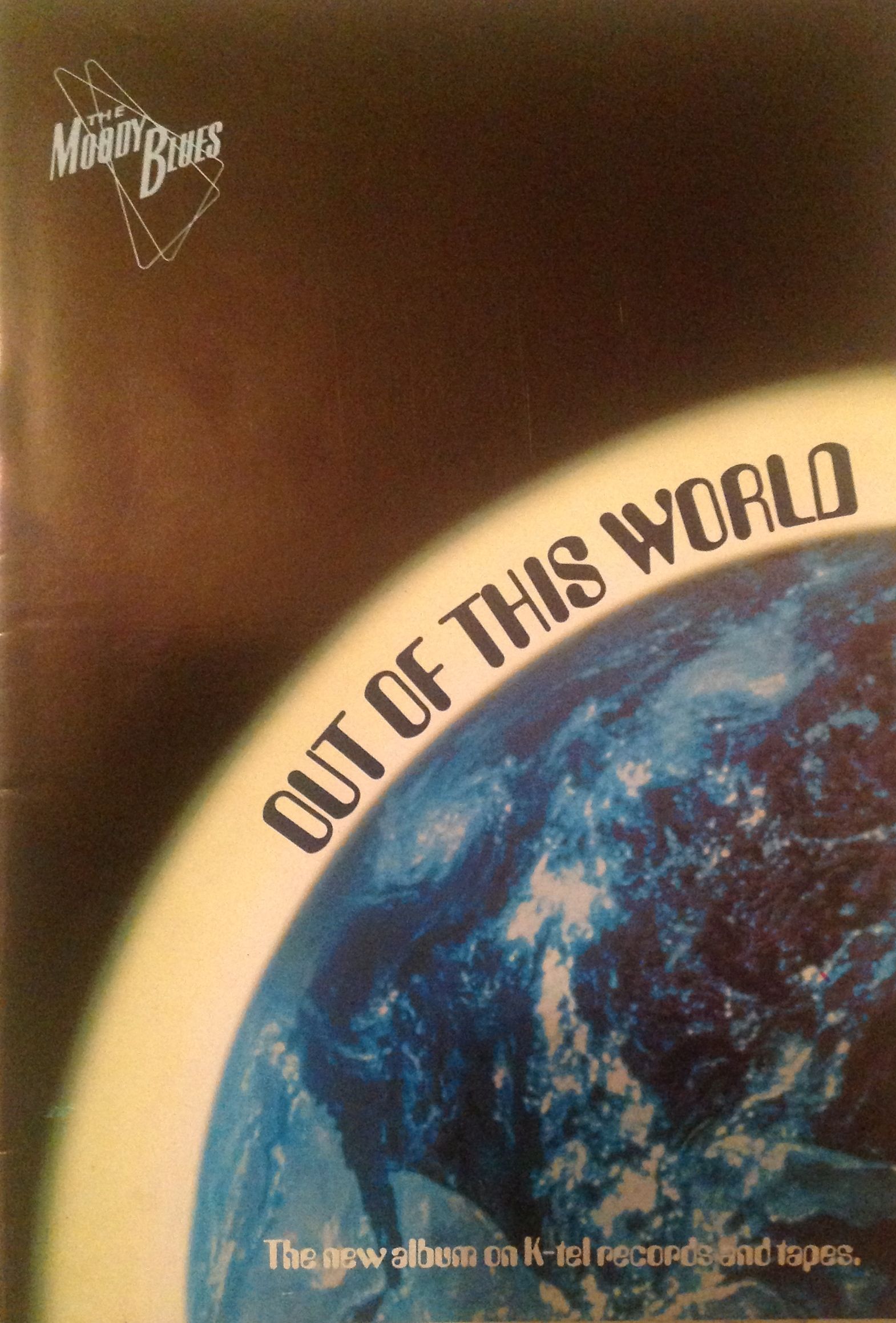
From the tour programme: “The legend that never really went away while their music lived on is now back live with Patrick Moraz in the keyboard seat and their first appearances in the U.K. for six years sealed by two capacity appearances at Wembley Arena in 1979…….now at the end of 1979, it’s time for Britain to welcome the Moody Blues back to the live stage. Inevitably, there’ll be people in the audience tonight who have never been fortunate enough to see the Moody Blues playing live, but just as many, and possibly more, will be those who’ve seen the group before and enjoyed their albums since the ’60s. A cause for celebration – the return of the Magnificent Moody Blues”. The programme advertised “Out of this World” which was a compilation album of Moodies classics released on K-Tel records.
Setlist: Steppin’ in a Slide Zone; Tuesday Afternoon; Twilight Time; The Day We Meet Again; The Story in Your Eyes; I’m Your Man; Top Rank Suite; Isn’t Life Strange; Driftwood; I’ll Be Level With You; Gypsy; Survival; The Balance; I’m Just a Singer (In a Rock and Roll Band); Nights in White Satin; Legend of a Mind; Question. Encore: Ride My See-Saw.
 Vintagerock's Weblog.