“My name is Luka, I live on the second floor, I live upstairs from you, Yes, I think you’ve seen me before If you hear something late at night, Some kind of trouble, some kind of fight, Just don’t ask me what it was…” (Vega, 1987) A great song which rings round and around in my head before, during and after this great concert.
 Suzanne Vega kept passing me by, or rather, I foolishly kept passing her by. Each time she played locally, usually at the Sage, I thought of going along, and then some reason made excuses to myself to pass. She was one of several artists over the years who, for no particular reason, I liked and yet I never took the time to go and see them in concert. Well, I have come to the decision that in future I will try and catch up on as many of those artists as I am able.
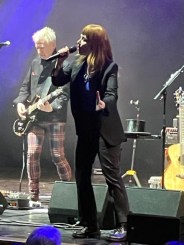 The song “Luka” rings round in my head as the concert grows nearer. I listen to her music on my friendly intelligent assistant, Alexa, and find that I know quite a few of her songs, which surprises me a little. Suzanne Vega emerged from the folk scene of Greenwich Village, New York, in the early 1980s; with her pure voice, a clutch of songs and an acoustic guitar. Her songs drew from storytelling each one weaving its own picture and enticing the listener to think about the content. She released her self-titled, highly acclaimed debut album in 1985. From the Sage website: “Known for performances that convey deep emotion, Vega’s distinctive, “clear, unwavering voice” (Rolling Stone) has been described as “a cool, dry sandpaper-brushed near-whisper” by The Washington Post, with NPR Music noting that she “has been making vital, inventive music” throughout the course of her decades-long career.…….[she]………“observes the world with a clinically poetic eye” (The New York Times), Vega’s songs have tended to focus on city life, ordinary people and real-world subjects. Notably succinct and understated, her work is immediately recognizable—as utterly distinct and thoughtful as it was when her voice was first heard on the radio over 30 years ago.”
 Like her songs, the stage set is minimal and she’s accompanied by a single, excellent, electric guitarist. She starts, well, at the start (where else to start?) with “Marlene on the Wall” and moves through a mixture of old and new tunes each one telling its own story. She is not afraid of bearing her soul, telling us of a teenage love affair at summer camp, initiated through a mutual admiration of Leonard Cohen and his music. She told the guy not to contact her again, and wrote a song to mark the affair. But he reappeared via a note and a bunch of flowers at a concert in Liverpool one night. This sparked another song and a lifelong friendship. They meet for lunch regularly. Her set, like her songs, is full of similarly quite personal stories. She alternates between her acoustic guitar, a lovely dapper top hat and a quirky little finger clicking dance. Wonderful. (Note to myself. One day I must summon up the courage to wear the battered old top hat I bought some time ago on eBay. Or maybe not: perhaps I will silly or too eccentric, unlike Vega).
 Do we like Blondie or Lou Reed? The Lou Reed vote wins (and includes Vega’s own vote) so we are treated to “Walk on the Wild Side”. I recognise many more songs than I expect. “Tom’s Diner” gets into my head and sticks there. “Da da da da…….” Not a bad way to end an evening.
I’m pleased I made the effort Suzanne. There is a depth and honesty within the simplicity of your stories. Thanks for sharing them with us. “Luka” comes back into my mind. So does the top hat. Maybe I will decide to wear it one day after all. Thanks again for a lovely evening and thoughts of my top hat.
 Setlist: Marlene on the Wall; Small Blue Thing; Caramel; Gypsy; In Liverpool; The Queen And The Soldier; When Heroes Go Down / Lipstick Vogue; Rock in This Pocket (Song of David); Last Train from Mariupol; Solitude Standing; Left Of Center; I Never Wear White; Some Journey; Luka; Tom’s Diner;
Encore: Walk on the Wild Side; Tombstone; Rosemary
 A bit of an adventure. I always try and get to see
 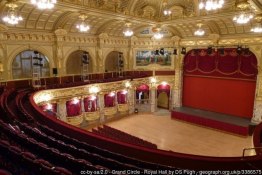 The Royal Hall is a wonderful, exquisite, old, building (see image courtesy of Wikimedia Commons). I have been there twice before, once to see Camel and on another occasion to see the Groundhogs, Martin Turner’s Wishbone Ash and Focus as part of a Classic Rock package tour. When we arrived, Fairport were already on stage, just starting their first set.
 Their official site promised: “Fairport Convention have been entertaining music lovers for over half a century, having formed in 1967. During that time the band that launched British folk-rock has seen many changes, but one thing has remained the same – Fairport’s passion for performance. This year’s Winter Tour will present a mix of long-established Fairport favourites and some surprises from albums old and new.”
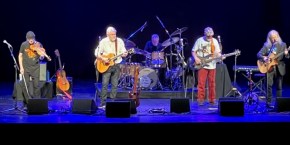 The current band features founding member Simon Nicol on guitar and vocals, long-time member Dave Pegg on bass guitar, Ric Sanders on violin, Chris Leslie on fiddle, mandolin and vocals. This time round Fairport Convention were also joined on stage by former member Dave Mattacks on drums. Sadly, we arrived too late to catch the opening act
  Fairport always guarantee a pleasant evening with a mixture of fun stories, and songs old and new. The first set was exactly that with songs from their latest album and closing with “Sloth” from the 1970 Full House LP. “Stuffing their set with a surprising amount of new material for a vintage act, Fairport are still clearly having fun and brought the house down.” (The Guardian)
 During the interval I picked up a programme, signed by the band. Dave Pegg was, as usual, at the merchandise desk greeting fans and signing items. He kindly signed two programmes for me, one for me and one for my friend John in the USA. I also purchased a lovely little book which Peggy had produced to accompany a box set some years ago. The cover is full of images of him over the years (see picture). It was good to meet up with Richard Houghton, the publisher of
  After a glass of red wine, we took our seats for the second half of the show. Once again, we were treated to a selection of songs old and new culminating in the traditional folk song “Matty Groves” and the always highly anticipated encore finale “Meet on the Ledge”. The vocals of Hannah Sanders from the opening act added an extra dimension to the song which of course was originally sung by the sadly missed Sandy Denny.
 We left via the exit (see sign, courtesy of Wikimedia Commons) and were greeted by our taxi driver. The drive north was equally scary with a true pea souper fog that limited our speed. We eventually picked up carer number two, Elaine, close to 1 AM and they put me to bed just after 1:10 AM. An interesting, exciting, scary, yet worthwhile evening.
 “Fairport is an institution, a festival, purveyors of memories, and keepers of the folk flame. But most of all they are a brilliant live band.” (Folk & Tumble magazine)
 Lindisfarne have an intriguing and somewhat confusing history. There are, in practice, currently two versions of the band touring at the moment. The first, the
  The second version of
  Their first hit, the Clements-penned “Meet Me on the Corner”, paved the way for their classic Fog on the Tyne to become the UK’s top-selling album of 1972. LINDISFARNE’s unforgettable songs, powerful live performances and unpretentious style led to worldwide success and an enviable reputation as festival favourites, and the annual Christmas concerts they presented in their native Newcastle became the stuff of legend.
 We had great seats in the front row and got there just in time to see Lindisfarne (no support act) begin the proceedings with old favourite “No Time to Lose”. The concert was in two sets with a short interval between them. What can I say! The new (-ish) band play all the old favourites and do them 100% justice. Rod Clements is a quiet yet charismatic front man who introduces many of the songs. Dave Hull-Denholm performs his father-in-law’s songs with the reverence they deserve and his vocals sound very much like Alan Hull. Steve Daggett sings quite a few of the songs and again does justice to the Lindisfarne repertoire. So in the first set we get great tunes such as the enigmatic, melodic early classic “Lady Eleanor”. This song always intrigues me. The lyric “in came Roderick Usher with the lady Eleanor” is not quite true to the Edgar Allan Poe tail “The Fall of the House of Usher”. The lady in question is actually Madeline not Eleanor. I wonder why they use that particular poetic licence? Other favourites are “Road to Kingdom Come” and, closing the first set, “January Song”.
 The second set begins with another great Lindisfarne classic “Alright on the Night”. Soon we get a wonderful, atmospheric performance of the much underrated “Dingley Dell”. This brings back lovely memories of seeing Lindisfarne at Newcastle City Hall on the Dingley Dell tour. I went both nights as there were different supports each night and I was a fan of each band: Stackridge and Genesis! Happy days. Then, my particular favourite which still makes the hair stand up on the back of my neck: Dave performing “Winter Song”. Soon we are into the hits: “We can Swing Together”, “Fog on the Tyne” and “Meet me on the Corner”, followed by the massive hit Lindisfarne reunion song “Run for Home”. And the closer, yes it had to be “Clear White Light”. I am transported back to the first time I saw Lindisfarne in the City Hall sandwiched between headliner Van der Graaf Generator and new up-and-coming band Genesis. All for 25p as I recall! Happy days
 On the way out we are given a flyer for the Newcastle City Hall Lindisfarne Christmas concert, following the tradition of many years. I went to what I think was the 1st Christmas concert at Newcastle City Hall in 1971. Sadly I am unable to attend this year as I will be seeing Rod Stewart at Newcastle Arena on the same night. Such dilemmas always annoy me and sent to try me! This was one of the reasons I made the trip to Yarm to see Lindisfarne. Many thanks to carer Jan for taking the photos. No merchandise to buy this evening.
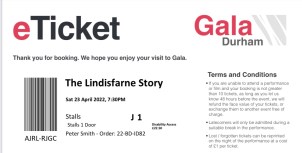 It is almost a month since my last concert and I was feeling quite ready for another evening out. I decided a couple of months ago it was about time I caught up on the legendary
  The Lindisfarne Story, as the name suggests, features Ray and Billy telling the story of the band and singing acoustic versions of some of their better-known songs with Billy on vocals and guitar and Ray on bongos, drum box, and a small drum kit. On their current tour Ray and Billy are focusing on the 50th anniversary of the Fog on the Tyne album, telling the story of the band, that particular album and discussing, and playing, each track in consecutive order. The concert started at 7:30 PM prompt, the first half featuring side 1 of the album, followed by a short interval and a second-half taking us through side 2 of the album. The show is well presented using old video of the band to great effect and also clips of friends old and new such as local heroes Bruce Welch, Sting, Billy Nail and Sam Fender. The history behind each track, who wrote it and the lyrics is explained in some detail followed by a great rendition of each song. So they start with track 1 which is “Meet Me on the Corner” and carry on track by track. Many of the songs are well-known to me, others less so but I certainly learned a lot about the history of each track on this massively successful album. I had also forgotten just how successful the album was! Along the way they treat us to other Lindisfarne favourites such as “Lady Eleanor” and old blues songs, and 60s hits, which Billy Mitchell used to sing in a local band and in working men’s clubs such as “Needles and Pins” and “Hi Ho Silver Lining” (both of which got the crowd singing along; excellent!)
 Some facts I found about the album, on Wikipedia:”Fog on the Tyne is a 1971 album by English rock band Lindisfarne. Bob Johnston produced the album, which was recorded at Trident Studios in Soho, London, in the mid-1971 and released in October that year on Charisma Records in the United Kingdom and Elektra Records in the U.S..
 During the interval carer Jan and I treated ourselves to a drink from the bar and purchased 2 CDs, of 50 years of Fog on the Tyne, one for me and one for my friend John in the USA. We were soon back in our seats and into side 2 of the album, which features the wonderful Alan Hull classic “January Song”. I forgotten that they had covered one of Scottish folk singer Rab Noakes songs on the album. I saw Rab Noakes many times supporting Lindisfarne “back in the day”, and really enjoyed him (mental note to myself: check Rab Noakes website to see if I can go and see him any where, any time!) And so it continued, track by track, concluding with a great singalong of, of course, “Fog on the Tyne”. A great show, well executed, by 2 guys who have been there since the early days. We both really enjoyed it and learned a lot about the band, the songs and their history. On the way out Ray and Billy kindly signed my CDs. A great end to a perfect evening. Roll-on my next Lindisfarne outing.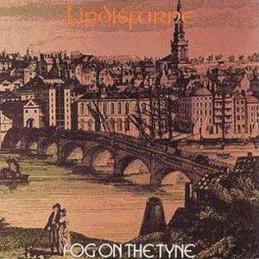
 It was a strange and winding road that took me to the Sage last Thursday to see
  going more out of interest, and for my two children, rather than as a true fan. For two very different reasons, on the evening, the aforementioned kids were unable to come along so I decided to go, with my carer Jackie, to experience Billy “on my own”(although I am never totally on my own, as like the naughty child I am, I’m not allowed out by myself).
 He treated us to many songs from the new album which are more about his reflections on life than his normal political songs. He also talked a lot about his experience of the pandemic and how it has given him time to focus on recording and reading books. Like me he admitted to buying many books, reading a quote or two, and then storing them away. He alluded to his acoustic Gibson guitar smelling of old books and how wonderful that smell was; a sentiment which I wholly agree with. He looked very dapper with a new hairstyle and in smart jeans (something which I still possess but can never wear). He was accompanied by a keyboard player who kept him in check about the tuning of his guitars.
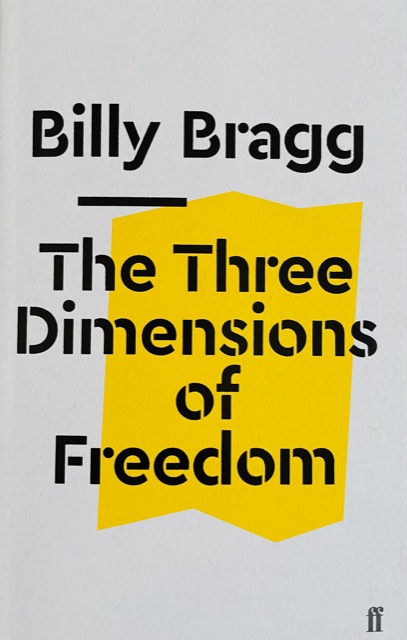 I also treated myself (and my friend John) to a copy of Billy Bragg’s book “The Three Dimensions of Freedom”, as there was no programme on sale: “At a time when opinion trumps facts and truth is treated as nothing more than another perspective, free speech has become a battleground. While authoritarians and algorithms threaten democracy, we argue over who has the right to speak. To protect ourselves from encroaching tyranny, we must look beyond this one-dimensional notion of what it means to be free and, by reconnecting liberty to equality and accountability, restore the individual agency engendered by the
  So this was another streaming event, this time by our old friend and troubadour Bob Dylan. I expected the event to be live, but it was clearly pre-recorded. However, this was not a disappointment and did not detract from the enjoyment of the concert, rather the pre-recorded setting of the event enabled a greater depth and atmosphere than would have been possible had it been a live performance. The streaming started late on Sunday night UK time and although I was really looking forward to it, I have to admit to wimping out and watching it the next morning.
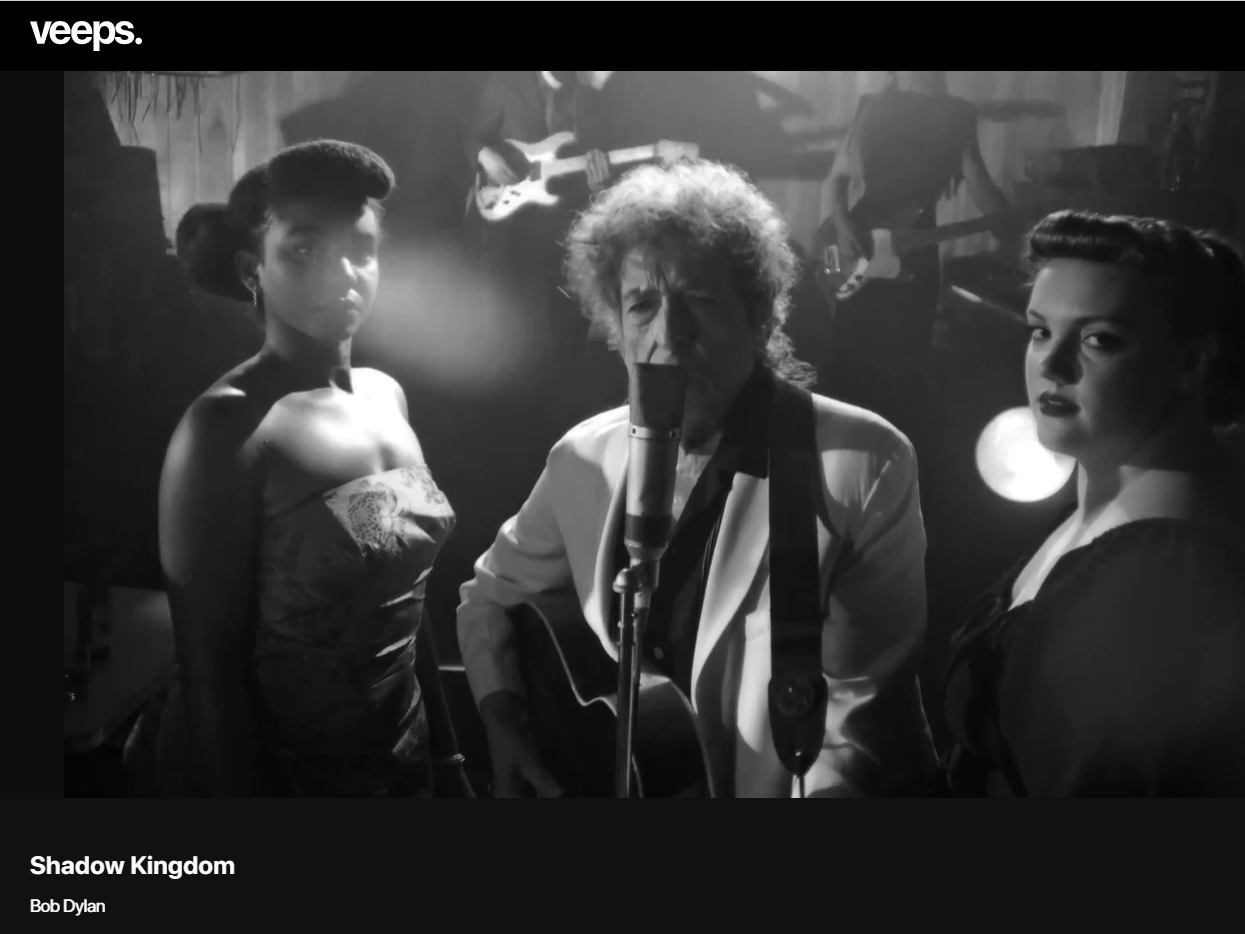 Picture the scene. A smoky bar somewhere in Marseille, Dylan surrounded by his musicians including guitars and double bass and performing in front of a small audience. Everyone in the audience was smoking very heavily (and it looked like genuine smoke, but I suspect it wasn’t, and I also suspect that they weren’t really sitting directly in front of Dylan). However the effect was great and looked genuine. Dylan was dressed well, sometimes there was a change of suit or jacket; sometimes he would be playing guitar or mouth harp, sometimes simply standing singing. Sometimes he would be centre stage, and for other songs he would be to the left. The credits told us that the bar was in Marseille, but this was actually fictitious. I’m sure that it was all recorded within studios in America; but nonetheless, as I have said earlier, the effect was authentic and absolutely excellent.
 This was Bob Dylan, in my view, reborn. No more strange vocalising, no more “up singing”; this was Dylan with a strong, deep, emotional voice that in many ways returned to the form he was on in the late 1970s when I first saw him. This was Dylan performing, no more standing still, he would make small mannerisms with his hands; pointing and moving to emphasise the lyrics. When he sang classics (particularly the ones I recognised) such as “Forever Young” and “I’ll be your Baby Tonight” his voice was deep, twisting and turning and emotional. This took me back to the Dylan I saw in Blackbushe Aerodrome in 1978. Tremendous. I had tears in my eyes. The old Bob has returned, singing to us from his heart and his soul in a way that he has not achieved, in my view, for many years. You have to see it to understand. He really was that good, in my view.
 Dylan, at 80, remains a unique and indescribable presence in modern music. Long may the troubadour continue to sing to us and let’s hope the never-ending tour will soon resume so that we can witness the legend perform for us again.
  The sixth formers would carry LPs under their arms to school. They played them in a little room upstairs in the dining hall at lunchtime. Sometimes, if I was lucky, they allowed me upstairs to their elite “Record Club” to listen to their new, magical, psychedelic sounds. The records they carried were badges of honour and included Frank Zappa’s Hot Rats, the Crazy World of Arthur Brown album, Cream’s Wheels of Fire, Tyrannosaurus Rex’s My People Were Fair and Had Sky in Their Hair, But Now They’re Content to Wear Stars on Their Brows, and
  Sure, Ian’s voice is not what it was and the old coat is gone, but the flute playing seems great and the songs remain as soulful, passionate, poignant and intriguing as ever. So we start at the very beginning (a very good place to start) with “My Sunday Feeling”; Track 1 Side 1 of This Was. This is followed by their first minor chart hit “Love Story”, followed by “A Song for Jeffrey” which is well known to all of us from the cheap compilation album You Can All Join In. Pure magic. The years disappear and the old songs flow over us all. These are followed by other classics from the first couple of albums. My favourites are the aforementioned “Living in the Past”, the magical flute solo which is “Bouree” and the spooky, almost scary “
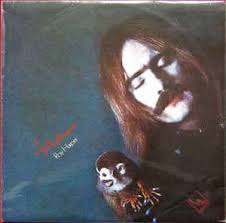 “And O how the sea she roars with laughter
 On why he has decided to tour again, Harper said: “Partly because many of the things I wrote about in McGoohan’s Blues in 1968 are still very relevant 50 years later, and partly because my third record was a watershed moment in my recording life, it’s been long in my mind that I should dust it off and bring it on tour again.”
 sing “I Hate the White Man” but, hey, you can’t always get what you want. Jackie my carer is now a Roy Harper convert, which is great. Me, I had a lovely evening, spent with an old friend.
 A taxi from Sunderland to Darlington (return) is expensive. But, what the hell, my lovely daughter Laura was singing in the band The Shining Levels at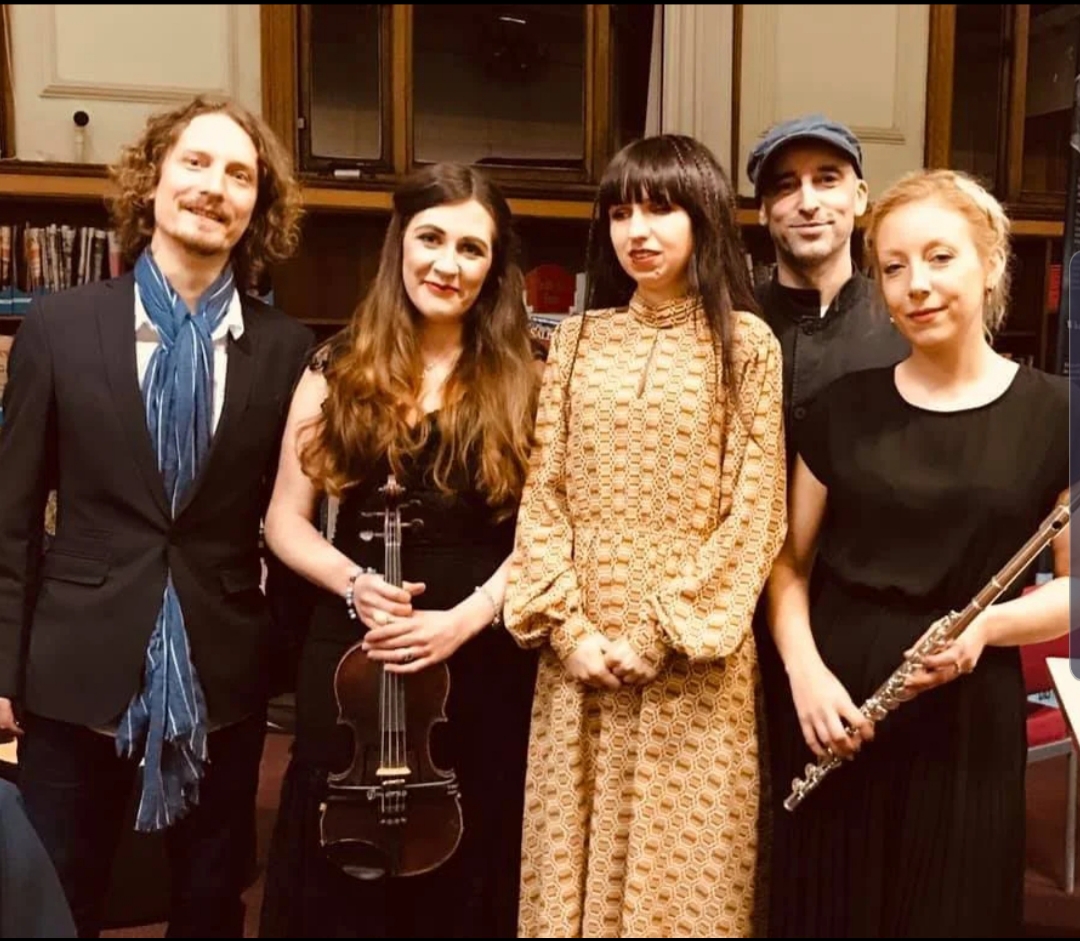
 and transfixed the audience in their haunting, swirling mix of sounds. The eclectic combination of folk music, book readings and mix of flute, violin, a female trio of vocals and male vocals has to be experienced to understand just how beautiful, yet at the same time dark and powerful, their sounds can be.
 Vintagerock's Weblog.