Deep Purple Newcastle Odeon 1974
Support from Elf
 So Deep Purple returned to the North East with a new line-up. Ian Gillan and Roger Glover had departed and in came local lad David Coverdale, who hailed from Saltburn, on vocals and Glenn Hughes, from Trapeze, on bass and vocals. The gig had sold out pretty quickly, which was some achievement given the changes in the band and the fact that they had graduated from the City Hall to the larger capacity Odeon. I went along with a group of mates, with some trepidation; I just couldn’t imagine how the new guys were going to fit it, and live up to the huge reputation that was Deep Purple. Support came from Elf, who featured Ronnie James Dio on vocals, and delivered an impressive set. Purple had released the new album Burn, and one of mates had bought it. We’d all listened to it and agreed that it was pretty good. The Deep Purple we all experienced that night was easily on par with its predecessor. They exploded onto the stage with “Burn”; Coverdale was on fire, Blackmore was his old self, Jon was attacking his organ, Hughes added a more soulful dimension to the vocals, and Ian Paice provided the solid back beat. I have a theory that bands can find great strength at times of change. I’ve seen it happen a couple of other times: when Genesis came back without Gabriel is another example. Deep Purple came back stronger than ever, and the strength of the songs on Burn helped. Mistreated, Might just take your life, and Burn itself are all very powerful songs. Setlists from the time show the set as being: Burn; Might Just Take Your Life; Lay Down, Stay Down; Mistreated; Smoke on the Water; You Fool No One; The Mule; Space Truckin’. Encore: Going Down; Highway Star.
  My friend John sent me his own recollections of the gig: “For years I though this was the City Hall; I had a great seat near the front. They played Burn and Mistreated from the new album which were great plus I think Might Just Take your life, You Fool No One and Lay Down Stay Down. Burn was the starting track, Mistreated was the highlight for me and think they played Highway Star, Space Trucking and presumably Smoke on the Water.Support was Elf with Rockin Ronnie. Remember Glenn Hughes had really long hair – had seen him once before in Trapeze.”
It was all of 11 years until I saw Deep Purple again. I didn’t see the Tommy Bolin line-up; they toured the UK but didn’t play the North East, although a show at Middlesbrough Town Hall (which would have been a home-coming show for David Coverdale) was rumoured but, to my knowledge, never happened.
Posts Tagged ‘blues’
11 Sep
Deep Purple Newcastle City Hall 1973
Deep Purple Newcastle City Hall 1973
Support from Nazareth
 This was the last time that I saw the classic Deep Purple Mark II line-up in the 70s. By this point tensions in the band were growing and relations between Gillan and Blackmore were not good. Both Gillan and Glover were to leave the band before the year was out. This tour came just as the Who Do We Think We Are album was released. This is not their strongest album but it does feature the great hit single: Woman from Tokyo. Published setlists from the time show the set as being: Highway Star; Smoke on the Water; Strange Kind of Woman; Mary Long; Lazy; The Mule; Space Truckin’; and Black Night. My friend John recalls them also playing Woman from Tokyo; Smooth Dancer and Never Before from Machine Head. My main recollection from the gig was how different Gillan looked. He had grown a beard and was wearing a smart jacket and slacks; a very different image to that of previous tours. Reports of shows from that period suggest that you could sense the tensions within the band and the growing distance between the members, but I can’t say I noticed anything amiss. I was sitting upstairs with a group of friends, and enjoyed the gig, although not quite as much as previous tours. Nazareth were a great support act. A few months later the unthinkable had happened and Gillan and Glover had both departed. I thought that was the end of Deep Purple, which was far from what transpired, more of which tomorrow.
10 Sep
Deep Purple Newcastle City Hall 1972
Deep Purple Newcastle City Hall 1972
Support from Glencoe
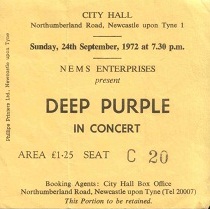 Deep Purple were back at the City Hall in 1972 and this was the band at its peak. This was the Mark II version of the band, which most people regard as the ultimate and classic line-up of Deep Purple. In 1972 Purple had world-wide success with the release of their album Machine Head, and in the same year they recorded the superb live album Made In Japan. They started with Highway Star, which is just the perfect set opener; it kicks off with a great riff, its fast and up-tempo, and there’s a wonderful solo from Blackmore. They played all their best known songs, including the now classic Smoke on the Water which was then new to the set. Other songs which featured in the set at that time were Child in Time; The Mule; Strange Kind of Woman; Lazy; and Space Truckin’. All great. It didn’t get any better than this at the time.
  The encores will probably have been one or two of Black Night; Speed King and possibly Lucille; I can’t be certain. Its difficult to put into words just how great Deep Purple were at that time; they were easily on a par with Zeppelin and Sabbath. Jon Lord’s swirling organ and the unbelievable vocal range that Gillan had in those days gave them something unique, which set them apart from any other band. And Blackmore was amazing, so confident, so flashy in his guitar technique. For this gig I was lucky enough to be sitting in the third row, right in front of Ritchie, and I just couldn’t keep my eyes off him. And Purple were so LOUD; my ears were ringing for days after. My hearing isn’t so good these days, and I reckon the main culprits are Deep Purple, the Who and Motorhead! I remember support act Glencoe well and saw them a few times around that time. They featured Norman Watt Roy on bass and John Turnbull on guitar, who I’d seen in Bell and Arc. Both of them went on to be part of Ian Dury and the Blockheads, and Norman is now bass player for Wilko Johnson. They were a good band, who deserved more recognition. Tomorrow I’ll bring together my memories of the 1973 Deep Purple tour, which was the last time I saw the classic line up in the 70s. Things were not great in the Purple camp, and sadly the band was about to disintegrate.
9 Sep
Deep Purple live in the early 70s
Deep Purple live in the early 70s
 Deep Purple were just untouchable live in the early 70s. They had all those classic rock songs: Black Night, Speed King, Strange Kind of Woman, Child in Time; and they were all top class musicians and performers. I can picture them now; Jon Lord rocking his Hammond organ back and forth while squeezing rich swirling chords out of it; Ritchie Blackmore sombre, dressed all in black: black hat with a sliver buckle, black scoop neck top, black velvet flares; Ian Gillan, long lion-like hair, screaming and screeching the vocals, Roger Glover on bass, wearing a hat and leather trousers, smile across his face, rocking back and forth in time to the music; and Ian Paice on drums, a constant in terms of rhythm, but also in terms of the band and its many incarnations. This was the classic Purple Mark II line-up. I first saw Deep Purple at Newcastle City Hall in 1971, which was the Fireball tour. They were loud and just amazing. I was seated in the 7th row, and had a great view. I was a young kid and I was just fascinated and enthralled by Blackmore, who was the ultimate guitar showman in those days, running both hands up and down the neck of his Fender Stratocaster, pulling at the amps, ringing feedback from the guitar, throwing it in the air. I too had a Strat at that time and was watching his every move; total hero worship. My mate John was there and recalls: “My first gig at the City Hall – I remember it was just fantastic. They played the now-classics from “Deep Purple In Rock”: Speed King, Child in Time, plus Black Night and my all time favorite the single Strange Kind of Woman plus a lot from Fireball. While not their best album I thought it was a great show with Fireball, No No No, Demons Eye, No One Came, the extended version of the Mule plus the rather odd Anyones Daughter. Support was Bullet featuring members of Atomic Rooster John Cann and Paul Hammond – although for years I thought it was Glencoe”. Setlists from the time also show that Highway Star was included in the set, although it was yet to appear on record, as it featured on Machine Head, which came out in 1972. I think the encore will have been Black Night, followed by Lucille and a medley of old rock n roll songs. Thanks also to John for the scan of his Fireball poster.
  John was lucky enough to see Deep Purple at Sunderland Top Rank in 1970. I wasn’t at that gig, and am so jealous of him. John’s memories of that gig: “I was 15 and it was my first gig. Free were the headliners but as the Purple van broke down on the highway and they arrived late, they played last. We arrived at about 6.30pm and queued up outside with many others; the line was from the door across the bridge before. It was billed as an Indoor Festival with five bands. I don’t remember the first band (Yellow), Principal Edwards were strange but I really enjoyed Cochise and bought their album (which features Steve Marriott on the stand out track Thats Why I sing the Blues). At this time they were still playing tracks from the Mark I line plus tracks from their new, and soon to be classic album, Deep Purple In Rock. I believe they played Speed King, Child in Time, Into the Fire (?) and the old songs I remember were a very long Wring that Neck and Mandrake Root at the end of the set. The encore was the hit single Black Night and Lucille which I thought was odd – why would a cool band play such an old song?. I had much to learn. I seem to remember the show finished at about 1.30am which I thought was very cool and then I walked home on my own because the others left early, missing the encore.”
8 Sep
Dio Newcastle City Hall 1984
Dio Newcastle City Hall 1984
Support from Queensryche
 This concert in 1984 was the last time I saw Dio in a concert hall setting. I did see Ronnie and the band a few years later at the Monsters of Rock festival 1987. This gig had strong support from up and coming act Queensryche, who had just released their second album and were building up their own strong following. Dio had also just released their second album “The Last in Line”, and the set featured a collection of songs from that album, their previous album “Holy Diver” and a few Rainbow and Sabbath songs. The evil, but cute. looking guy on the programme is “Murray”, who appeared on the band’s album covers, as well as in the backdrop for the live shows. Note Murray sports the devil’s horn salute that was the trademark of Ronnie.
  Setlist: Stand Up and Shout; One Night in the City; Don’t Talk to Strangers; Mystery; Egypt (The Chains Are On); Holy Diver; Heaven and Hell; The Last in Line; Rainbow in the Dark; Man on the Silver Mountain / Starstruck; Long Live Rock ‘n’ Roll. Encore: We Rock; The Mob Rules. A DVD of performances from two Dio concerts in 1983 and 1984 was released a few years ago, and gives a great write-up of Dio’s rock stature at that time: “Ronnie James Dio remained at the forefront of hard rock for over twenty years and his position as the powerful voice, driving force and front man to rock gods ‘Dio’ is the stuff of legends. The finest hard rock album to come out of 1983 (Holy Diver) and a second serving of rock genius in 1984’s ‘The Last In Line’, Dio found themselves in embarking on a sell-out world tour. Delivering concert performances of the highest calibre and putting on the kind of value-for-money show that had become something of a lost art, the Holy Diver world tour won the band adulation from fans, critics and fellow musicians alike.”
7 Sep
Dio Newcastle City Hall 1983
Dio Newcastle City Hall 1983
Support from Waysted
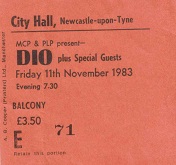 I first saw the late Ronnie James Dio when he fronted the band Elf. Elf were support act on the Deep Purple Burn tour of 1974, which I caught at Newcastle Odeon. My mate John also reminded me that we saw Elf as support for Johnny Winter at the New Victoria Theatre, London, also in 1974. I them saw him several times in Ritchie Blackmore’s Rainbow, and also in Black Sabbath. Ronnie was a great rock singer, with a tremendous range, his style mixing heavy metal with an almost operatic approach. Ronnie was also tremendously charismatic and powerful on stage, with a great stage presence which transcended his diminutive stature. I can picture him now leading the crowd on, his hands making the devil’s horn salute. A great talent, who is much missed.
  By 1984 Ronnie was of sufficient stature to be able to front his own band Dio. Playing alongside him were the three other great rock talents of Vinny Appice on drums; Jimmy Bain on bass and Vivian Campbell on guitar. Dio’s music drew heavily from his previous bands, retaining Ronnie’s distinctive style, and some of the dark satanic imagery of Sabbath. The set was a mix of track from the the new Dio lp, Holy Diver, and rainbow and Sabbath songs: Stand Up and Shout; Straight Through the Heart; Shame on the Night; Children of the Sea (Black Sabbath); Holy Diver; Stargazer (Rainbow: a great favourite of mine at the time; I’d forgotten this one!); Heaven and Hell (Black Sabbath); Rainbow in the Dark; Man on the Silver Mountain (Rainbow: another great song); Starstruck (Rainbow). Encore: Evil Eyes; Don’t Talk to Strangers. Support came from Waysted, Pete Way of UFO’s side project, which also featured fellow UFO member Paul Raymond.
4 Sep
Dr Feelgood Newcastle City Hall 1977 to 1979
Dr Feelgood Newcastle City Hall 1977 to 1979
 So Wilko was gone and Gypie Mayo was in. I had big doubts as to whether this could work. Wilko was a class act, and would be very hard to follow. The chemistry between Lee and Wilko was obvious, they worked together so well. It could never be the same again. So we went along to see; and it worked. All credit to Gypie Mayo for taking this on and making it work, but work it did. Apparently Gypie only had a week to learn the set before going out on this tour. He kept his own style, and didn’t try to imitate Wilko, but he and Lee worked together and the Feelgoods continued to rock, just as they had before.
  Support for the 1977 tour came from the very excellent Mink DeVille, who hit the charts around the same time with “Spanish Stroll”. We went along to the City Hall early to make sure we caught their set; this was one gig where we gave the bar a miss. Will DeVille was a cook guy and warmed the crowd up well for our session in the Dr’s surgery.
  Dr Feelgood often seemed to choose a strong support act to open for them. The support in 1978 was Squeeze, who are another class act. I think support in 1979 came from Red Beans and Rice.
 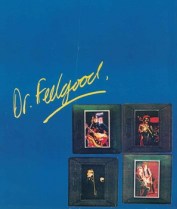 After 1979, the Feelgood’s North East gigs were in smaller venues than the City Hall, such as Durham University and Redcar Coatham Bowl. By 1981 there had been more change and Gypie Mayo had left then band, to be replaced by Johnny Guitar. I saw that line up at the Rock on the Tyne festival which took place over the 1981 August Bank Holiday weekend. This was the start of several more line up changes, which have gone on until this day.
  I saw Dr Feelgood once more, at Newcastle Mayfair in 1987. I’ll blog on that gig shortly. Its easy to forget just how great Dr Feelgood were in the 70s, particularly as a live act. Without the Feelgoods we may not have had punk, and things just wouldn’t have been the same. I spent some great nights with these guys.
3 Sep
Dr Feelgood Newcastle City Hall 1975 and 1976
Dr Feelgood Newcastle City Hall 1975 and 1976
 Dr Feelgood were just plain amazing in their early days. They grew out of pub rock and preceded punk, and were pretty untouchable as a live act. I first saw them as support for Hawkwind on their 1974 tour, and was blown away by them. I couldn’t take my eyes off the two front men Lee Brilleaux and Wilko Johnson. Wilko strutted backwards and forwards across the stage, playing his Fender Telecaster in his characteristic choppy style, while Lee stared menacingly at us all, dressed in a sharp white suit, wringing the mike and pumping his fist. Sparko and The Big Figure silently and relentlessly provided the rhythm. I loved those tunes: “Back In the Night”, “Roxette”, “She does it right”. There was no one like them and no-one to touch them.
 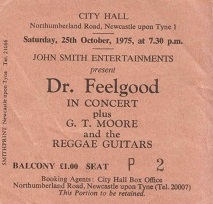 The Feelgoods visited the City Hall every year from 1976 to 1979 and I went each year. They were always a great live act, and I never saw them put on anything other than a great performance. They also had some pretty cool support acts: GT Moore and the Reggae Guitars on the 1975 tour, and the George Hatcher band in 1976 (although the ticket says Clover, I am pretty sure they were replaced on the tour by George Hatcher). I also saw them at the Reading Festival in 1975, where they were the favourites of the weekend. Went with a group of mates; I can remember all of us coming back from the local pub specially to catcg the Feelgood’s set.
 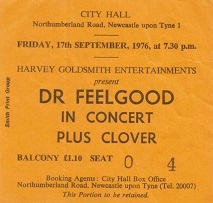 And then the unthinkable happened, and Wilko was gone. I was shocked, and couldn’t see how the band would survive the loss of such a charismatic figure. Wilko wrote many of the songs, and was so crucial and integral to their sound, and their live show. But survive they did. I’ll blog tomorrow on the post-Wilko gigs that I saw at the City Hall. The live album “Stupidity” gives an idea of a setlist from those days: Talking About You; 20 Yards Behind; Stupidity; All Through The City; I’m a Man; Walking The Dog; She Does It Right; Going Back Home; I Don’t Mind; Back in the Night; I’m a Hog for You Baby; Checking Up on My Baby; Roxette; Riot in Cell Block No. 9
30 Aug
Dire Straits Newcastle City Hall 1980 and 1982
Dire Straits Newcastle City Hall 1980 and 1982
 Dire Straits returned to the City Hall in 1980, and again in 1982. By this time they were on their way to mega-stardom and could easily sell out a venue of this size. In fact on both occasions the band sold out two nights at the City Hall. If you look at the two ticket stubs, you can see that both gigs were on the 9th December, exactly two years apart from each other. The line up of Dire Straits had changed, with David Knopfler leaving his brother’s band, and the members for the 1980 tour being Mark Knopfler (vocals and guitar), John Illsley (bass), Pick Withers (drums) and new band members: Alan Clark (keyboards) and Hal Lindes (guitar). The albums at the time were Making Movies (1980), and Love Over Gold (1982). The nine times platinum Brothers in Arms was to follow a few years later in 1985.
  Dire Straits developed a lot during these early years of their career; the songs were longer, more involved and more complex, with greater opportunity for Mark to solo. This was the period of great tracks such as Romeo and Juliet, Tunnel of Love, and Private Investigations, all of which are epic songs, and they all soon became big favourites of their live shows. Although I enjoyed those City Hall gigs in 1980 and 1982, I also missed the bar band who had broken onto the scene with Sultans of Swing. If you compare a Dire Straits setlist from 1979 with one from 1982, the contrast is quite stark and quite obvious. In 1979 a typical Dire Straits show featured around 20 (quite short) songs. By 1982 the length of the songs had increased to the extent that a typical set comprised around only a dozen songs.
  Also by now the gigs had no support act and no interval; these were evenings of pure Dire Straits music, and quite long shows. A typical setlist from 1982: Once Upon a Time in the West; Industrial Disease; Expresso Love; It Never Rains; Romeo and Juliet; Love Over Gold; Private Investigations; Sultans of Swing; Twisting by the Pool; Two Young Lovers; Portobello Belle; Tunnel of Love
  I saw Dire Straits twice more in concert, both at large gigs. In 1985 I saw them at Wembley Stadium when they appeared at Live Aid, and again at Knebworth in 1990 during the Silver Clef concert. It was 21 years till I saw Mark Knopfler again, when he co-headlined with Bob Dylan in Glasgow. I was disappointed that he didn’t play Sultans of Swing, although looking at setlists from previous gigs it seems that he does still include it his set. For me, Sultans is his supreme moment; his guitar playing seems so simple, so effortless and yet so complex, and his lyrics tell the story of his band at the time. Just perfect.
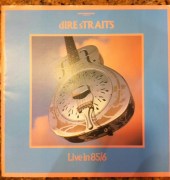 Thanks to John for the scan of the Brothers in Arms programme. I checked out the setlists for Live Aid and Knebworth. For Live Aid at Wembley Stadium 1985, they played Money for Nothing and Sultans. At Knebworth in 1990 they played Solid Rock; I Think I Love You Too Much, and Money for Nothing. Those were the last times I saw Dire Straits. Mark Knopfler is touring again next year and playing the Newcastle Arena. I met well go along and see him.
29 Aug
Dire Straits in concert late 70s
Dire Straits in concert late 70s
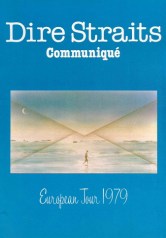
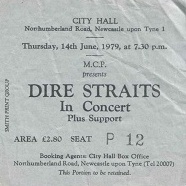 I can’t remember where I first saw Dire Straits, or where I first hear “Sultans of Swing”, but the song was everywhere during 1978. It provided a welcome alternative to the fast and loud punk music which was also omnipresent in university student unions and ballrooms at the time. Not that I didn’t like punk, I did, but it was nice to have a softer alternative. Somehow this rootsy pub rock band crept up from left field, and established themselves as a major act. Their relentless touring was a large part of the secret to their success. I saw them support Talking Heads at Newcastle Poly, a few months later headlining at Middlesbrough Rock Garden, and then back at the Poly. Each time “Sultans” was the stand out song of the night. By June 1979 Dire Straits were big enough to headline at Newcastle City Hall, in support of their second album “Communique”. I recall being surprised at how quickly they had graduated to playing concert halls, and wondering if they could sell out such a large venue. The fact was, the tickets sold out quickly for the City Hall gig and the place was packed. This was one of those nights that posed a dilemma for me.
  The City Hall had Dire Straits, and on the same night The Police were headlining at the Mayfair, with support from The Cramps. My mate Ian and I decided to try and see both gigs, and for once the timings worked. We went to the City Hall, saw the Dire Straits gig (the support came from a band called Metro) and then we headed straight down to The Mayfair for The Police. We had missed The Cramps, but saw The Police’s set. A great night, seeing two great bands who were both on their first headlining tour, and both on the brink of mega stardom. “Sultans” is still my favourite Dire Straits song, and for me they were at their very best in those early days. A typical Dire Straits setlist from 1979: Down to the Waterline; Six Blade Knife; Once Upon a Time in the West; Lady Writer; Single-Handed Sailor; News; What’s the Matter Baby?; Portobello Belle; Wild West End; Lions; Angel of Mercy; Solid Rock; Sultans of Swing; Where Do You Think You’re Going?; Southbound Again; Setting Me Up; Twisting by the Pool.
 Vintagerock's Weblog.