 “There’s a time and the time is now and it’s right for me, It’s right for me, and the time is now, There’s a word and the word is love and it’s right for me, It’s right for me, and the word is love “ (Yes, 1970).
 Last time that I saw Yes was only a couple of years ago and I was just recovering from Covid. It seems an age ago now. I was terrified at the time that I might not survive, having been classed as vulnerable, but I was actually okay. I reckon I caught it going to see the Rolling Stones at Murrayfield. If I did then it was worth it.
 Now they say that one forms allegiances to the bands that you see when you are young. This has certainly been the case with me. I first saw Yes in 1969 when I was all of 12 years old and they were supporting the Bonzo Dog Band (who had just been in the chart with “I’m an Urban Space Man”). The music was loud, exciting, bright and like nothing else I had ever experienced before. I went on my own and I was in the front row a few feet away from the band who, in those days was Jon Anderson (vocals), Peter Banks (guitar), Chris Squire (bass guitar), Tony Kaye (keyboards) and Bill Bruford (drums). Completely different from the lineup I saw the other night.
 From that night on I have been a lifelong Yes fan and must have seen them many, many times over the years since. The lineup has changed along a winding, meandering road with Steve Howe replacing Peter Banks on guitar in 1970 and Rick Wakeman and Alan White joining on keyboards and drums respectively, shortly afterwards. Then came many lineup changes, lots of classic albums, and mega prog stardom. Along the way Jon Anderson left, as did Rick Wakeman, and Steve Howe left and then rejoined the fold. Chris Squire and Alan White both sadly passed away; local hero Alan White very recently (he hailed from Chester le Street). But the true story of Yes is much, much more complicated than that!
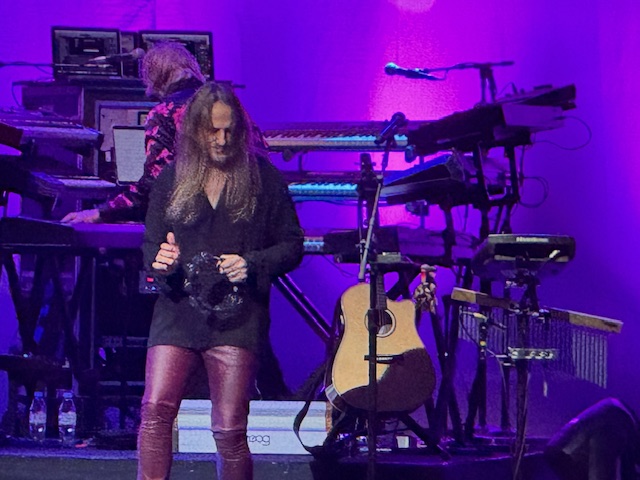 The current members of Yes remain the same as last time I saw them and are: Steve Howe – guitars (first joined in 1970); Geoff Downes – keyboards (first joined in 1980 for the Drama album in a strange incarnation of the band where he and Buggles compatriot Trevor Horn joined for a short period); Billy Sherwood – bass guitar (since 2015); Jon Davison – lead vocals (since 2012); Jay Schellen – drums (has been playing drums with the band since 2017, sometimes deputising for Alan White who sadly passed away in May 2022).
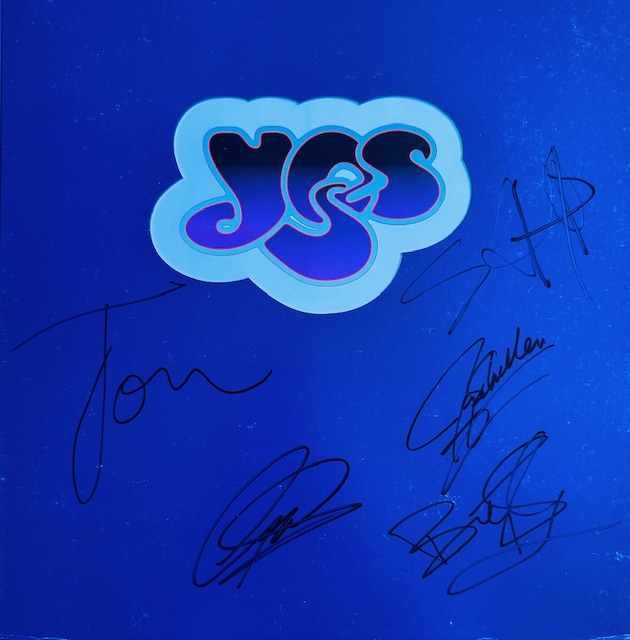 As I entered the Glasshouse I was greeted by a lovely surprise. Roger Dean, the designer of all those lovely album covers was in the foyer talking people through a great layout of his signed prints. Some of them were exceptionally large, and quite expensive, but nonetheless exquisite. I invested in a small, signed print of the Yes logo (it is away getting framed at the moment, image to follow). Fantastic. I bought a massive, again rather expensive, signed programme which takes you through the entire history of the band and their classic songs. Well spent up for the evening I entered the hall ready for part 1 of the show.
 The first set included a short selection of Yes classics. Within this were some of my favourite songs: “Going for the One”, “I’ve Seen All Good People” and their epic cover of Simon and Garfunkel’s “America” ……. “Kathy”, I said as we boarded a Greyhound in Pittsburgh, Michigan seems like a dream to me now”… “She said the man in the gabardine suit was a spy, I said “Be careful, his bowtie is really a camera””. (Simon and Garfunkel, 1968). I actually heard the Yes version before the original. Classic. It brings tears to my eyes. Then came a welcome surprise back to the Time and a Word album and the title track. I remember seeing the original band play this in 1970, before any of the current members were part of the Yes family. Perfect it takes me back to when I was 13.
Time for a Guinness and a double Jack Daniels to settle me down after all that excitement!
 The second set comprised a mini selection of tracks from Tales of Topographic Oceans. I really enjoyed the shortened version.
The encores take us back to the early days and “Roundabout” followed by closing song “Starship Trooper”. Memories of Yes headlining the Reading festival in 1975 come flooding back. The finale was a short section of the Beatles’ “I Feel Fine” at the end of “Starship Trooper”. Another excellent evening of Yes music. Last time I said that I hoped that I could experience many more such evenings. Only a couple of years later and here I was again. Let’s hope these regular visits of the band continue. They never fail to deliver.
Many thanks to Jan for the photographs and to Chris for navigating the site.
Setlist: Set 1: Machine Messiah; It Will Be a Good Day (The River); Going for the One; I’ve Seen All Good People; America; Time and a Word; Don’t Kill the Whale; Turn of the Century.
Set 2: South Side of the Sky; Cut from the Stars; The Revealing Science of God (Dance of the Dawn) / The Remembering (High the Memory) / The Ancient (Giants Under the Sun) / Ritual (Nous sommes du soleil).
Encore: Roundabout; Starship Trooper; ‘I Feel Fine’.
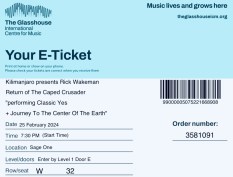 I first saw Yes in 1969, supporting the Bonzo Dog Doo Dah Band before
  On entering The Glasshouse Jackie and I headed for the merchandise stand where I met up with two friends I had not seen for some time. A nice surprise. The evening was full of surprises; more of which later. I purchased a couple of programmes, a signed poster and a T-shirt. We then moved speedily to the bar and I treated myself to a bottle of Newcastle Brown ale, something I have not had for many years (no Guinness available). Jackie and I then took to our seats.
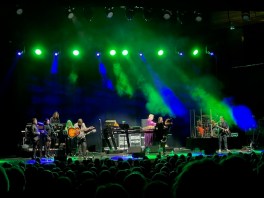 Having taken up our seats at the rear of the hall, I uncharacteristically decided to have a look through my programme. To my delight I noticed that the lead singer for the evening was
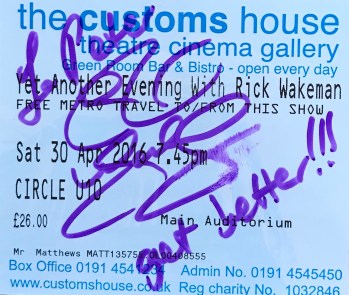
 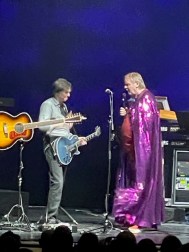 The concert was in two parts: a set of Yes classics, and after a short interval, a full performance of Rick Wakeman’s orchestral extravaganza LP Journey to the Centre of the Earth. So, we were treated to a short run through of some of the greatest prog rock of the early 1970s including a couple of my favourite songs: “Roundabout” and “And You and I”. It seemed a strange idea to have a lady like Mollie fronting the band and in effect taking the role of Jon Anderson, but it worked well. Jon always had quite a high pitched vocal, so maybe it was an inevitable choice. Mollie has a strong, powerful vocal and danced a little, charismatic and mesmerising. The plaudits of Mollie are many.
 From the Mollie Marriott website: “Proving she can rock like her father, Mollie started her career in rock music at the age of 15 when working with Britpop legends, Oasis. Since then she has worked with and supported some powerhouses in rock: Robert Plant, The Who, Jeff Beck, Mark Knopfler, The Faces and the Modfather himself Paul Weller, who she worked with on her debut album, Truth Is A Wolf released in 2017.”
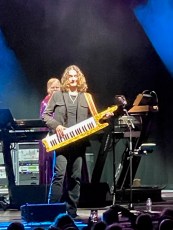 And so came the interval and time for a Jack Daniels, just to set me up for the rest of the evening. Rick returned wearing a different, equally flamboyant, cape and proceeded to lead his band through the entire journey to the centre of the earth album which, to my eyes and ears some 50 years later, was much, much more enjoyable than the first time round when I thought it a little over the top prog. Mollie was again excellent as was Rick, surrounded by an array of synthesisers and keyboards. This was clearly his music, his band/orchestra and it was absolutely fantastic. At the end of this extended piece, the crowd (the hall was full, by the way) gave Rick Wakeman a well deserved standing ovation.
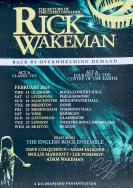 I thought that would be the end of the concert. But the house lights remained down and the crowd continued to cheer for more. And Rick did indeed return to give us more. A wonderful rendition of “Starship Trooper” closed the evening. An evening full of memories, surprises and more importantly, excellent 1970s music. Perfect.
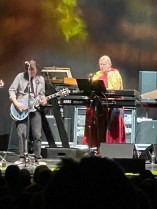 Setlist: Set 1: Roundabout; The YES Suite (Part A – The Meeting); The YES Suite (Part B – Wonderous Stories); The YES Suite (Part C – South Side of the Sky); And You and I;
 Well it finally happened. I contracted Covid! Possibly when I went to see the Rolling Stones at Anfield (at least I was in good company as a certain Sir Mick Jagger also went down with the nasty virus). Luckily we are both clear now although it took me a week to get there, that is before I tested negative. In the meantime I missed a few concerts but I was so wiped out I couldn’t possibly have attended. Still I was feeling just about well enough to venture out last night to see one of my favourite all-time bands, Yes.
 From that night on I was a lifelong Yes fan and must have seen them many, many times over the years since. The lineup has changed along a winding, meandering road with Steve Howe replacing Peter Banks on guitar in 1970 and Rick Wakeman and Alan White joining on keyboards and drums respectively, shortly afterwards. Then came many lineup changes, lots of classic albums, and mega prog stardom. Along the way Jon Anderson left, as did Rick Wakeman, and Steve Howe left and then rejoined the fold. Chris Squire and Alan White both sadly passed away; local hero Alan White very recently (he hailed from Chester le Street). But the true story of Yes is much much more complicated than that!
 The tour had originally been billed as a recreation of the Relayer album; however (and to my delight) something changed their minds and it became a recreation of the Close to the Edge album. A much better choice! The show started with something of a very pleasant surprise. Illustrator Roger Dean, creator of the Yes logo, many of their album covers and several other progressive rock LP covers, walked on stage and took us through a slideshow of his life as an illustrator and with Yes. Fantastic! This was followed by a fitting tribute to Alan White with many nice images of the great drummer appearing on the backdrop.
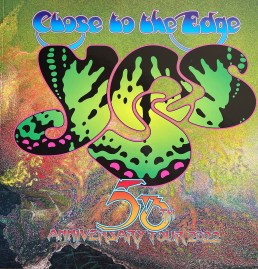 During the interval I partook in a pint of lager (no Guinness I am afraid) and bought a couple of copies of the programme/book (one for my friend John in the USA) which is a sumptuous product celebrating the 50th anniversary of Close to the Edge and taking the reader through the whole history of the band.
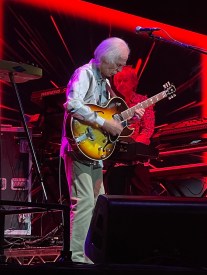 Setlist:
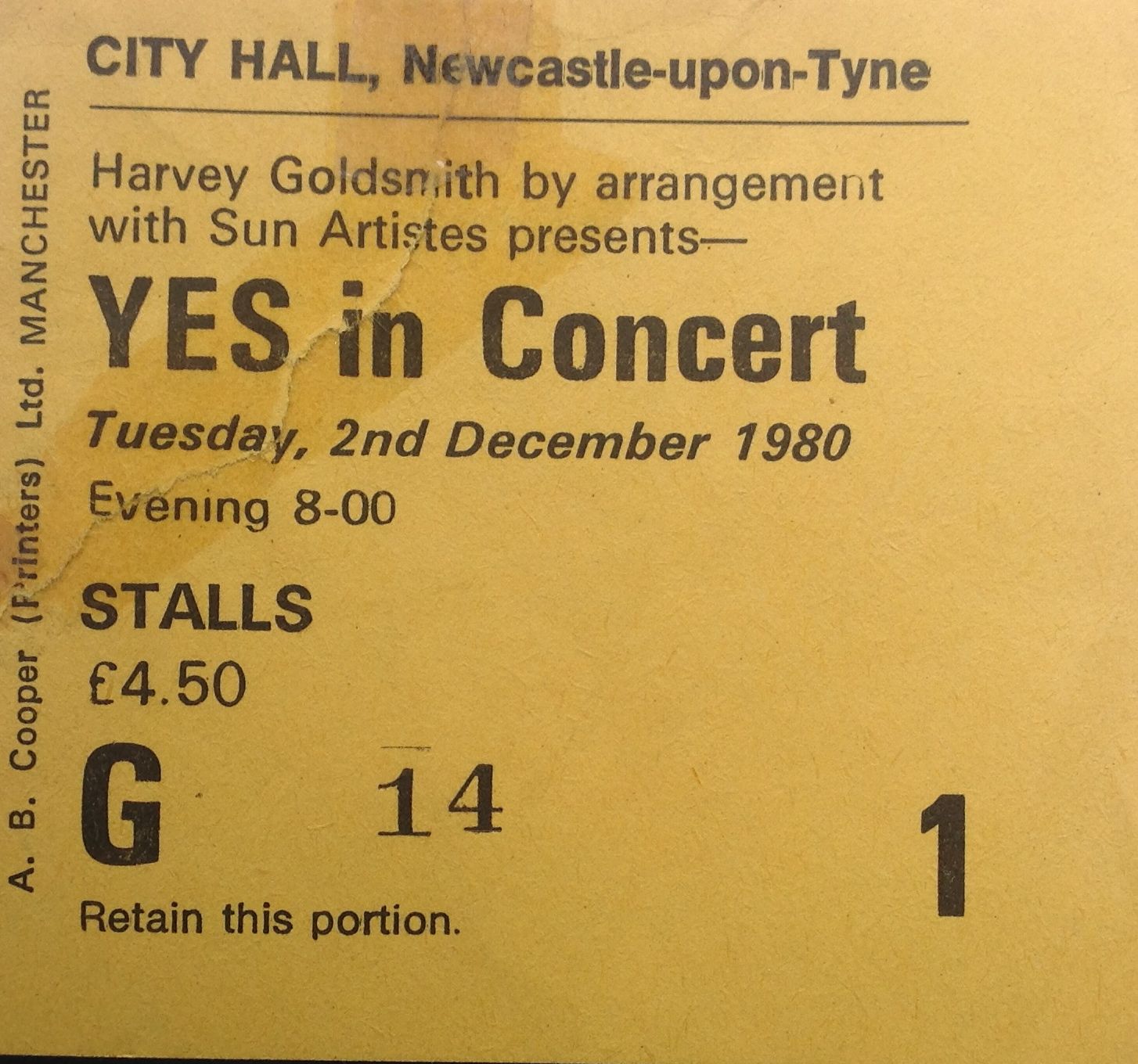
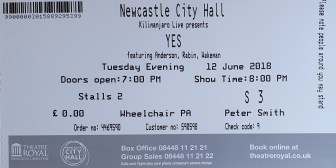 combination of Jon Anderson, Rick Wakeman and Trevor Rabin. Jon Anderson is, of course, a founder member of the band and Rick Wakeman a member of the “classic” Yes line-up. I never saw the line-up of Yes with Trevor Rabin in the band and, I must admit, it was not one of my favourite incarnations of Yes. To me, and I guess many other fans, Jon Anderson epitomises Yes. I have an image in my mind of Jon singing “Close to the Edge” on a warm balmy evening at the Reading Festival, rising out of a smog of dry ice and smoke, wearing a smock top; his vocals soaring above the field and up into the sky. That was probably one of the best times I saw Yes, along with some wonderful shows in the early days when they were still playing covers like “Something’s Coming” from West Side Story and “Eleanor Rigby” by the Beatles. So Jon Anderson holds a special place in the Yes hierarchy for me. So was this be the true Yes that I was about to see? Why, even the ticket called the band “Yes”!
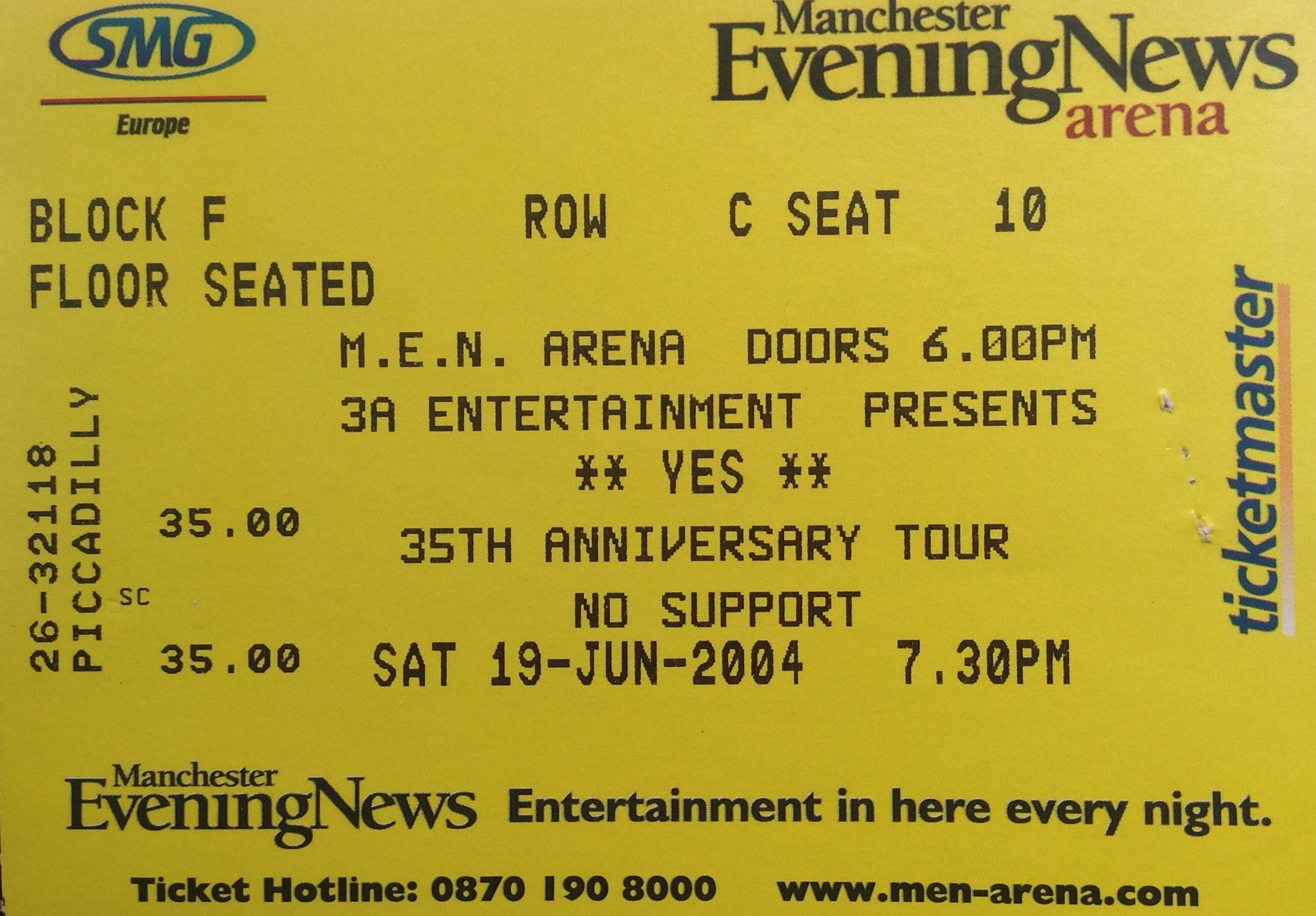
 When is Yes not Yes? (or is it No?). Having lost founder member, some would say leader, and unique bass player Chris Squire; Yes have now no original members in the band. I realise, of course, that guitarist Steve Howe has been in the band since the early 70s and that he was a member of the classic lineup of Yes. However, when I first saw the band in 1969, the guitarist was Peter Banks. And of course keyboard player Geoff Downes was a member of the band at the time of the Drama album when he and Buggles colleague, Trevor Horn joined the band in quite a strange incarnation of Yes. And drummer Alan White remains in the band and was a member of the classic line-up. But the fact remains that, since the sad passing of Chris Squire, the current line up of Yes contains no original members. Now there are many classic rock bands with one original member including Deep Purple (drummer Ian Paice), the Moody Blues (drummer Graeme Edge), Uriah Heep (guitarist Mick Box) and Status Quo (singer/guitarist Francis Rossi). But I can think of no other well-known rock band with no original members. In the case of Deep Purple and the Moody Blues it was the second incarnation of the band who are recognised as the classic lineup and the same is somewhat true of Yes. There are a few 60s bands with no original members including The Fortunes and Marmalade.
 Anyway back to my conundrum: when is Yes not Yes? I have written elsewhere (Smith, 2016) about how the soul and spirit of a band can transcend the members, using The Who as an example; and I think only in performance can this truly be judged. So I went along with great interest to see if the current lineup maintained the spirit, soul and ethos of what I recognise to be Yes. A few weeks later I was due to see Jon Anderson, Rick Wakeman and Trevor Rabin play “Quintessential Yes: The 50th Anniversary Tour” at Newcastle City Hall. So I was bound to make comparisons between the two incarnations of the Yes band.



 Vintagerock's Weblog.