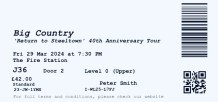
 Another great concert at the Fire Station which is proving to be an excellent hometown venue. And with two of my favourite 1980s bands.
 Support came from the semi psychedelic music of the Icicle Works. Now, I was a big fan of the Icicle Works during the 1980s and saw them perform several times in that period. Ian McNabb has kept The Icicle Works flag flying in recent years performing their material as a solo artist. However, this was the first time in 25 years that he and original bassist Chris Layhe have played together.
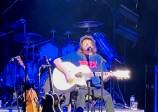 So, the lineup I saw was this duo of McNabb and Layhe and it was great to see them together again. My favourite song is “Love Is a Wonderful Colour” which closed the set. A great support act, worthy of headline status in their own right.
 Bought myself a lovely lyric sheet for “Love Is a Wonderful Colour” which Ian and Chris kindly signed for me. Setlist: Hollow Horse; Little Girl Lost; Evangeline; Out of Season; Starry Blue Eyed Wonder; Understanding (Country) Jane; Birds Fly (Whisper to a Scream); Love Is a Wonderful Colour
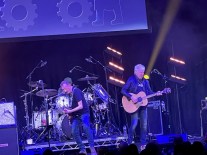 Big Country formed in Dunfermline, Fife, in 1981. The band’s music incorporates Scottish folk music, their guitar-driven sound resembling the Celtic tones of bagpipes and fiddles. The band’s classic lineup between 1982 and 2000 consisted of Stuart Adamson (vocals, guitar) Bruce Watson (guitar) Tony Butler (bass guitar) and Mark Brzezicki (drums).
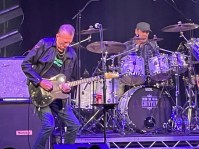 Following Adamson’s death in 2001, Big Country reformed in 2007, with the surviving members. Between 2010 and 2013, they also reformed with Mike Peters of The Alarm on lead vocals. Since then Big Country has continued with two of the original members (Watson and Brzezicki) and Simon Hough on vocals.
 Steeltown was the second studio album by Big Country, recorded at ABBA’s Polar Studios in Stockholm. Released in 1984 Bruce Watson remembers: “We started work on Steeltown back in June 1984 at Abba’s studio. My Dad was a miner, so what we did was knuckle down to hard work for six weeks”. The album was based around the steel industry in Corby, Northamptonshire which was mainly populated by Scottish workers. The album went straight to number 1 in the UK album charts.
 They have recruited an excellent new guitarist whose playing gives homage to the late, great Stuart Adamson. To my shame I am not familiar with Steeltown (although I probably saw them on the tour to promote the album). It was great to hear their music again. Particularly as they also performed great personal favourites such as: “Look Away” And “In a Big Country”. They concluded their set with “Fields of Fire” incorporating another great Celtic song “Whiskey in the Jar”. An excellent end to an excellent evening.
Many thanks to Elaine for the photos and Chris for manipulating the site.
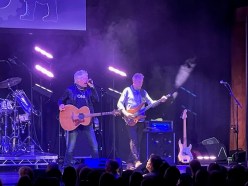 Setlist: Flame Of The West; East Of Eden; Steeltown; Where The Rose Is Sown; Come Back To Me; Tall Ships Go; Winter Sky; Rain Dance; The Great Divide; Just A Shadow; Look Away; Chance; In A Big Country; Wonderland; Fields Of Fire / Whiskey In The Jar
Encore: Restless Natives
 Stuart Adamson formed Big Country after leaving the Skids, and in my view their work far surpassed his earlier band. The Skids were a fun live band, very much a product of the punk era, whereas Big Country were much more innovative and adventurous. It was clear that Stuart was the musical driving force behind the Skids, co-writing, alongside Richard Jobson, the band’s most famous songs such as Into the Valley. I first saw them in Dingwalls in Newcastle, which was a club which ran in the early 80s, out of what had been the old German Bierkeller.
  Their first single Harvest Home had just been released, and their jangling, swirling sound which married scottish traditional folk with rock, sounded so new and fresh. They were soon having big chart success with Fields of Fire and In a Big Country, and could command headlining status on a tour of major concert venues. Their 1983 tour brought them to Newcastle City Hall, and the first of a couple of great nights I spent with them in that venue. Big Country and Stuart Adamson in particular connected with the audience in a manner rarely seen.
  At times band and crowd were at one, singing together those great anthemic songs, with Stuart rocking back and forth leading us all on, as if to battle. The support on the 1983 tour was One The Juggler, who were an interesting and now forgotten band; quite theatrical if I remember correctly. I also remember seeing them at Newcastle Dingwalls.
 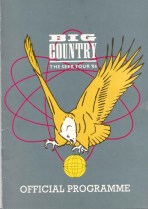 I next saw Big Country on their 1986 tour, again at the City Hall. By then they had released their third album The Seer, and the single Look Away was their biggest hit in the UK. Once again, it was a great night with another stirring set from the band. The last time I saw Big Country was at Roker Park, Sunderland in 1987, when they appeared as one of the support acts for David Bowie on his Glass Spider tour. It wasn’t one of Bowie’s best performances, and in contrast Big Country delivered their usual storm and went down very well with the crowd. They were obviously a lot of fans of the band there, and I’m sure that many people felt that their performance was better than Bowie’s that day. The band has recently reformed after Stuart Adamson’s tragic death, and have been once again touring the UK.
 “Good evening Newcastle”, said David Bowie as he took the stage at this gig. Big mistake for a gig in Sunderland; rivalry between the two towns run deep, particularly in the context of football, and saying this in Roker Park, the home of Sunderland football, was not a good idea. It was to be an omen for the rest of the gig, which wasn’t one of Bowie’s best. In theory, this should have been a great gig. Bowie has a great band, with Peter Frampton coming in on guitar. He had promised that this tour would see a return to theatricals of the scale of the US Diamond Dogs tour. There was great anticipation for the gigs, which ultimately played to 3m people, exceeding the Serious Moonlight tour.
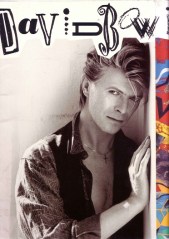 The day was wet, as I recall, and Big Country went down a storm, perhaps better than Bowie. Bowie’s setlist focussed on his more recent catalogue, and particularly his latest lp Never Let Me Down, ignoring the Ziggy era. The stage set was Ok, but somewhat silly, and personally I didn’t think it was as impressive as promised. At one point Bowie came down from the stage on a swing, and the spider just looked strange (but was it a forerunner of the recent U2 stage set up?). The programme for the gig (shown left) was obviously produced for the word tour, with lots of glossy photos of David, and nothing about the support acts; there was also an edition of the Sunderland Echo produced specially for the event (see below).
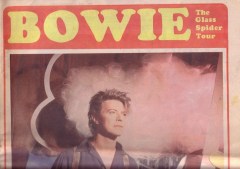 Setlist: Up the Hill Backwards; Glass Spider; Day-In Day-Out; Bang Bang; Absolute Beginners; Loving the Alien; China Girl; Fashion; Scary Monsters; All the Madmen; Never Let Me Down; Big Brother; ’87 and Cry; Heroes; Time Will Crawl; Beat Of Your Drum; Sons of the Silent Age; Dancing With the Big Boys; Zeroes; Let’s Dance; Fame; Encore: Blue Jean; Modern Love. Towards the end of the gig Bowie said: “I’m glad the rain has kept off”. It then poured down during the encore. Not a good day; I was slowly losing faith in Bowie, and I was to suffer further disappointment at a Tin Machine gig a few years later (see my blog of a few days ago). Tomorrow I’ll report on The Reality tour which I caught in Dublin in 2003, and which restored my faith in Bowie.
 Vintagerock's Weblog.